

You've likely had a workout like this: 30 minutes of hard cardio, soaked through your shirt, heart pounding, and the scale doesn't budge for weeks. It's demoralizing. And if that sounds familiar, the issue likely isn't your effort. It's your fat burning heart rate zone.
Most people are training too hard to burn fat. That sounds backwards, but it's one of the most consistent findings in exercise science. Your body has a specific intensity range where fat is its preferred fuel, and most cardio routines blow right past it.
Short on time? Our companion piece, which heart rate zone burns the most fat, gives the quick answer. This guide goes deeper into why.
Why Harder Isn't Always Better for Fat Loss
The issue is fuel. At high exercise intensities, your body relies heavily on carbohydrates because they're fast-converting and readily available. Fat requires more oxygen to convert into energy, and when you're pushing hard, your body doesn't prioritize it. So the harder you work, the more you're running on carbs, not fat stores.
Drop the intensity, and the equation changes. At lower, more comfortable efforts, your body has what it needs to tap into fat as its primary fuel source. It doesn't feel like much, and that's the point. That lower-intensity range is called Zone 2.
What Zone 2 Feels Like
Zone 2 sits at roughly 60–70% of your heart rate reserve, the aerobic range where your body burns fat efficiently without tapping out your recovery.
The best way to describe it: you should be able to hold a full conversation. Not fragments between gasps, an actual back-and-forth. Your breathing picks up, but it stays controlled. You feel like you could keep going for an hour if you had to. If you're silently suffering, you've gone too far.
For a lot of people, especially those used to pushing hard, Zone 2 feels suspiciously easy. That discomfort of "am I even doing anything?" is one of the main reasons people abandon it. But your muscles are working, running on a cleaner, slower-burning fuel.
The Science (Kept Simple)
When researchers look at what intensity produces the most fat burning per minute, the answer reliably lands in a moderate range, not in high-intensity cardio. A study of 300 healthy adults in the Journal of Applied Physiology found that peak fat burning occurred on average at about 48% of VO₂ max, or roughly 62% of max heart rate. For most people, that's a little easier than Zone 2. Fitness moves the peak higher: in a study of trained cyclists, it came at about 64% of VO₂ max, or 74% of max heart rate, which lands inside Zone 2.
A 2025 study of 50 cyclists found that each rider's peak fat burning lined up closely with their first ventilatory threshold, the point where breathing starts to pick up noticeably. It also found wide differences between riders, which is why a personal number beats a generic chart.
Push past that, into Zone 3 and beyond, and carbohydrate metabolism takes over. You're burning more calories per minute at higher intensities, but the proportion coming from fat drops sharply. More effort doesn't equal more fat burned. It means you're burning a different fuel.
Zone 2 vs. High-Intensity Cardio
Zone 2 is often the better tool for fat loss, even though it burns fewer calories per minute. To be fair, high-intensity training does burn more total calories per minute: a 20-minute HIIT session will likely out-calorie a 20-minute Zone 2 jog. That's real, but calorie-per-minute isn't the whole picture. A few things tip the balance toward Zone 2:
You can do it longer. Zone 2 is sustainable. A 60-minute Zone 2 session burns considerably more total fat than a 20-minute intense one, even accounting for the calorie difference per minute.
You can do it more often. High-intensity training beats up your body. Most people need 48 hours of recovery between hard sessions, limiting you to 2–3 per week. Zone 2 is low enough stress that many people do it daily. More sessions per week adds up fast.
You stick with it. This one doesn't get enough credit. Zone 2 doesn't leave you wrecked. You can do it regularly for months without burning out, and that's where fat loss happens.
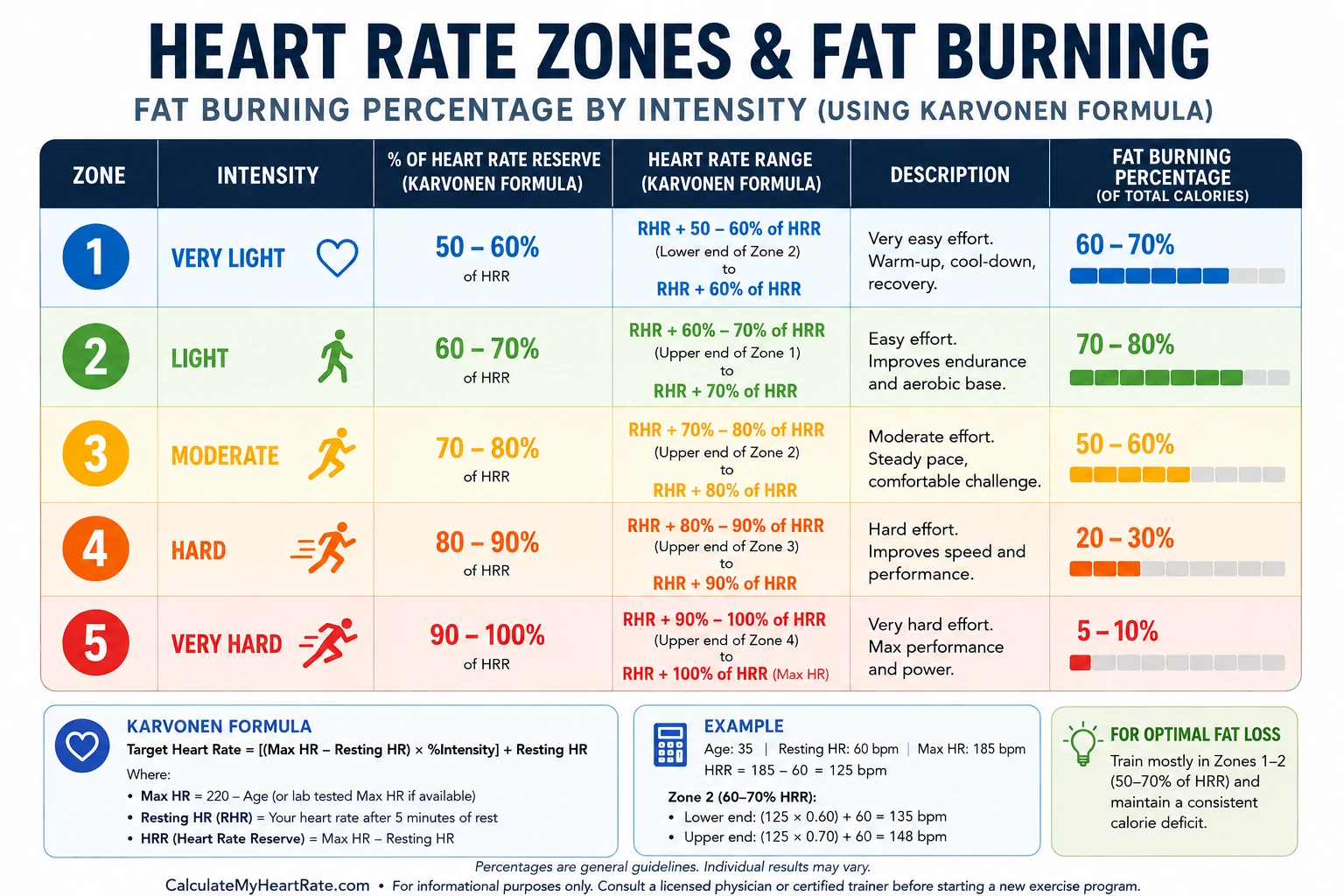
How to Find Your Fat Burning Heart Rate Zone
The Karvonen formula finds your zone by factoring in your resting heart rate to calculate your Heart Rate Reserve (HRR), rather than relying on a flat percentage of your max heart rate:
Most generic advice, including the American Heart Association's standard guidelines, sets moderate intensity at "50–70% of your max heart rate." It's simple, but it misses your resting heart rate. 2 people of the same age can have resting heart rates that differ by 25 bpm or more: a conditioned person might sit at 48 bpm, while someone sedentary might be at 75 bpm. Using the same formula for both gives them the same target zone, which doesn't make much physiological sense.
For Zone 2, intensity is 60–70%. Here's a real example with a 38-year-old whose resting heart rate is 62 bpm:
- Max HR = 220 − 38 = 182 bpm
- Heart Rate Reserve = 182 − 62 = 120 bpm
- Zone 2 lower = 62 + (0.60 × 120) = 134 bpm
- Zone 2 upper = 62 + (0.70 × 120) = 146 bpm
Now run the age-only formula: 60–70% of 182 = 109–127 bpm. That's a gap of nearly 20 beats per minute. At that difference, you'd be undertraining relative to your actual aerobic capacity.
Fat Burning Heart Rate by Age (Quick Reference)
Your Zone 2 range shifts with both age and resting heart rate. Here's a quick snapshot at 3 ages, comparing a more sedentary resting heart rate (~70 bpm) to a fitter, more active one (~55 bpm):
| Age | Resting HR ~70 (Sedentary) | Resting HR ~55 (Active) |
|---|---|---|
| 25 | 145-158 bpm | 139-153 bpm |
| 45 | 133-144 bpm | 127-139 bpm |
| 65 | 121-130 bpm | 115-125 bpm |
See the full breakdown, every age in 10-year steps with both resting heart rate scenarios, in our fat burning heart rate by age guide. Or skip the lookup entirely and get your exact range with the fat burning calculator above.
Fat Burning Heart Rate Zone for Women
The Karvonen formula itself isn't sex-specific. It works from your own resting heart rate and estimated max heart rate, not population averages. But the max heart rate estimate that feeds into it matters, and the standard 220-minus-age formula tends to run less accurate for women than for men.
Research on maximal heart rate prediction found the Gulati formula (206 − 0.88 × age), developed specifically from a study of women, fits women's max heart rate more closely than 220 minus age. For a 45-year-old woman, that's the difference between an estimated max HR of 175 bpm (220 minus age) and 167 bpm (Gulati), which shifts the Zone 2 window down by several beats per minute.
If you're a woman calculating your fat-burning zone, get your max HR from the Gulati formula calculator first, then enter that number as a custom Max HR on the full Karvonen calculator to get Zone 2 built on a more accurate ceiling. The Zone 2 calculator above uses 220 minus age by default, which is the generic estimate this section is about improving on.
Measuring Your Resting Heart Rate
Do this first thing in the morning before you get out of bed. Lie still, place 2 fingers on your neck or inner wrist, and count beats for 60 seconds. That's it.
The AHA calls 60 to 100 bpm normal for adults, and most land somewhere in the 60s or 70s. Regularly active people often fall in the 50s. Well-trained endurance athletes can dip into the 40s or lower.
Measure over 3 consecutive mornings and average the numbers for better accuracy. Most fitness wearables (Garmin, Apple Watch, Whoop) track this automatically during sleep, which works too. See our guide to understanding resting heart rate for what a normal number looks like and what can throw yours off day to day.
What a Zone 2 Session Looks Like in Practice
Any steady-state cardio works, walking (especially with incline), jogging, cycling, rowing, swimming, elliptical. The activity matters less than keeping your heart rate in the 60–70% HRR window throughout.
What surprises most people is how slow they need to go to stay in Zone 2. If you're used to pushing during cardio, you'll likely need to back off significantly. That means your aerobic base has room to grow, which is exactly what Zone 2 training builds over time.
A reasonable starting week:
| Day | Activity |
|---|---|
| Monday | 45-min Zone 2 walk or jog |
| Tuesday | Rest or light stretching |
| Wednesday | 50-min Zone 2 cycling or elliptical |
| Thursday | Rest |
| Friday | 60-min Zone 2 walk or jog |
| Saturday | Optional: 30-min Zone 2 + bodyweight strength |
| Sunday | Rest |
4 weeks of this, done routinely, will produce real changes in your endurance and how your body responds to exercise.
The Mistakes That Stall Progress
Most people who quit Zone 2 training aren't failed by the method, they're tripped up by 1 of these 4 mistakes.
Going too hard. By far the most common one. If you can't speak in full sentences, you've drifted out of Zone 2. Slow down, even if it feels almost embarrassingly easy. The zone works precisely because it isn't hard.
Using age-only formulas. The standard 220-minus-age approach can put your zone off by 15–20 bpm or more. That's the difference between training in your fat-burning zone and missing it entirely. Use the Karvonen formula, or the calculator above.
Expecting fast results. Zone 2 adaptations build gradually, improved fat oxidation, lower resting heart rate, better endurance at the same effort level. These changes take weeks to show up, and months to compound. People who quit after 2 weeks never see them.
Doing 1 session a week. Zone 2 adaptations depend on weekly volume. 1 session a week maintains fitness at best. 2–4 sessions is where the adaptations start stacking.
When Will You See Results?
It depends on where you're starting from and how regularly you show up. That said, here's a rough timeline based on what tends to happen:
In the first 2–4 weeks, most people notice they're less winded at moderate effort and recovering faster between sessions. The scale may not have moved yet, but something is clearly changing.
By 6–12 weeks, body composition shifts start showing up. Your Zone 2 pace gets faster at the same heart rate, which means your aerobic engine is growing. Resting heart rate often drops a few beats.
Past the 3-month mark, with steady training and reasonable nutrition alongside it, fat loss becomes more pronounced and your overall fitness feels meaningfully different from where you started.
One Last Thing
Zone 2 isn't flashy to talk about, and it's not flashy to do either, at least not at first. There's no music-pumping, sweat-dripping intensity to it. You're jogging slowly, or walking with purpose, while people at the gym push past you.
The physiology is consistent. Your body can sustain fat burning for long stretches at a pace that feels manageable, not maximal. Build enough aerobic base through sustained Zone 2 work, pair it with decent nutrition, and fat loss follows.
Frequently Asked Questions
What is the biggest mistake people make with Zone 2 training?
Going too hard. Zone 2 should feel conversational: if you can't speak in full sentences, you've drifted into Zone 3 or higher. It's an easy mistake to make since Zone 2 often feels almost too easy, but that's the point. Pushing harder doesn't make the session more effective. It adds fatigue without the aerobic benefit.
Why is the 220-minus-age formula inaccurate for Zone 2 training?
The standard 220-minus-age approach can put your zone off by 15–20 bpm or more: the difference between training in your fat-burning zone and missing it entirely. 2 people of the same age can have noticeably different resting heart rates, which shifts every zone boundary. The Karvonen formula accounts for your resting heart rate and gives a zone calibrated to your actual cardiovascular fitness, not your age alone.
How many Zone 2 sessions per week do I need?
2 to 4 sessions per week is enough for fat-burning adaptations to start building. 1 session per week maintains fitness at best.
What should I expect in the first month of Zone 2 training?
In the first 2 to 4 weeks, expect subtle changes rather than dramatic ones: you'll likely feel less winded at a given effort and recover faster between sessions. The scale usually doesn't move yet, which is normal. More visible changes, like a faster Zone 2 pace or a lower resting heart rate, tend to show up further out, around 6 to 12 weeks in.
How long until Zone 2 training shows results?
Early adaptations, feeling less winded and recovering faster, are usually noticeable within 2 to 4 weeks. Visible changes to pace and fitness, like running faster at the same heart rate, tend to appear between 6 and 12 weeks. Meaningful fat loss and a noticeably different fitness level usually take 3 months or more of steady training, alongside reasonable nutrition.
This article is for informational purposes only and does not constitute medical advice. Please consult a physician or certified fitness professional before starting a new exercise program.