Why Resting Heart Rate Matters
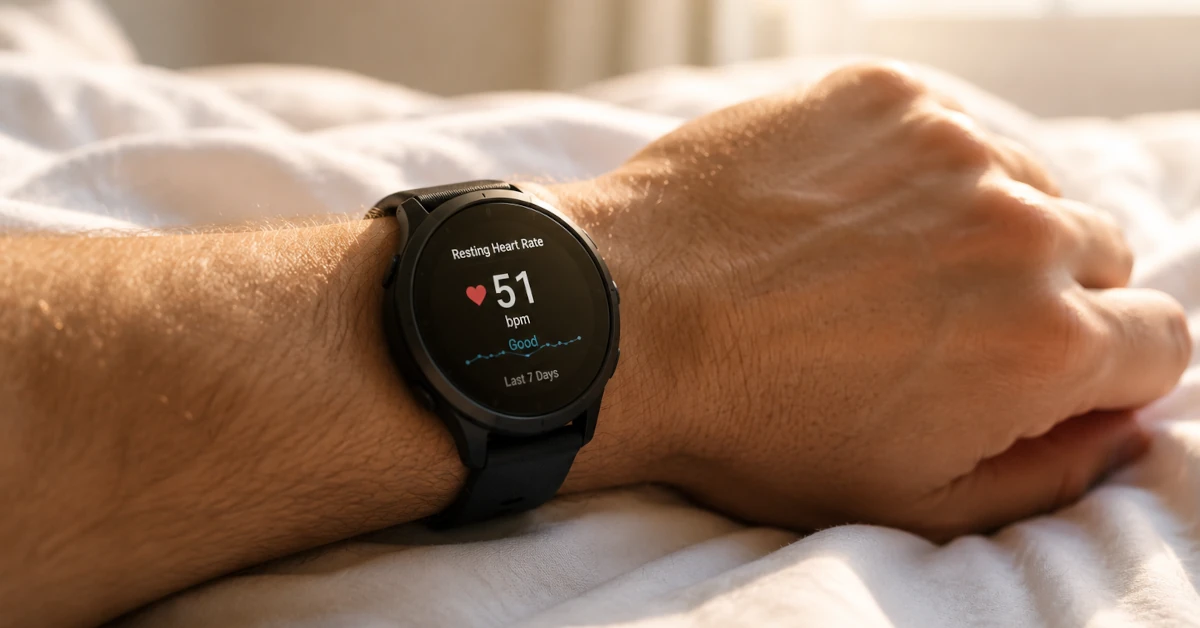
Your watch says 74. A friend the same age who runs a few times a week sees 54 on theirs. Genetics explains part of that gap. The part you control comes mostly from how much steady aerobic work your heart has done over the past few months, and that's what this guide covers: how to lower your resting heart rate, starting with the method that does the most.
A lower resting heart rate (RHR) means your heart pumps more blood per beat (higher stroke volume), so it doesn't need to beat as often to move the same amount of blood. That's a direct sign of the cardiovascular efficiency aerobic training builds. Well-trained endurance athletes often have resting heart rates in the 40s. Sedentary adults commonly sit in the 70s or 80s.
RHR is the number of times your heart beats per minute when you're fully at rest, measured first thing in the morning before you get out of bed. It's one of the simplest heart health markers you can track, and all you need is a watch.
RHR also connects to longevity. A 2016 meta-analysis of general-population studies found that every 10 bpm higher resting heart rate came with about a 9% higher risk of death from any cause and an 8% higher risk of cardiovascular death. That's an association, not proof that lowering your number adds years, but it's a consistent one.
For training purposes, RHR also matters because it determines your heart rate reserve (HRR), the usable range that the Karvonen formula uses to calculate training zones. The lower your resting HR, the wider your HRR and the more room between each training zone.
A lower resting heart rate isn't the only benefit that shows up on your watch. The same aerobic training also speeds up heart rate recovery after exercise, a related but distinct marker of how efficiently your nervous system shifts between effort and rest.
Age 40, Max HR 180 (Tanaka estimate)
Resting HR at 72 bpm: Zone 2 (60–70% HRR) = 137–148 bpm
Resting HR at 58 bpm, after 3 months of steady Zone 2 training: Zone 2 (60–70% HRR) = 131–143 bpm
A 14 bpm drop in resting heart rate shifts the whole Zone 2 range down by 5 to 6 bpm. If you keep training off the old numbers, you'll run your easy days a little too hard. Recalculate your zones any time your resting heart rate changes by 5 bpm or more.
What Is a Normal Resting Heart Rate?
| RHR Range | Category |
|---|---|
| Below 50 bpm | Athletic (endurance trained) |
| 50–60 bpm | Excellent |
| 60–70 bpm | Good / Active |
| 70–80 bpm | Average (sedentary adults) |
| 80–100 bpm | Below average (still within the normal range) |
| Above 100 bpm | Tachycardia. Talk to a doctor |
These are population-level guidelines, not strict cutoffs. The American Heart Association considers 60–100 bpm a normal adult resting range. Genetics plays a large role. Some people have a low RHR with little training, while some trained athletes plateau at 55 bpm no matter how much they train. Track your own trend, not someone else's number.
Not sure which category you fall into? Enter your number into the resting heart rate calculator to see your exact fitness level. For ranges broken down by age and sex, see what counts as a good resting heart rate.

Method 1: Regular Zone 2 Aerobic Training
This is by far the biggest driver of resting heart rate reduction. Regular aerobic exercise, particularly sustained moderate-intensity Zone 2 work, triggers cardiac adaptations: the heart chambers enlarge, the walls thicken slightly, and stroke volume increases. With more blood pumped per beat, the resting rate drops.
The key is regularity and volume. 3 to 5 sessions per week of Zone 2 training (60–70% of heart rate reserve) at 45–90 minutes each is the protocol most reliably associated with RHR reductions. Sporadic high-intensity exercise doesn't produce the same cardiac remodeling effect as sustained aerobic volume.
How much can you expect? Most people see 5–15 bpm reductions with 3–6 months of sustained Zone 2 training. People starting out of shape, above 85 bpm, often see larger drops.
Method 2: Prioritize Sleep Quality and Duration
Chronic sleep deprivation keeps cortisol and sympathetic nervous system activity elevated, which directly raises resting heart rate. That's because sleep is when the cardiovascular system performs most of its recovery. During deep sleep, heart rate drops to its true resting baseline and the parasympathetic nervous system (the "rest and digest" system) dominates.
In a controlled study of 13 healthy men, 5 nights of sleeping under 5 hours shifted the nervous system toward sympathetic ("fight or flight") activity and impaired blood vessel function. That's the same shift that pushes resting heart rate up. Fixed sleep and wake times, a dark, cool room, and less screen time in the evening are among the fastest non-exercise changes you can make.

Method 3: Reduce Chronic Stress
Psychological stress activates the sympathetic nervous system, the same "fight or flight" system that drives heart rate up during exercise. Chronic stress keeps this system partially activated at baseline, elevating cortisol levels and maintaining a higher resting heart rate than your cardiovascular fitness level would otherwise produce.
The strongest evidence here is for yoga. A 2014 meta-analysis of 44 randomized trials found yoga lowered heart rate by about 6.6 bpm compared with usual care. Research on seated meditation and slow breathing is thinner and less consistent, but both work through the same calming pathway. Daily meditation (10–20 minutes) and slow diaphragmatic breathing (5-minute sessions) are low-cost ways to bring chronic stress down. None of these replace exercise, but they address a cause that exercise alone doesn't fully fix.
Method 4: Stay Well Hydrated
Dehydration reduces blood plasma volume, meaning the heart has to beat more frequently to circulate the same amount of oxygen. Even mild dehydration (1–2% body weight loss in fluid) measurably raises resting heart rate. It's also an easy cause to fix.
Spread your fluid intake through the day instead of catching up at night. Your morning RHR reading will also be more accurate when you're properly hydrated.
Method 5: Limit Caffeine and Alcohol
Both can keep your resting heart rate higher than it needs to be, though caffeine's effect is smaller than its reputation suggests.
Caffeine is a stimulant, but in regular coffee drinkers it has little lasting effect on resting heart rate because the body adapts to a daily habit. The bigger cost is sleep. Caffeine has a half-life of about 5 hours, so an afternoon cup is still in your system at bedtime, and shorter, lighter sleep raises your next-morning RHR. Keep coffee to the morning.
Alcohol disrupts sleep architecture (particularly deep sleep stages) and elevates sympathetic nervous system activity during the hours after consumption. Even 2 or 3 drinks often show up as a higher resting heart rate the next morning if you track it with a wearable. Cutting back usually brings your average down within a few weeks.
Method 6: Maintain a Healthy Body Weight
Excess body fat raises the work your heart does at rest, because it has to supply blood to a larger body. In a 4-month study of overweight and obese adults with type 2 diabetes, a calorie-restricted diet led to about 10% weight loss, and heart rate fell from about 69 to 60 bpm.
That study used diet alone. Pairing weight loss with Zone 2 aerobic training adds the heart adaptations from Method 1 on top.
Method 7: Choose Regularity Over Intensity
A hard workout once a week won't move your resting heart rate much. The heart remodels in response to a steady signal: 3 to 5 aerobic sessions per week, week after week, for months. If your RHR hasn't budged despite some tough sessions, look at how often you train before you look at how hard.
If you're starting from scratch, begin with 30-minute Zone 2 walks 2 or 3 times a week and add time as it feels easy. Expect a small drop, around 2 to 4 bpm, within 6 to 8 weeks. The changes keep adding up as long as you keep training.
How to Measure Your Resting Heart Rate Accurately
Measure first thing in the morning, before you get out of bed and before coffee. Lie still for a minute, then count your pulse at your wrist or neck for 60 seconds. Average 3 mornings in a row for a reliable baseline. A single reading can swing with sleep, hydration, or a stressful dream. The free pulse timer handles the 60 seconds and the math.
Wearables such as Garmin, Apple Watch, Whoop, and Oura track RHR automatically during sleep and give more reliable averages than manual checks. Watch 7-day and 30-day trends instead of daily numbers. Day-to-day swings of ±5 bpm are normal. For more on what the number tells you, see understanding your resting heart rate.
Frequently Asked Questions
How quickly can you lower your resting heart rate?
Resting heart rate usually takes 4–8 weeks of regular aerobic training to drop enough to measure. The first changes are small, 2–4 bpm. With 3–6 months of regular Zone 2 training, most people see a drop of 5–15 bpm, and people who start above 85 bpm can see more. Better sleep and lower stress can move the number sooner, but by less.
What resting heart rate indicates good cardiovascular fitness?
The American Heart Association lists 60–100 bpm as the normal adult range. Regularly active adults often sit below 70 bpm, and a reading under 60 is common and usually healthy in people who train. Well-trained endurance athletes often land at 40–55 bpm. Your own trend matters more than any category: a drop from 75 to 62 bpm is meaningful whether or not 62 counts as "elite."
Can meditation or breathing exercises lower resting heart rate?
Yes, though the effect is smaller than aerobic training. A 2014 meta-analysis of 44 randomized trials found yoga lowered heart rate by about 6.6 bpm compared with usual care. The evidence for seated meditation and slow breathing is thinner, but both calm the sympathetic nervous system, which helps when stress is what keeps your resting heart rate up.
What is too low for a resting heart rate?
A resting heart rate below 60 bpm (bradycardia) is common in fit athletes and typically not a concern. Below 50 bpm in non-athletes or below 40 bpm in athletes warrants medical evaluation if accompanied by symptoms like dizziness, fatigue, shortness of breath, or fainting. Without symptoms, a low resting heart rate in active people is generally a sign of good cardiovascular conditioning.
Does losing weight lower resting heart rate?
Yes. Extra body weight raises the work your heart does at rest. In a 4-month study of overweight and obese adults with type 2 diabetes, a calorie-restricted diet produced about 10% weight loss, and heart rate fell from about 69 to 60 bpm. That study used diet alone. Adding aerobic training brings its own heart adaptations on top of the weight loss.
This article is for informational purposes only and does not constitute medical advice. Consult a physician before starting a new exercise program, especially if you have cardiovascular risk factors, symptoms like chest pain, dizziness, or an elevated resting HR above 100 bpm.