

You've seen it: 2 people jump on a treadmill side by side, same age, same max heart rate on paper, and the same target zone from every heart rate chart out there. 10 minutes in, one of them is chatting easily. The other is fighting for breath.
The gap comes down to a number most heart rate charts ignore entirely: your heart rate reserve.
What Is Heart Rate Reserve?
Heart rate reserve (HRR) is the difference between your maximum heart rate and your resting heart rate. If your max heart rate is 185 bpm and your resting heart rate is 58 bpm, your HRR is 127 bpm.
The concept was introduced by Finnish physiologist Martti Karvonen in the 1950s as part of a formula for calculating target heart rate zones. Karvonen recognized that using raw max heart rate percentages to set zones was physiologically imprecise, because the same percentage of MHR represents different levels of cardiovascular stress for people with different fitness levels.
HRR solves this by anchoring zone calculations in the actual range each person has available, not the max-HR ceiling alone. It's the foundation of what's now called the Karvonen formula.
How to Calculate Your Heart Rate Reserve
You need 2 numbers: your maximum heart rate and your resting heart rate.
Estimating your max heart rate: The simplest method is 220 minus your age. A 40-year-old estimates 180 bpm. This formula has a ±10–12 bpm standard deviation, which is "good enough" for most training purposes without lab testing.
Measuring your resting heart rate: Measure first thing in the morning before getting out of bed. Lie still, find your pulse at your neck or wrist, and count beats for 60 seconds. Take the average of 3 consecutive days for accuracy. Wearables with continuous HR monitoring (Garmin, Apple Watch, Whoop) also provide accurate overnight averages.
- Max HR = 220 − 40 = 180 bpm
- Resting HR = 62 bpm
- Heart Rate Reserve = 180 − 62 = 118 bpm
The Karvonen Formula: Using HRR for Training Zones
Once you have your HRR, the Karvonen formula calculates target heart rates for any intensity level:
For Zone 2 (fat burning aerobic zone), intensity is 60–70%. Using our example above:
- Zone 2 lower = 62 + (0.60 × 118) = 133 bpm
- Zone 2 upper = 62 + (0.70 × 118) = 145 bpm
HRR vs. Max Heart Rate Percentage: What's the Difference?
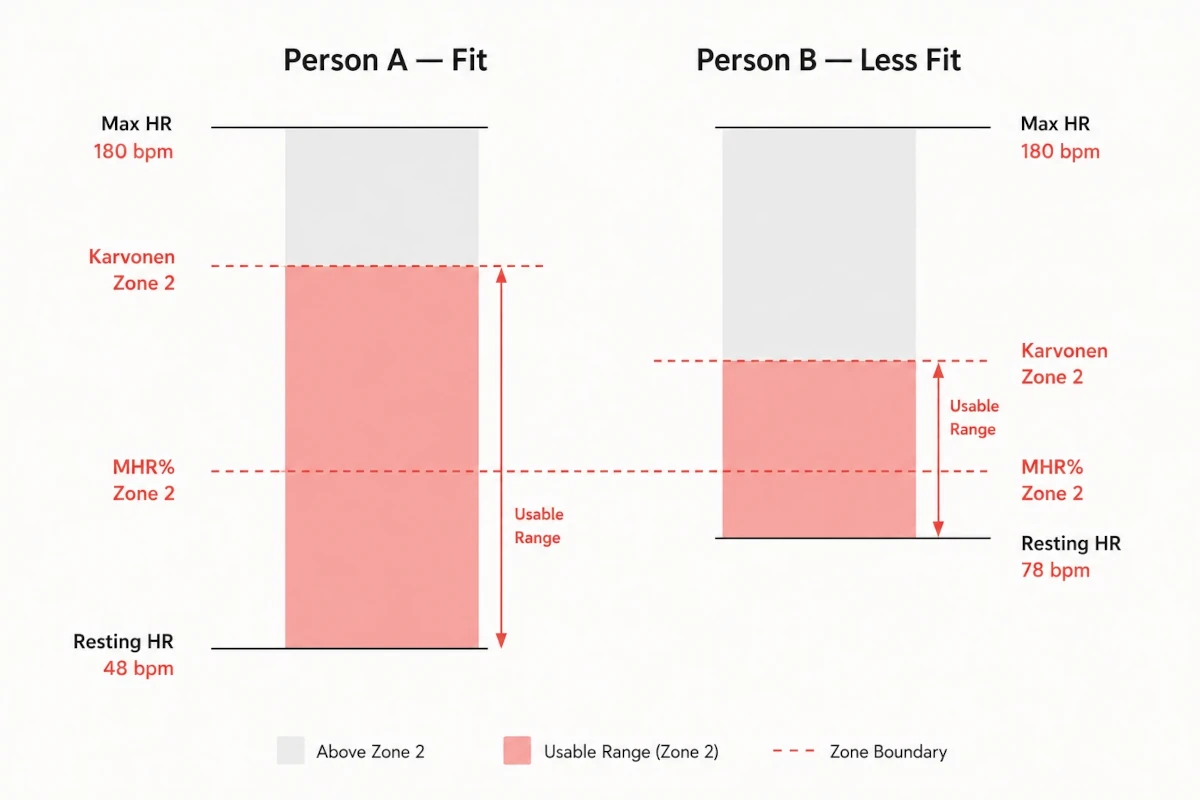
The core difference: max heart rate percentage (MHR%) treats every person the same age identically, regardless of fitness level. HRR doesn't, because it factors in resting heart rate too. Most consumer fitness devices and exercise charts still use raw MHR%, showing Zone 2 as "60–70% of max HR." For a 40-year-old with MHR 180, that's 108–126 bpm, simple, but blind to how fit that person is. Compare 2 40-year-olds:
| Measure | Person A (Fit) | Person B (Less Fit) |
|---|---|---|
| Age | 40 | 40 |
| Max HR | 180 bpm | 180 bpm |
| Resting HR | 48 bpm | 78 bpm |
| HRR | 132 bpm | 102 bpm |
| Zone 2 (MHR%) | 108–126 bpm | 108–126 bpm |
| Zone 2 (Karvonen) | 127–140 bpm | 139–149 bpm |
Using raw MHR%, these 2 people get identical zones. Using the Karvonen formula with HRR, both zones shift, but not by the same amount, and not in the direction you'd expect: Person B's Zone 2 lands higher in absolute bpm, not lower. That's because Karvonen anchors zones to resting heart rate, and Person B's resting heart rate runs 30 bpm above Person A's. Person A reaches true Zone 2 effort at a lower heart rate because a bigger HRR gives more room above resting to work with. Same relative effort, different absolute numbers, which is exactly what raw MHR% misses. For Person A, 108–126 bpm would feel like a brisk walk, not an aerobic training zone.
This is the core reason the Karvonen formula produces zones that feel right when you use them: they account for your actual physiology, not your age alone. If you coach, the same gap shows up across every client on your roster. See our guide to heart rate zone tools for coaches.
How HRR Changes with Fitness
Max heart rate stays relatively fixed across fitness levels (it declines slowly with age but doesn't respond much to training). Resting heart rate responds strongly to aerobic training.
Over weeks and months of sustained Zone 2 training, most people see their resting heart rate drop, sometimes significantly. A person who starts at 78 bpm resting might see it drop to 65 or lower after several months of regular aerobic work. This lowers the floor of their HRR calculation and increases the range.
That increasing HRR is a direct reflection of your growing aerobic base. It means your heart is pumping more blood per beat at rest (stroke volume) and needs fewer beats per minute to maintain the same output. This efficiency translates into better performance at every training zone.

HRR as a Health Marker
Research has also examined how quickly your heart rate falls after exercise, a measure called heart rate recovery. A drop of less than 12 bpm in the first minute after stopping exercise has been associated with increased cardiovascular risk, as shown in landmark research published in the New England Journal of Medicine. It won't diagnose anything, but it's worth tracking.
Similarly, a higher HRR at rest (due to a low resting heart rate) is reliably associated with lower all-cause mortality and better cardiovascular outcomes in large population studies. There are good physiological reasons for this: a heart that beats efficiently at rest is a heart that's adapting positively to aerobic demand.
Want to see how your HRR translates into personalized training zones? The calculator does the Karvonen math automatically. Enter your age and resting heart rate.
New to the site? This walkthrough covers the calculator, the 5 Max HR formulas, and the resting heart rate tracker in order, start to finish.
Already wearing a Garmin or Apple Watch? See how to get these same HRR-based zones onto your device in Apple Watch vs. Garmin heart rate zones.
Frequently Asked Questions
How do I calculate my heart rate reserve?
Heart rate reserve equals max heart rate minus resting heart rate. Enter your age and resting heart rate into the Karvonen calculator on the homepage and it calculates your HRR automatically, along with the 5 training zones built from it. If you don't know your max heart rate, the calculator estimates it as 220 minus your age by default, or you can enter a more accurate value from the Tanaka, Nes, Gulati, or Oakland Nonlinear formula.
What is a good heart rate reserve?
A larger heart rate reserve is generally associated with better cardiovascular fitness. HRR is the difference between your max heart rate and resting heart rate. A fit 35-year-old with a resting HR of 50 bpm has an HRR of about 135 bpm (185 − 50), while a sedentary peer with a resting HR of 80 bpm has an HRR of only 105 bpm. The same MHR produces a larger usable training range for the fitter individual.
Does heart rate reserve change with fitness?
Yes: as aerobic fitness improves, resting heart rate typically decreases. Since MHR stays relatively fixed, a lower resting HR means a larger heart rate reserve. This is one of the reasons why fitter athletes have better zone granularity and why the Karvonen formula produces more differentiated zones for trained individuals.
What is the difference between heart rate reserve and max heart rate?
Max heart rate is the absolute ceiling: the fastest your heart can beat. Heart rate reserve is the usable range: max heart rate minus resting heart rate. HRR is a better measure of cardiovascular capacity than raw MHR because it accounts for baseline. 2 people with the same MHR but different resting HRs have meaningfully different cardiovascular ranges to work with.
Can heart rate reserve predict fitness level?
HRR is a reasonable proxy for cardiovascular fitness. Larger HRR (driven by a lower resting heart rate) tends to correlate with better aerobic capacity. A related measure, heart rate recovery, tracks how quickly your heart rate falls in the 1–2 minutes after exercise and is used as a predictor of cardiovascular health. A drop of less than 12 bpm in the first minute post-exercise has been associated with higher cardiovascular risk.
Why does the Karvonen formula use heart rate reserve instead of max heart rate?
Using HRR instead of raw MHR accounts for each person's unique baseline. 2 people of the same age have the same estimated MHR, but if one has a resting HR of 50 and the other 75, calculating zones as a simple percentage of MHR gives them identical targets despite meaningfully different cardiovascular fitness levels. The Karvonen formula anchors zone calculations in the actual range each person has to work with, producing zones that correspond more accurately to real metabolic thresholds.
This article is for informational purposes only and does not constitute medical advice. Please consult a physician or certified fitness professional before starting a new exercise program.