

You ride the same loop twice in a week. On Tuesday it takes 52 minutes and feels easy. On Saturday, into a headwind, it takes 61 minutes and leaves you cooked. Your speed says Saturday was the slower ride. Your heart rate says it was the harder one, and that's the number your training responds to. Cycling heart rate zones give you a target that doesn't change with the wind, the hills, or the bike you're on.
Why Heart Rate Zones Work Well for Cycling
Heart rate cuts through all the variables that make cycling hard to measure by pace or speed. It reflects what your cardiovascular system is doing, the demand being placed on your aerobic system, regardless of terrain, conditions, or equipment. Zone-based training by heart rate gives you a reliable physiological target that produces steady adaptations, on rolling outdoor hills or an indoor trainer alike.
Speed, by contrast, is nearly useless as a training metric on a bike. It's determined by power output, road gradient, wind, weight, rolling resistance, and drafting, factors that change constantly. Riding at 20 mph on a flat road with a tailwind requires a fraction of the effort of 20 mph into a headwind on a climb. Speed tells you nothing about training stimulus.
Power meters offer even more precision, but heart rate remains the most accessible and broadly useful metric for zone-based cycling training.
The 5 Cycling Zones
These zones use the Karvonen formula with heart rate reserve (the gap between your resting and max heart rate), so they account for your fitness level and not only your age. Calculate your personal zone numbers with your age and resting heart rate.
One cycling-specific note: heart rate usually runs a few beats lower on the bike than when running at the same effort, because cycling uses less muscle mass. If you also run, a max heart rate taken from a hard run will set your cycling zones slightly high. The best max heart rate for cycling zones comes from a hard effort on the bike. For the running side, see heart rate zones for running.
| Zone | % HRR | Effort Feel | Primary Purpose |
|---|---|---|---|
| Zone 1 | 50–60% | Easy, spinning | Warmup, cooldown, active recovery |
| Zone 2 | 60–70% | Easy, conversational | Aerobic base, fat burning, long rides |
| Zone 3 | 70–80% | Moderate, breathing harder | Aerobic endurance (use selectively) |
| Zone 4 | 80–90% | Hard, lactate threshold | Tempo efforts, FTP building |
| Zone 5 | 90–100% | Maximum, VO₂ efforts | Short, maximal intervals |
Zone 2: Base Miles and Fat Burning
Zone 2 (60–70% HRR) is the foundation of cycling fitness. At this intensity, you can hold a conversation, your breathing is elevated but comfortable, and you feel like you could ride for hours. Physiologically, fat is the primary fuel and your body is building mitochondrial density in the slow-twitch muscle fibers that power long aerobic efforts.
Base miles in Zone 2 are not glamorous training. They feel almost too easy. But they build the aerobic base that makes Zone 4 intervals more productive, speed up recovery between hard sessions, and improve your ability to burn fat. Riding every session hard enough to feel productive tends to stall progress, because there's no easy volume underneath the hard work.
If fat loss is a goal, Zone 2 helps because you can ride 60 to 90 minutes, several times a week, and still recover. Total calories burned over the week is what drives weight loss, and long rides you can repeat add up. For more on how that works, see heart rate zones for weight loss and the fat burning heart rate zone.
Zone 4: Threshold Work and FTP
Zone 4 (80–90% HRR) is the lactate threshold zone, the highest sustainable intensity before lactic acid accumulates faster than it can be cleared. In cycling terms, this is close to your Functional Threshold Power (FTP), the power you can sustain for roughly 60 minutes at all-out effort.
Training in Zone 4 directly raises your lactate threshold, which means you can ride harder for longer before fatigue forces a slowdown. Classic Zone 4 sessions on the bike include 2–3 × 15–20 minutes at threshold with 5–10 minutes recovery, or 40–50 minute steady-state efforts at the top of Zone 3 into Zone 4.
Zone 4 sessions require 48+ hours of recovery. Most cyclists do 1–2 threshold sessions per week, surrounded by Zone 2 rides.
Heart rate reserve isn't the only way to define that threshold zone. Joe Friel's LTHR-based zone system builds all 7 of its zones directly from a tested lactate threshold heart rate instead.
Zone 5: VO₂ Max Intervals
Zone 5 (90–100% HRR) is maximum effort, short, hard intervals that drive VO₂ max adaptations. On the bike, these look like 3–6 × 3–5 minute efforts at maximum sustainable intensity (harder than threshold but not an all-out sprint), with equal or longer recovery between sets.
VO₂ max work raises the ceiling of your aerobic power, improves climbing ability, and sharpens race fitness. 1 Zone 5 session per week is typically sufficient, with the rest of the week in Zone 2 and 1 Zone 4 session.
Sample Cycling Training Week
A week that mixes base miles, threshold work, and VO₂ max intervals, with enough easy riding between them to recover.
| Day | Session | Zone | Duration |
|---|---|---|---|
| Monday | Rest or active recovery | Zone 1 | – |
| Tuesday | Threshold intervals | Zone 4 | 60 min (2×20 min efforts) |
| Wednesday | Easy spin | Zone 2 | 45–60 min |
| Thursday | VO₂ max intervals | Zone 5 | 50 min (5×4 min efforts) |
| Friday | Rest or easy spin | Zone 1–2 | 30–40 min |
| Saturday | Long base ride | Zone 2 | 90–120 min |
| Sunday | Easy recovery ride | Zone 1–2 | 45–60 min |
Indoor vs. Outdoor Zone Training
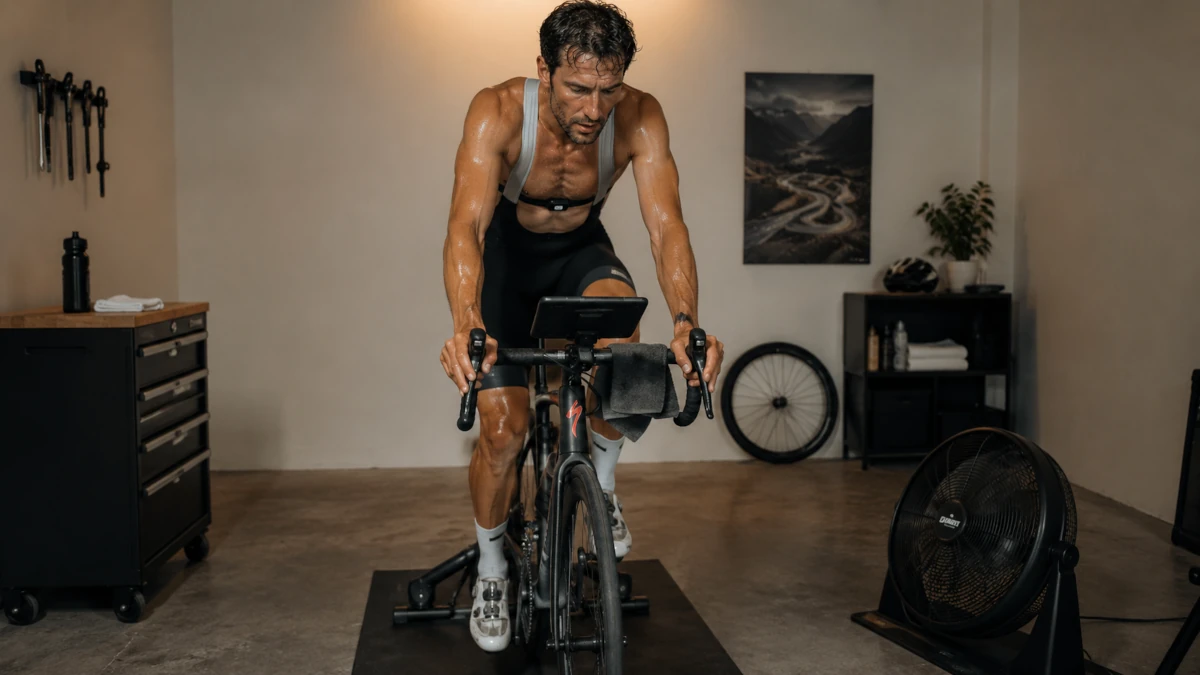
Indoor trainer sessions produce more heat stress than outdoor rides. Outdoors, the air moving past you at riding speed carries heat away. Indoors, that airflow is gone, and a study of cyclists riding in hot, humid conditions found body temperature and heat storage climbed higher in still air than with air moving at riding speed. Your body sends more blood to the skin to shed that heat, so heart rate rises relative to power.
A fan makes a measurable difference even in a normal-temperature room. In a 2023 study of 16 recreationally active adults riding at 70% of heart rate reserve, riders held 15% more power at the same heart rate with a fan than without one. This is normal. Ride to the same heart rate zones, accept a slightly lower power output indoors, and use a strong fan.
Outdoor Zone 2 can be challenging on hilly terrain, climbs will push you into Zone 3–4 even if you're pedaling easy. On rolling routes, focus on average heart rate over the whole ride rather than chasing a strict zone ceiling at every moment. Descents and flats will bring it down. Accept the variation.
Heart Rate Lag and Cardiac Drift
Heart rate on a bike doesn't always match effort in the moment. 2 quirks explain most of the mismatch:
HR lag: Heart rate doesn't respond instantly to changes in effort. It starts rising within seconds of a harder effort, but it takes 1 to 2 minutes to settle at the new level. This matters most for intervals: at the start of a hard Zone 4 effort, your HR will read low for the first minute or so before catching up. Don't sprint to compensate. Trust the effort and let HR settle.
Cardiac drift: On longer rides (60+ minutes), heart rate gradually rises even at constant power and conditions. This is driven by dehydration and cardiovascular fatigue. Your HR may be 10–15 bpm higher at the end of a 2-hour Zone 2 ride than at the start, even if effort felt identical. Stay hydrated and use average HR for zone assessment on long rides rather than end-of-ride readings.
Frequently Asked Questions
What heart rate zones are best for cycling fitness?
A combination of Zone 2 (60–70% heart rate reserve, or HRR) for aerobic base building and Zone 4 (80–90% HRR) for lactate threshold development drives the most well-rounded cycling fitness. Zone 2 builds the aerobic base that sustains long rides. Zone 4 raises the threshold at which fatigue sets in. Most cyclists benefit from roughly 80% of weekly volume in Zone 2 and 20% in Zone 4–5.
What heart rate should I cycle at to lose weight?
Zone 2 (60–70% of heart rate reserve) is the best default for most riders. Weight loss comes down to total calories burned over the week, and Zone 2 rides can last 60–90 minutes without leaving you too tired to ride again the next day. Add 1 harder session a week if you recover well. Use the Karvonen formula with your age and resting heart rate to find your personal Zone 2 range.
Should I use heart rate or power for cycling training?
Power meters give instantaneous, objective feedback unaffected by temperature, fatigue, or cardiac drift, making them superior for pacing intervals and measuring absolute fitness gains. Heart rate reflects actual physiological stress, which power doesn't directly measure. Many cyclists use both: power for pacing intervals, heart rate for monitoring overall exertion and recovery. If you only have 1, a heart rate monitor is far more accessible and sufficient for zone-based training.
Why is my heart rate higher on an indoor trainer than outdoors?
Indoor trainers produce more heat stress. Without the airflow you get from riding outdoors, your body sends more blood to the skin to shed heat, and heart rate rises relative to power. In a 2023 study, riders at 70% of heart rate reserve held 15% more power at the same heart rate with a fan than without one. This is normal. Target the same zones, accept a slightly lower power output indoors, and use a fan.
What is cardiac drift in cycling and how do I handle it?
Cardiac drift is the gradual rise in heart rate over the course of a long steady-state ride, even at constant power output. It's caused by dehydration and increasing cardiovascular demand as the session progresses. After 60–90 minutes, heart rate can drift 5–15 bpm above where it started at the same effort. To handle it, stay well hydrated and don't keep easing off to chase a rising number. Recognize drift for what it is and use average HR over the ride rather than momentary readings for zone assessment.
This article is for informational purposes only and does not constitute medical advice. Please consult a physician or certified fitness professional before starting a new exercise program.