You strap on a new fitness tracker, go for your first run, and watch your heart rate climb to 162 bpm. Now what? That number alone tells you almost nothing, which is exactly where this guide comes in.
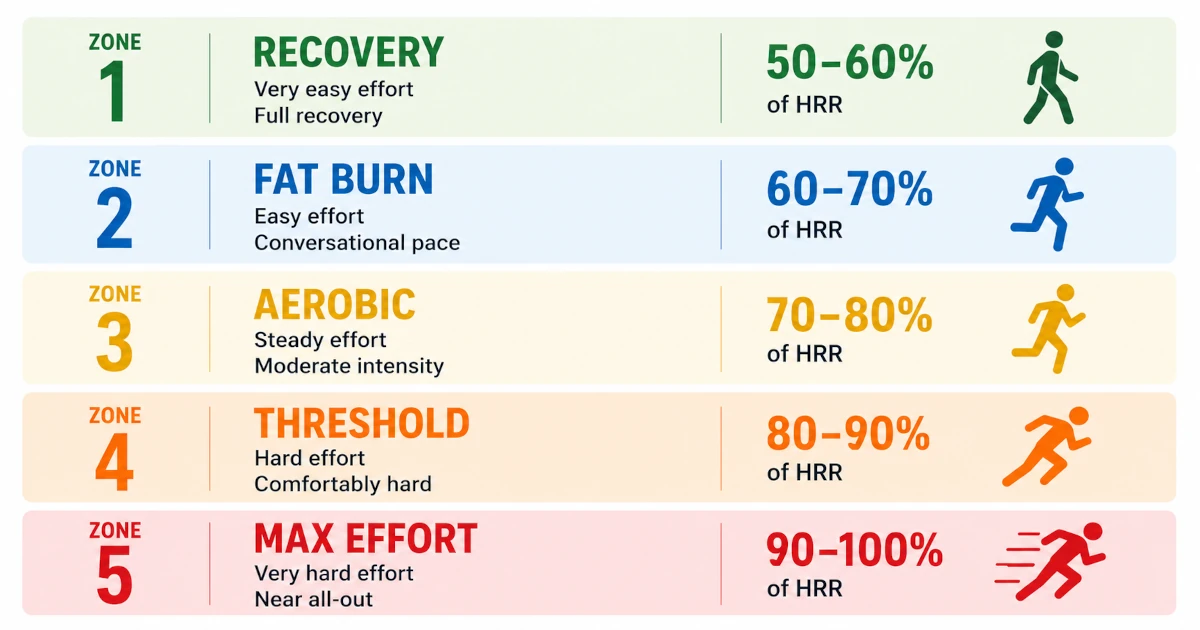
A target heart rate zone for exercise is a specific beats-per-minute range tied to what your body is training: burning fat, building cardiovascular fitness, or developing peak output. This guide covers which zone to start in, how to check it with or without a device, the mistakes most beginners make, and a 4-week plan. For a full explanation of all 5 zones, see what exercise heart rate zones are.
Why Heart Rate Zones Matter for Your Workout Results
Zones give every workout a clear purpose. A Zone 2 session builds your aerobic base. A Zone 4 interval pushes your lactate threshold higher. Zone 1 keeps you active on recovery days without adding to your fatigue.
Without a target zone, you have no reliable way of knowing whether you're going too hard, too easy, or about right for what you're trying to accomplish. Without that feedback, most people drift into the same gray middle ground, working at a moderate intensity that's not quite hard enough for strong adaptation, but too hard to recover from quickly enough to train often.
Zone too low: wasted time
Spending all your cardio in Zone 1 means your heart rate barely rises above resting. Your body adapts to the effort quickly, and cardiovascular progress stalls. It's always better than sitting still, but it's not training.
Zone too high: risk of overtraining
Defaulting to Zone 4 and 5 every session drains your recovery reserves faster than you can replenish them. Over several weeks, the signs are hard to miss: persistent fatigue, declining motivation, and a resting heart rate that won't come down. For a deeper look at how to gauge whether you're pushing too hard, see our article on whether you're exercising hard enough.
Zone on target: fat burn and cardio gains
For most beginners, the majority of cardio should happen in Zone 2, the fat-burning, base-building zone that's sustainable enough to train in regularly without needing 2 days of recovery afterward.
How to Calculate Your Target Heart Rate Zone
Use the Karvonen method. It's the most accurate way to find your zones without a lab test, because it accounts for your fitness level as well as your age.
The Karvonen method factors in your heart rate reserve, the gap between your resting heart rate and your maximum heart rate. Your resting heart rate reflects how efficient your cardiovascular system currently is, so including it produces zones calibrated to you specifically.
Heart Rate Reserve = Max HR − Resting HR
A trained person might have a resting heart rate of 52 bpm. A beginner might sit at 72 bpm. The Karvonen formula produces meaningfully different zones for each, as it should.
Example: calculating zones for a 35-year-old beginner
Age: 35. Resting heart rate: 65 bpm (measured first thing in the morning, before getting up).
- Max HR = 220 − 35 = 185 bpm
- Heart Rate Reserve = 185 − 65 = 120 bpm
- Zone 2 lower = (120 × 0.60) + 65 = 137 bpm
- Zone 2 upper = (120 × 0.70) + 65 = 149 bpm
The simpler 220-minus-age method gives the same person a Zone 2 of 111–130 bpm, up to 26 bpm lower. Someone following those numbers would spend their Zone 2 sessions in Zone 1 or below. For the full walkthrough, including how to measure resting heart rate and estimate max heart rate, see the step-by-step zone calculation guide.
Which Heart Rate Zone Should Beginners Start In?
Zone 2. For almost every beginner, almost every time, the answer is Zone 2.
Most people new to cardio do the opposite instinctively: they push hard, get winded, feel like they're grinding, and spend most of their time in Zone 3 or 4. That work still counts, but it doesn't build the aerobic foundation that makes everything else possible. High-intensity effort without an aerobic base is effective in the short term and limiting in the long term.
The "talk test": no device needed
If you don't have a heart rate monitor yet, the talk test is a reliable zero-cost check, and one the Mayo Clinic recommends as a practical measure of exercise intensity.
In Zone 2, you should be able to hold a full conversation without gasping between words. Your breathing is elevated and purposeful, but you could answer a question in complete sentences. If someone called you mid-jog and you'd struggle to finish a sentence, you've drifted above Zone 2, so ease off slightly. If you could comfortably sing a few bars, you're likely in Zone 1 and have room to pick up the pace.
Why Zone 2 works for beginners
Zone 2 does several things at once. Fat supplies a large share of its fuel. It increases mitochondrial density in your muscle cells, which improves your endurance. And it does all of this at an intensity you can sustain for 30 to 60 minutes without the kind of fatigue that requires days to recover from. The Cleveland Clinic notes that for people focused on fat loss and endurance, Zones 1–3 are the most effective and sustainable place to train.
For how fat burning changes across zones, and why total calories matter more for weight loss, see our article on the fat-burning heart rate zone.
How long should you stay in Zone 2?
For beginners, 20 to 30 minutes in Zone 2 3 times a week is enough to produce real cardiovascular adaptation. One of the clearest early signs of progress: your resting heart rate starts to drop over four to six weeks, which reflects a more efficient heart at rest.

The Best Way to Track Your Heart Rate (For Beginners)
The talk test is a solid starting point. But real-time heart rate data changes how you train in a way that estimation alone cannot. A few weeks in, most beginners find that seeing the actual number (and knowing whether it's drifting above their zone) is worth the investment.
Option 1 (Free): the talk test
No device, no cost, no setup. Use the method described above. It's a valid way to gauge effort level and exactly what most beginners should use before buying anything. The limitation is precision: you might be at 138 bpm or 154 bpm with no way to tell the difference, and for a 35-year-old beginner, those are 2 different zones.
Option 2 (Budget): a wrist fitness tracker ($100–$160)
A wrist tracker gives you a continuous heart rate reading in real time. Accuracy for steady-state cardio (walking, jogging, cycling) is good. Not clinical-grade, but more than adequate for zone-aware beginner training.
Option 3 (Most Accurate): a chest strap monitor ($50–$120)
A chest strap reads the electrical signals from your heart, the same underlying principle as a clinical ECG. Research repeatedly shows chest straps match the accuracy of medical-grade heart rate monitoring in ways that optical wrist sensors cannot, particularly during high-intensity or interval efforts where optical sensors lag and misread. Polar's breakdown of heart rate zone accuracy covers this in detail.
Common Beginner Mistakes When Using Heart Rate Zones
Most beginners run into the same handful of pitfalls when they start training by heart rate.
Always training in Zone 3: the gray zone trap. Zone 3 is the most common default for motivated beginners because it feels productive: you're breathing hard, sweating, clearly working. The problem is that Zone 3 is intense enough to accumulate fatigue without producing the same aerobic base adaptations as Zone 2, and not intense enough to generate the stimulus that Zones 4 and 5 provide. A plan built entirely in Zone 3 tends to plateau faster than one anchored in Zone 2 with occasional harder efforts.
Ignoring resting heart rate. The Karvonen formula requires your resting heart rate. Guessing 70 bpm when your actual number is 58 bpm produces inaccurate zones. Measure it properly: count your pulse for 60 seconds first thing in the morning, before you get out of bed. Three mornings averaged is more reliable than 1 reading.
Treating 220-minus-age as an exact number. It's a population estimate, not a measurement of your physiology. If your personal Zone 2 regularly feels more like a grinding effort than a manageable one, your actual maximum heart rate may differ from the formula's output. Use it as a starting point, not a final answer.
Checking heart rate only at the end of a workout. Heart rate at the end of a session reflects the early stages of recovery, not the zone you spent your time in. Check it during your effort, every 5 to 10 minutes at first, until you develop a reliable sense of pacing.
Comparing your zones to someone else's. A 42-year-old regular runner whose Zone 2 peaks at 148 bpm and a 42-year-old beginner whose Zone 2 tops out at 131 bpm are both training correctly for their own bodies. Zones are individual by design. There's no external benchmark to chase.
Your First 4-Week Heart Rate Training Plan
This plan doesn't require any equipment. You can run the talk test throughout. Once you have a heart rate monitor, use it to confirm your effort against the zone targets.
| Week | Workout | Duration | Target Zone |
|---|---|---|---|
| Week 1 | Easy walk or light jog | 20–30 min, 3×/week | Zone 1–2 |
| Week 2 | Brisk walk or easy bike | 30 min, 3×/week | Zone 2 |
| Week 3 | 20 min Zone 2 + 5 min Zone 3 push | 25 min, 3×/week | Zone 2–3 |
| Week 4 | Easy run or swim | 30–35 min, 3–4×/week | Zone 2 |
Week 3 is the only point where you deliberately push into Zone 3, and it's brief. The purpose of weeks 1, 2, and 4 is to build the habit and the aerobic base. Finishing those sessions feeling good (not depleted) is the goal. The CDC recommends 150 minutes of moderate activity a week for adults. This plan starts at 60 to 90 minutes a week and builds toward that, which gives your body time to adapt. Progress in Zone 2 training is measured in weeks and months, not single sessions.
Frequently Asked Questions
What is a good target heart rate for exercise?
For general cardiovascular health, the American Heart Association recommends exercising at 50–85% of your maximum heart rate. In practice, most beginners should aim for Zone 2: 60–70% of their heart rate reserve using the Karvonen formula. Use the free calculator at CalculateMyHeartRate.com to find your personal Zone 2 range. It takes under a minute.
What heart rate zone burns the most fat?
Fat still supplies a large share of your fuel in Zone 2 (the 60–70% heart rate reserve range). For most beginners, fat burned per minute peaks at an easier effort, but Zone 2 burns more total calories. Higher zones burn more calories per minute, with more of them coming from carbohydrate. For weight loss, total calories burned over the week matters most, and Zone 2 is the easiest intensity to repeat often enough for that to add up. For beginners focused on fat loss, regular Zone 2 training is the most practical starting strategy.
Is 150 bpm too high for a beginner?
It depends on your age and resting heart rate. For a 35-year-old with a resting heart rate of 65 bpm, Zone 2 tops out at approximately 149 bpm, so 150 bpm puts you right at the Zone 2 and Zone 3 boundary. For an older beginner or someone with a higher resting heart rate, 150 bpm could sit in Zone 3 or Zone 4. Calculate your personal zones before drawing any conclusions from a raw number.
How do I know if I'm in the right heart rate zone without a device?
Use the talk test. In Zone 2, you can hold a full conversation in complete sentences without gasping between words. Your breathing is elevated, but you're in control of it. If you're too winded to speak in full sentences, you've moved above Zone 2. If you could comfortably sing a verse of a song, you're likely in Zone 1 and have room to increase your pace.
What is a normal resting heart rate for adults?
The American Heart Association considers 60–100 bpm normal for healthy adults. Well-trained endurance athletes often register between 40 and 60 bpm. A resting heart rate trending downward over weeks of steady training is one of the clearest early indicators that your cardiovascular fitness is improving.
Where to Start
Heart rate zone training doesn't require expensive gear or a background in exercise science. For a beginner, the practical summary is this: most of your cardio should feel conversational. If you're too winded to speak in sentences, you're working harder than you need to for the results you're after.
Start in Zone 2. Use the talk test if you don't have a tracker yet. When you're ready to get precise, a chest strap like the Polar H10 will give you data you can trust, and the Fitbit Charge 6 is a solid wrist-based option if all-day wear matters to you.
The free Karvonen calculator at CalculateMyHeartRate.com calculates your personal 5-zone targets in under a minute. Run it once, and you'll have specific bpm numbers to train within, not a generic range that could apply to anyone.
This article is for informational purposes only and does not constitute medical advice. Consult a physician or certified fitness professional before starting a new exercise program. Results vary by individual physiology.