

Am I exercising hard enough? You've finished a workout thinking 1 of 2 things: that felt too easy or that absolutely destroyed me. Neither extreme is especially useful when your goal is steady progress.
The frustrating truth is that exercising at the wrong intensity, either too high or too low, is 1 of the most common reasons people don't see results from cardio. Too easy, and you're not creating enough stimulus for adaptation. Too hard, too often, and you dig into a recovery deficit that leaves you fatigued, unmotivated, and prone to injury.
Heart rate zones solve this problem. They give you an objective, measurable target so you're not relying on feel alone, and they tell you precisely how hard you should be working depending on what you want your workout to accomplish.
What Does "Hard Enough" Mean?
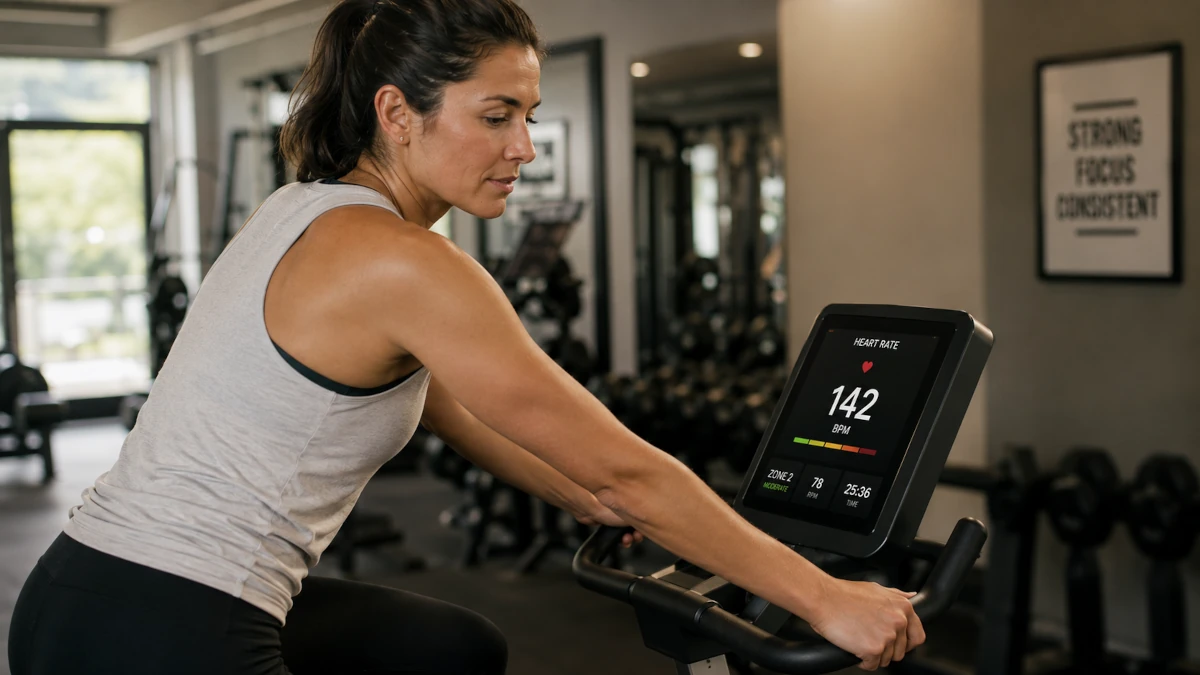
For most beginners working out 3 to 4 times a week, hard enough means solidly in Zone 2 for most of your cardio, occasionally dipping into Zone 3, and reaching Zone 4 or 5 only occasionally and intentionally.
The phrase "hard enough" is relative on its own, which is exactly the problem with relying on it. Heart rate zones fix that: instead of asking how hard you're working subjectively, they measure what percentage of your cardiovascular capacity you're using right now, and whether that's appropriate for today's workout goal.
Here's the 5-zone framework used by exercise physiologists, calculated using the Karvonen method (which uses your heart rate reserve rather than just your maximum heart rate):
| Zone | Name | % of HRR | The Point of Training Here |
|---|---|---|---|
| Zone 1 | Recovery | 50–60% | Movement without stress, aids recovery |
| Zone 2 | Fat Burn | 60–70% | Aerobic base, fat metabolism, sustainability |
| Zone 3 | Aerobic | 70–80% | Cardiovascular fitness and endurance gains |
| Zone 4 | Threshold | 80–90% | Raising your lactate threshold, hard effort |
| Zone 5 | Max Effort | 90–100% | Peak output, short intervals only |
The Cleveland Clinic provides a clear breakdown of what each zone means for your body and your goals.
The Most Common Mistake: Training Too Hard, Too Often
The most common error beginners make is going too hard too often, without enough Zone 2 foundation underneath, rather than going too easy. This runs counter to what most people assume.
When every workout is a grinding effort, a few things happen. Recovery takes longer, so you can't train as frequently. Motivation drops because training never feels good. And because you're always operating near your capacity, you have little energy left for the harder sessions that produce big fitness gains.
The 80/20 approach, roughly 80% of your training in Zones 1 and 2 and 20% in Zones 3 through 5, is endorsed by exercise physiologists, and research on elite endurance athletes found most of them train roughly this way. A strong aerobic base is what makes harder efforts possible and productive. WHOOP's breakdown of heart rate zone training covers how to apply this balance in a structured weekly training plan. For a deeper look at Zone 2 specifically, see our guide on Zone 2 training: what it is, why it works, and how to do it.
What Does Too Hard Feel Like?
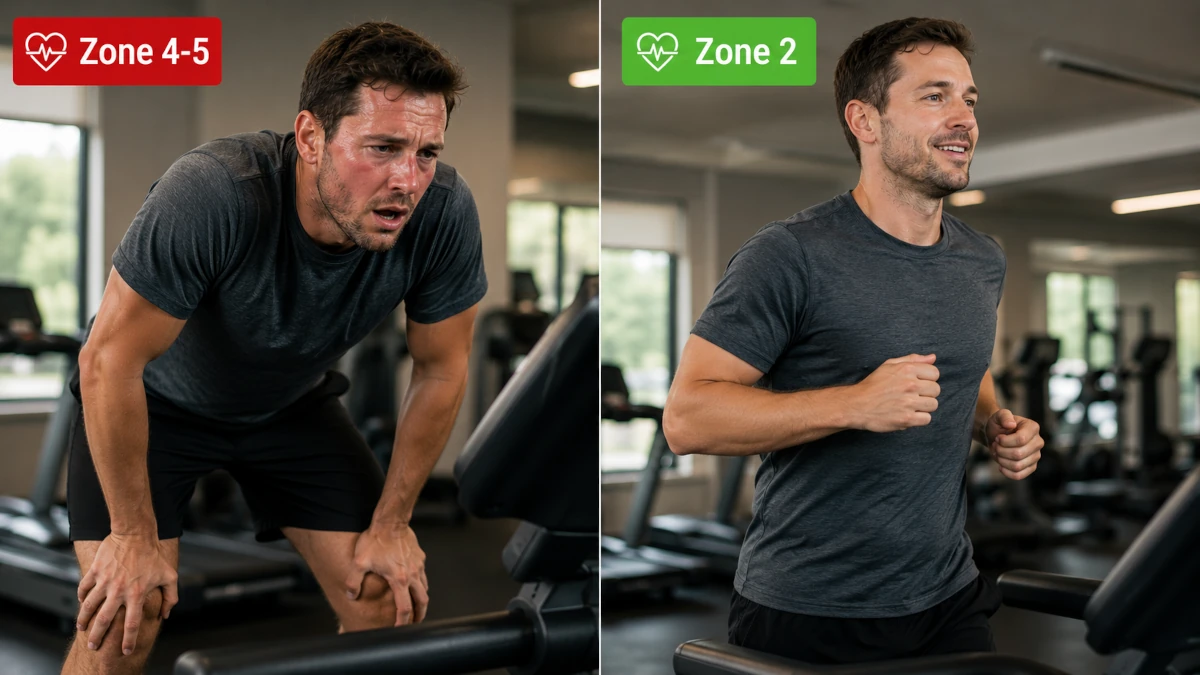
If you're routinely exercising in Zone 4 or 5 without meaning to, your body will tell you. Watch for these signals:
- You're constantly out of breath and can barely speak during cardio
- Workouts feel like survival rather than effort
- You feel tired for hours or the whole day after exercise
- Motivation to work out declines week over week
- Resting heart rate is creeping upward (a sign of accumulated fatigue)
These aren't signs of a good workout. They're feedback that you're spending too much time above Zone 3 without the recovery to support it.
What Does Too Easy Feel Like?
The flip side is real too. Zone 1 training has its place, but if every session is a leisurely stroll that barely elevates your heart rate, you won't make cardiovascular progress.
Signs you may be going too easy:
- Your heart rate never meaningfully rises above resting
- You could read a book or scroll your phone without trouble
- You finish workouts feeling exactly the same as when you started
- After weeks of training, nothing is getting easier
Zone 2 should feel like effort: sustainable, continuous effort where your breathing is elevated and you're clearly working, even if it's not dramatic. If "easy" is your default, nudge up the pace until you're breathing more purposefully.
How to Calculate Your Personal Training Zones
The Karvonen formula gives you personalized zones based on your heart rate reserve, the difference between your resting heart rate and your maximum heart rate.
The formula:
Step 1: Measure your resting heart rate first thing in the morning, before getting out of bed. Count your pulse for 60 seconds.
Step 2: Estimate your max heart rate using the 220-minus-age formula (or use the 220 minus age calculator to get your zones at the same time).
Step 3: Subtract resting from max to get your heart rate reserve (HRR).
Step 4: Plug your HRR into the formula using each zone's upper and lower percentages.
Example: 45-year-old with a resting heart rate of 70 bpm
- Max HR: 220 − 45 = 175 bpm
- HRR: 175 − 70 = 105 bpm
- Zone 2 lower: (105 × 0.60) + 70 = 133 bpm
- Zone 2 upper: (105 × 0.70) + 70 = 144 bpm
This person should be running between 133 and 144 bpm for Zone 2 fat-burning cardio. That's a precise target, not a feeling.
How to Track Your Heart Rate During a Workout
Once you have your zones, you need a way to see your heart rate in real time. A few options, from most to least accurate:
Chest strap monitor (Polar H10, Garmin HRM): The gold standard. In a 2017 study that tested wrist and chest devices against an ECG, the chest strap was the most accurate. Connects via Bluetooth to most fitness apps and gym equipment. Polar's guide to heart rate zone basics covers how to pair one with zone-based training.
Smartwatch: Apple Watch, Garmin, and Fitbit devices offer good accuracy for steady-state cardio like walking, jogging, and cycling. Less reliable during exercises with a lot of arm movement or very high-intensity intervals.
Wrist check or neck check: 2 fingers to your radial (wrist) or carotid (neck) pulse. Count beats for 15 seconds, multiply by 4. Perfectly valid if you're doing steady-state exercise where you can pause briefly.
How Often Should You Check Your Zones?
If you're new to zone training, check your heart rate every 5 to 10 minutes during cardio until staying in your target zone becomes intuitive. Most people develop a feel for what Zone 2 feels like within a few weeks and don't need to monitor as frequently.
Recalculate your zones every 4 to 6 weeks, or whenever your resting heart rate moves by 3 bpm or more. A dropping resting heart rate is one of the clearest indicators that your cardiovascular fitness is improving. Your zones should be updated to stay accurate. Colorado State University's overview of heart rate zone training offers good context on why precise zone targets matter as your fitness evolves.
Frequently Asked Questions
I'm a beginner, which zone should I be in for my cardio?
Zone 2 for most of your cardio, most of the time. It's sustainable, it builds the aerobic base that makes everything else possible, and it produces real fat loss results without the recovery burden of harder zones.
My heart rate spikes above Zone 2 when I run: does that mean I should walk?
Not necessarily, but it might mean slowing your pace or taking walk breaks until your aerobic base develops. A run/walk approach is entirely legitimate and often smarter than grinding through Zone 3 or 4 unnecessarily. There's no shame in walk intervals.
Should I train in different zones on different days?
Yes, ideally. Most training plans mix Zone 2 sessions (the majority), occasional Zone 3 efforts, and short Zone 4–5 intervals once or twice a week for more experienced exercisers. Variety trains different energy systems and prevents the stagnation that comes from doing the exact same thing every session.
Can I use these zones for strength training?
Heart rate zones are designed for aerobic and cardiovascular exercise. During strength training, heart rate is a less reliable measure of intensity because it spikes and drops quickly with each set. For weight training, perceived exertion and load progression are more useful guides.
The only way to know if you're exercising at the right intensity is to measure it. Everything else is a guess.
Head to the free calculator at CalculateMyHeartRate.com, run your Karvonen calculation, and get your 5 personal heart rate zones in under a minute. Then the next time you finish a workout and wonder whether you worked hard enough, you'll know.
This article is for informational purposes only and does not constitute medical advice. Please consult a physician or certified fitness professional before starting a new exercise program.