

You and a friend finish the same 30-minute jog. You could keep going for another hour. Your friend is spent. Same pace, same route, but your hearts were working at different levels, so the run trained something different in each of you. Exercise heart rate zones measure that difference. They split your effort into 5 ranges of beats per minute, from light movement (Zone 1) to all-out effort (Zone 5), and each range produces its own training effect.
This guide covers what each zone is, what it feels like, and what it trains. To work out your own numbers, the step-by-step zone calculation guide walks through the math. If you want to know where to start, the beginner's target heart rate guide covers your first zone, gear, and a 4-week plan.
Find your own 5 zones Zone 2, 60-70% of your heart rate reserve, is where most cardio time should go. Enter your age and resting heart rate below to get all 5 zones calculated for you. →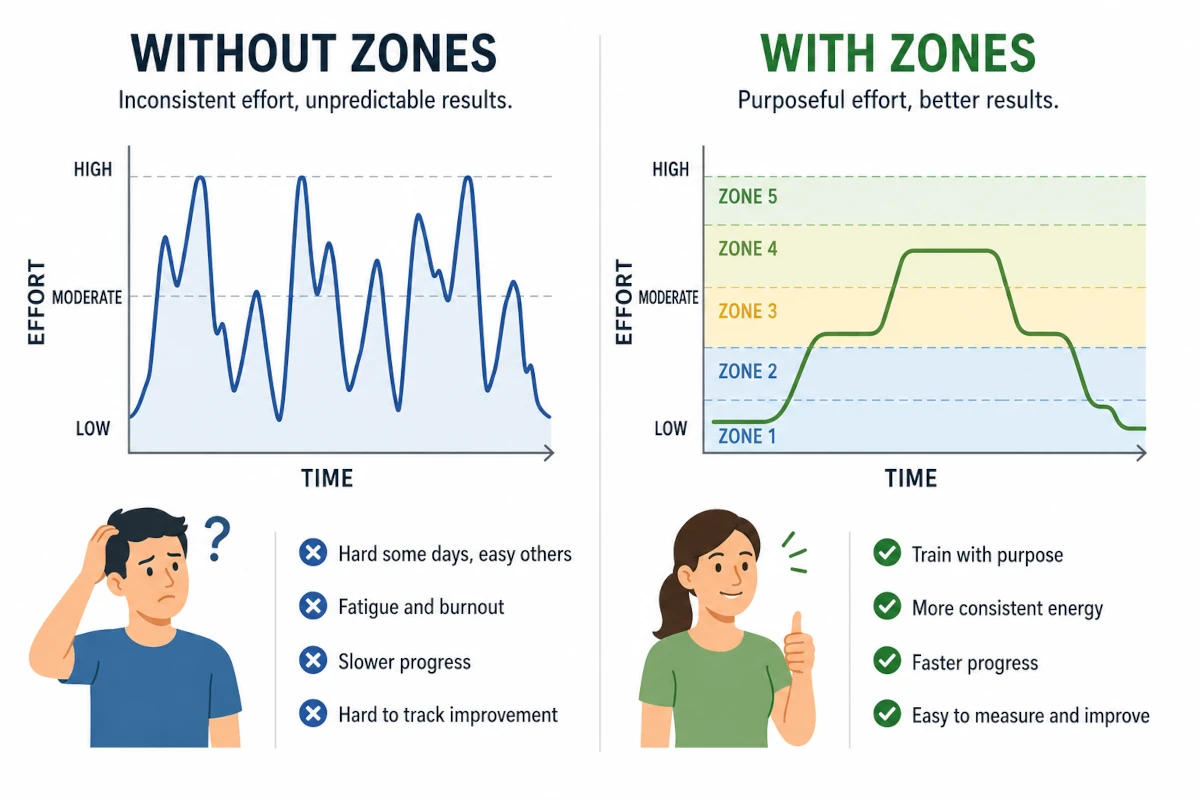
The Concept Behind the Zones
Zone training is built around the transition between energy systems as exercise intensity changes. Your heart rate during exercise is a direct window into how hard your body is working, reflecting the demand being placed on your cardiovascular system and your muscles at any given moment.
When exercise is easy, a slow walk for example, your heart doesn't need to work hard. When you push harder, your muscles demand more oxygen, your heart rate rises, and your body shifts the energy systems it's relying on.
At low intensity (Zones 1 and 2), your body runs primarily on fat as its fuel. That's a slow-burning, abundant energy source that your body is happy to use for extended periods. As intensity increases into Zone 3 and above, your body starts drawing more heavily on carbohydrates, a faster fuel source, but one that depletes faster and produces more metabolic waste.
This is why Zone 2 has become so widely discussed in fitness circles. It's easier, and it's metabolically distinct too. And for people focused on weight loss or building a sustainable fitness habit, it's often where the most useful work happens.
The 5 Heart Rate Zones Explained
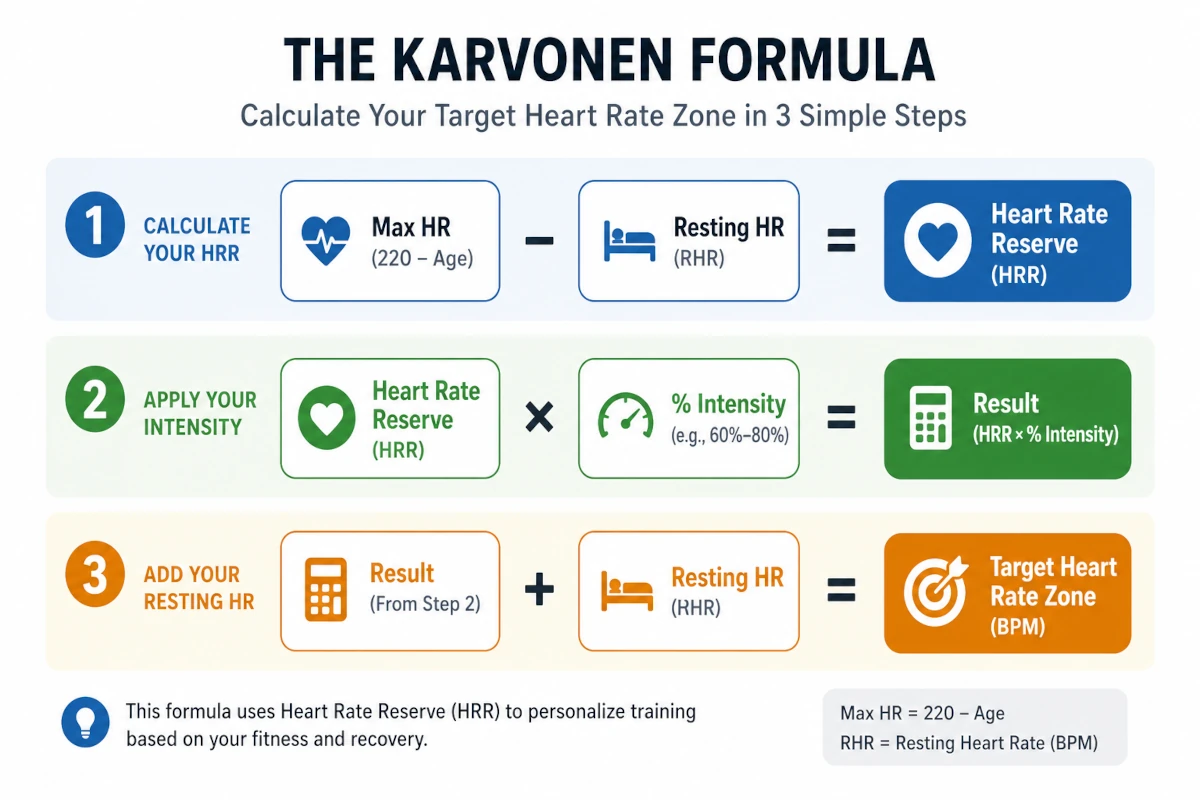
The most widely used framework divides training intensity into 5 zones based on a percentage of your heart rate reserve (HRR), the difference between your resting heart rate and your maximum heart rate. Using HRR, rather than maximum heart rate alone, gives you personalized zones that reflect your actual fitness level.
| Zone | Name | % of HRR | Purpose |
|---|---|---|---|
| Zone 1 | Recovery | 50–60% | Active rest, light movement, warm-up |
| Zone 2 | Fat Burn | 60–70% | Aerobic base building, fat metabolism |
| Zone 3 | Aerobic | 70–80% | Cardiovascular fitness, endurance |
| Zone 4 | Threshold | 80–90% | Lactate threshold, speed development |
| Zone 5 | Max Effort | 90–100% | Peak power, VO2 max, short intervals |
These percentages apply to the Karvonen method, which accounts for your resting heart rate. Research on 63 adults found that percent of heart rate reserve tracks the share of aerobic capacity you're using almost exactly, which makes these zones more accurate than simpler methods.
Zone 1: Recovery
Zone 1 is gentle, deliberate movement. A slow walk, easy cycling, or light swimming that barely registers as a workout. Your breathing stays normal, conversation is effortless, and your body is using this time to promote circulation and aid recovery from harder efforts.
Beginners sometimes skip Zone 1 entirely, thinking it's too easy to matter. Easy movement on rest days keeps the habit alive and adds some aerobic work without digging into recovery capacity.
Zone 2: Fat Burn
Zone 2 is the zone that has attracted the most attention from researchers and longevity-focused fitness professionals in recent years, and for good reason. Training in this range, where your breathing picks up noticeably but you can still hold a conversation, is where fat supplies a large share of your fuel while you still burn a meaningful number of calories.
It also builds mitochondrial density (the cellular machinery that produces energy), improves your body's ability to use fat over carbohydrates during exercise, and strengthens your cardiovascular system without the recovery cost of harder training. For general fitness, it's the most productive place to spend most of your cardio time. For weight loss, total calories burned over the week matter most, and Zone 2 is the easiest intensity to repeat often enough for them to add up. Our dedicated article on the fat-burning heart rate zone goes deeper on the science if you want to understand exactly what's happening physiologically.
Zone 3: Aerobic
Breathing becomes more labored in Zone 3. You can still speak, but you'd rather not. Full sentences take effort. Brisk running, fast cycling, and vigorous swimming typically land here.
Zone 3 builds general aerobic fitness and cardiovascular capacity. It's the zone where many recreational gym-goers naturally settle during cardio sessions. It has real value, but some research suggests that spending too much time exclusively in Zone 3, rather than mixing Zone 2 and Zone 4, may not optimize progress as effectively as a more polarized approach. Colorado State's exercise physiology guidance covers how to balance zones in a structured training week.
Zone 4: Threshold
This is where training gets hard. Zone 4 sits around the lactate threshold: the intensity at which your body produces lactate faster than it can clear it. Training near this threshold raises the point at which fatigue sets in, which is why it's central to improving athletic performance.
You'll know you're in Zone 4 because you can manage short bursts of speech at best, and sustaining the effort for more than 20–30 minutes is extremely challenging. Tempo runs, cycling intervals, and circuit training at high intensity often fall in this zone.
Zone 5: Maximum Effort
Zone 5 is all-out, unsustainable exertion: sprints, maximum-effort intervals, or final pushes. Most people can only hold Zone 5 for 30 seconds to 2 minutes before the body demands recovery. It builds VO2 max and fast-twitch muscle fiber development, but it comes at a recovery cost and isn't appropriate as a regular training destination for most people, particularly beginners.
How to Calculate Your Own Zones
The Karvonen formula is the method behind the zones described above: Target HR = (Heart rate reserve × % intensity) + Resting HR, where heart rate reserve is your max heart rate minus your resting heart rate. You need 2 numbers: your resting heart rate, measured first thing in the morning, and an estimate of your max heart rate. The step-by-step zone calculation guide walks through each one with a worked example, or the calculator below does the math for you.
Free Karvonen Heart Rate Zone Calculator Enter your age and resting heart rate to get all 5 zones calculated instantly. →How Zone Targets Shift as You Get Fitter
One of the underappreciated benefits of the Karvonen method is that it automatically updates as your fitness improves. When your resting heart rate drops, a clear sign of improved cardiovascular conditioning, your heart rate reserve increases and your calculated zones shift slightly as a result.
This means the zones stay accurate to your current fitness level rather than becoming stale over time. A good rule of thumb is to recalculate your zones every 4 to 6 weeks, or whenever your resting heart rate moves by 3 bpm or more. WHOOP's guide to heart rate zone training covers how to put these zones into practice week-to-week.
Frequently Asked Questions
Are heart rate zones the same for everyone?
No. The same zone number corresponds to different actual bpm values for different people, which is exactly why the Karvonen method is preferable: it accounts for individual differences through your resting heart rate.
What if I don't have a heart rate monitor?
You can use perceived exertion as a rough proxy. Zone 2 feels like "I can hold a full conversation but I'm breathing more than normal." Zone 4 feels like "I can only say a few words at a time." A monitor makes the zones more precise, but you can get value from the framework without one.
Do zones differ between activities like running and cycling?
Yes, slightly. Heart rate during cycling typically runs 5–8 bpm lower than during running at the same effort level, because running engages more muscle mass. If you train across multiple sports, some coaches recommend calculating sport-specific zones. Polar's training documentation details this adjustment.
How long should I spend in each zone per week?
Most exercise physiologists recommend spending around 80% of your cardio time in Zones 1–2, and around 20% in Zones 3–5. That split comes from research on elite endurance athletes, who train roughly this way across many sports. This balance builds a strong aerobic foundation while including enough high-intensity stimulus for continued progress.
Find Your Zones Now
Understanding the zones is the easy part. The hard part is applying them week after week. Start with your numbers. Head to CalculateMyHeartRate.com, run the Karvonen calculation, and save your 5 zones somewhere accessible. Next time you lace up, you'll have a bpm target in place of a vague intention to "work hard."
This article is for informational purposes only and does not constitute medical advice. Please consult a physician or certified fitness professional before starting a new exercise program.