
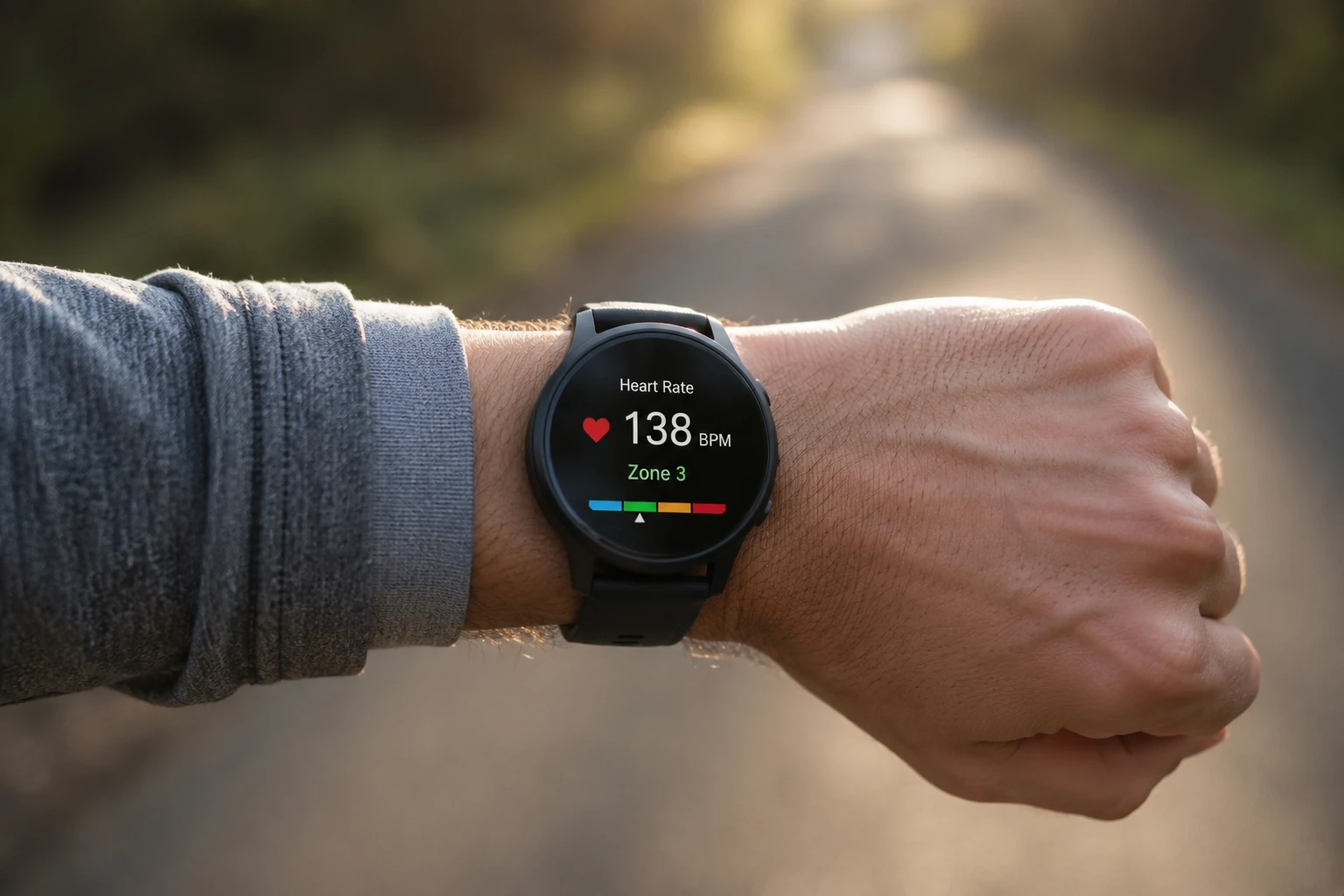
You've read that Zone 2 training builds endurance, so you head out for an easy run. 10 minutes in, your watch says Zone 3, and the pace it takes to drop back down feels closer to walking than running. That's a common first week with Zone 2. Below is what Zone 2 training is, how to find your own range, and why a pace that slow still builds fitness.
What Is Zone 2 Training?
Zone 2 is low-intensity aerobic exercise, roughly 60–70% of your heart rate reserve, the range where you're working steadily but can still hold a full conversation without gasping between words. Not short sentences. A full conversation. If you'd struggle to recite your grocery list out loud, you're already above Zone 2.
It's the pace that feels almost too comfortable, the one where you wonder if you're even doing anything useful. And that's exactly the point: it surprises most people to learn that the athletes who run the fastest marathons spend the majority of their training time at this exact pace, one most recreational runners would call embarrassingly slow. Not because they're taking it easy, but because they know something about physiology that took the fitness world decades to take seriously.
The Karvonen heart rate zones divide your training spectrum into 5 levels. Zone 2 is the second from the bottom, above gentle warm-up walking, but well below anything that feels hard. For most adults, it falls somewhere between 110 and 145 bpm depending on age, resting heart rate, and fitness level.

How to Find Your Zone 2 Heart Rate
The most accurate way is to calculate your heart rate zones using the Karvonen formula, which accounts for your resting heart rate rather than only your age. 2 people who are both 40 years old can have Zone 2 ranges that differ by 10 bpm or more depending on their cardiovascular fitness. Measure your resting heart rate first thing in the morning for 3 days and average it, then enter your age and resting heart rate into the Karvonen heart rate calculator: your Zone 2 range is the output for 60–70% heart rate reserve. For a full worked example with real numbers, see the Zone 2 heart rate calculator and 8-week training plan.
If you don't have a heart rate monitor, the talk test works surprisingly well as a rough check. You should be able to speak in full sentences without pausing for breath. If you're struggling to finish a sentence, slow down.
What Happens in Your Body During Zone 2
At Zone 2 intensity, fat supplies a large share of your fuel, and your aerobic energy system does most of the work. That system relies on mitochondria, the energy-producing structures inside your muscle cells.
The more mitochondria you have, and the more efficient they are, the more fat you can burn at a given pace and the longer you can sustain effort before your body has to lean on carbohydrates. Steady time at Zone 2 intensity is a reliable way to build mitochondrial density, and it's easy enough to repeat several times a week. The adaptation takes sustained time at the right intensity.
There's also the question of your slow-twitch muscle fibers. Zone 2 specifically recruits these fibers, which are built for endurance, highly resistant to fatigue, and rich in mitochondria. Training them routinely makes them better at their job.
The cumulative effect of months of Zone 2 work is a larger, more efficient aerobic base. Your easy pace gets faster at the same heart rate, and your VO2 max often improves too. Tracking either one over time is a clear way to confirm your aerobic base is growing.
Sports scientist Stephen Seiler, who spent years studying how elite endurance athletes train, found that the best performers in running, cycling, and cross-country skiing reliably did around 80% of their training volume at low intensity, Zone 1 and Zone 2. The remaining 20% was hard: threshold work and high-intensity intervals. Most recreational athletes flip this ratio without realizing it.
The "Black Hole" Problem
If Zone 2 is so effective, why don't more people train there? Because it doesn't feel like training. It feels like jogging. And there's a strong psychological pull toward working harder. Harder feels more productive, even when the physiology says otherwise.
What happens in practice is that most people end up in what researchers call the moderate intensity trap, sometimes called the black hole. Their easy runs drift up to Zone 3, which is uncomfortable enough to generate fatigue but not hard enough to produce the specific adaptations of true Zone 2 or genuine Zone 4–5 work.
They're working hard enough to accumulate fatigue, but not at the right intensity to build the aerobic base or develop top-end speed. The result is a plateau that feels baffling because they're training regularly but not improving.
A heart rate monitor solves this problem almost immediately. Put one on during your next "easy" run and check where your heart rate sits. A lot of people find they're spending most of their easy days 10–20 bpm above their Zone 2 ceiling. Their legs felt fine, so they never noticed.
The 80/20 Rule in Practice
The 80/20 split means that for a recreational runner training 5 days a week, 4 of those sessions should be easy Zone 1–2 work. 1 session, maybe 2 at most, should push into Zone 4 or Zone 5. The rest is recovery.
The 80/20 principle has been validated across multiple endurance sports. When elite athletes self-report their training intensity distribution, they reliably land near that 80% low / 20% high split. When researchers measure their training with heart rate monitors rather than relying on self-report, the numbers hold.
This is counterintuitive. Most people assume training harder produces better results. The evidence says otherwise. The fix is more Zone 2 volume, not harder Zone 2 sessions.
How to Structure Zone 2 in Your Training Week
Here's a simple framework for someone running four to five days a week. For what each of the other zones does in a running week, see heart rate zones for running.
| Day | Session |
|---|---|
| Monday | Rest or easy walking |
| Tuesday | Zone 2 run, 40–60 minutes |
| Wednesday | Zone 2 run, 30–45 minutes |
| Thursday | Quality session: intervals or tempo work (Zone 4–5) |
| Friday | Rest or Zone 1 walk |
| Saturday | Zone 2 long run, 60–90 minutes |
| Sunday | Zone 2 easy run, 30–45 minutes |
That's roughly 80% of the running volume in Zone 1–2, with 1 harder session each week. As your fitness develops, the long run lengthens. The quality session stays at 1 or occasionally 2 sessions per week.
The most common mistake is adding more hard sessions when progress stalls. Usually the opposite is the fix: more Zone 2 volume, less junk mileage in Zone 3.
For a week-by-week progressive session block with specific duration targets, see the complete Zone 2 training guide.
How to Stay in Zone 2 When It Feels Too Slow

Running in Zone 2 often means slowing down significantly. On hilly terrain, it can mean walking uphills to keep your heart rate from climbing. This is jarring at first, especially if you're used to running by pace or effort. A few things that help:
Ignore your pace. Zone 2 training is heart-rate based, not pace based. Your pace in Zone 2 will vary with heat, humidity, fatigue, and terrain. Accept that and run by feel and numbers rather than what the GPS says.
Use a chest strap, not only a wrist monitor. Optical wrist sensors can lag several beats behind your actual heart rate during changes in intensity. For Zone 2 training, where precision matters, a chest strap gives you the real-time accuracy you need.
Run alone or with patient training partners. Zone 2 runs are often too slow for group runs. Running with people who push the pace is one of the fastest ways to drift above Zone 2 without noticing.
Accept that it takes months. The aerobic adaptation from Zone 2 training is real but slow. Most people see clear evidence, a faster pace at the same heart rate, after 8–12 weeks of sustained training. Don't judge the method after 2 weeks.
How Long Until You See Results?
A common experience is that pace at your Zone 2 heart rate improves noticeably within 8–12 weeks. How quickly that happens depends on your starting point and how regularly you train in the zone.
Athletes who have been training primarily in Zone 3, the moderate intensity trap, often see the quickest gains when they shift to true Zone 2. The aerobic base responds well.
Beginners building from scratch may take longer to see tangible speed improvements, but their perceived effort at a given heart rate will drop steadily. The same run feels easier. Recovery between sessions improves. Morning resting heart rate tends to drop.
That last one is a useful tracking metric. Measure your resting heart rate weekly, the same morning, same conditions. A downward trend over months is a direct reflection of improving cardiovascular efficiency. You can log your resting HR and track the trend alongside your training zones.
Common Zone 2 Mistakes
These 5 mistakes account for most of the reasons Zone 2 training stalls out.
Going too fast. The most common one. Check your heart rate and trust what it shows.
Skipping it when pressed for time. Zone 2 runs are the first thing recreational athletes cut when life gets busy. But they're also the foundation. Cutting the base to make time for intervals leaves your hard sessions with less aerobic fitness underneath them.
Doing it sporadically. Zone 2 training rewards steady effort. 1 Zone 2 run per week while doing everything else hard won't move the needle. The aerobic adaptations require repeated, sustained stimulus over months.
Not eating enough. Zone 2 runs longer than about 75 minutes still use a meaningful amount of carbohydrate, even though fat supplies much of the fuel. Starting a long session hungry makes it harder to finish at the right effort. A light carbohydrate snack beforehand helps.
Expecting it to feel hard. If Zone 2 feels like hard work, your zones are likely miscalibrated, you're overtired, or you're fighting heat and humidity. Use the Karvonen calculator to verify your zones are based on your current resting heart rate, not an old measurement.
Frequently Asked Questions
How many days a week should I do Zone 2 training?
For most people training 4 to 6 days a week, 3 to 4 sessions should be in Zone 1–2. If you only have 3 days available, 2 of them should be Zone 2 and 1 should be your hard session.
Can I do Zone 2 training on a bike or in the pool?
Yes. Zone 2 is an intensity target, not a modality. Cycling, swimming, rowing, and the elliptical all work. Bear in mind that heart rate runs slightly lower on the bike than running for the same perceived effort. Cycling zones are typically 5–8 bpm lower than running zones.
Is Zone 2 the same as a "fat-burning zone"?
Roughly yes. Fat supplies a large share of your fuel in Zone 2, though for many people fat burned per minute peaks at a slightly easier effort. But the "fat-burning zone" framing is a bit misleading. It doesn't mean you burn more total fat calories than harder exercise, and for weight loss, total calories burned over the week matter more. The fat-burning heart rate zone article covers the distinction in more detail.
Do I need a heart rate monitor?
You can get by with the talk test for casual training, but a monitor makes a meaningful difference if you're serious about Zone 2 training. It removes the guesswork, catches you when you drift, and gives you objective data on your progress over time.
What if my Zone 2 heart rate puts me at a walking pace?
This happens, especially for beginners or people returning from a break. It means your aerobic base needs building. Walk if you need to. There's nothing wrong with fast walking in Zone 2 while your fitness catches up to your ambitions. Most people are running comfortably at Zone 2 pace within 6–12 weeks of steady training.
Zone 2 training asks you to trust a pace that feels too easy, in exchange for an aerobic foundation that eventually makes the hard stuff much more effective. That's the deal. Most people who stick with it for 3 months don't go back to their old approach.
Start with your numbers. Calculate your Zone 2 heart rate range using the Karvonen formula, strap on a heart rate monitor, and run slower than feels right for a few weeks. The adaptation will follow.
This article is for informational purposes only and does not constitute medical advice. Please consult a physician or certified fitness professional before starting a new exercise program.