

Why Heart Rate Beats Pace for Zone Training
Pace is a useful tool for race planning. But for training, it has a fundamental flaw: the same pace represents different physiological stress depending on conditions. A 9-minute mile in 85°F heat with 75% humidity is harder on your cardiovascular system than the same pace on a cool morning. An uphill segment spikes your heart rate while your pace slows. Fatigue from yesterday's workout affects today's effort at the same pace.
Heart rate, by contrast, directly reflects what your cardiovascular system is doing. When you target a zone by heart rate, you're targeting the physiological stimulus, the actual training effect, rather than a number on your watch face. That's why heart rate zone training produces more reliable adaptations than pace-based training, particularly for aerobic base building.
The 5 Running Zones
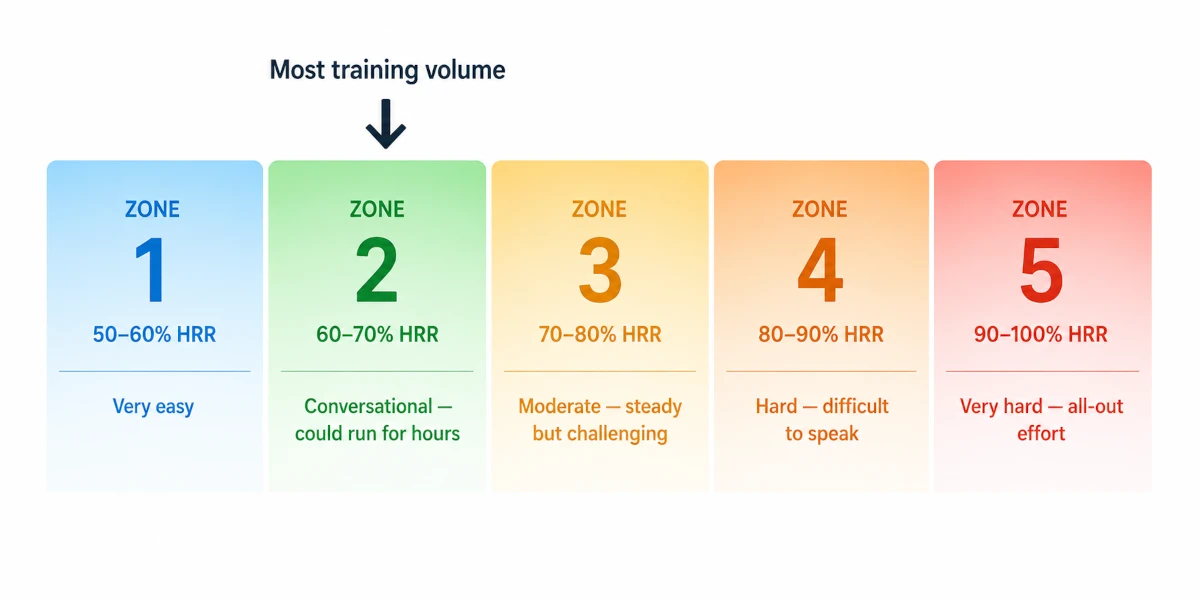
All 5 zones are calculated from your heart rate reserve using the Karvonen formula (the gap between your resting and max heart rate, not a percentage of max based on age alone), consistent with American Heart Association aerobic exercise intensity recommendations. Use the calculator to get your personal zone numbers, the table below uses general intensity descriptions as a guide.
| Zone | % HRR | Effort Feel | Primary Fuel | Best For |
|---|---|---|---|---|
| Zone 1 | 50–60% | Easy, walking pace | Fat | Active recovery, warmup/cooldown |
| Zone 2 | 60–70% | Comfortable, can hold conversation | Mostly fat | Aerobic base, fat burning, long runs |
| Zone 3 | 70–80% | Moderately hard, sentences get shorter | Mixed | Aerobic endurance (use sparingly) |
| Zone 4 | 80–90% | Hard, can speak a few words | Mostly carbs | Lactate threshold, tempo runs |
| Zone 5 | 90–100% | Maximum, cannot speak | Carbs | VO₂ max, speed intervals |
Zone 1: Recovery Running
Zone 1 is 50–60% of heart rate reserve, a comfortable effort that most people associate with a brisk walk or a slow jog. It doesn't drive significant fitness adaptations on its own, but it serves 2 important roles in a training week.
First, it's ideal for active recovery days between hard sessions, light movement that promotes blood flow and clears metabolic waste without adding meaningful training stress. Second, warmup and cooldown segments in Zone 1 prepare your cardiovascular system for harder efforts and help bring it down safely afterward.
Zone 2: The Engine Room
Zone 2 (60–70% HRR) is where most of your running mileage should happen, especially if you're building a base or training for endurance. At this intensity, your body runs primarily on fat, builds mitochondrial density in slow-twitch muscle fibers, and develops the aerobic capacity that underpins every other zone.
The hallmark of Zone 2 is that you can hold a full conversation, actual sentences, not single words. Your breathing is elevated but controlled. You feel like you could run for hours at this pace. For most recreational runners, this means significantly slower than their default "comfortable" pace.
This is the zone explored in detail in our fat burning heart rate zone guide and the Zone 2 training complete guide.
Zone 3: The Gray Zone
Zone 3 (70–80% HRR) is moderately hard: you can still speak, but in shorter bursts. It's the zone most recreational runners default to on their "easy" days when they push slightly more than they should.
The problem with Zone 3 is that it sits in an awkward middle ground: hard enough to accumulate meaningful fatigue and require 24–36+ hours of recovery, but not hard enough to deliver the adaptations you'd get from Zone 4–5 work. Over time, spending too much volume in Zone 3, also called "junk miles" or the "gray zone", leads to accumulated fatigue without commensurate fitness gains.
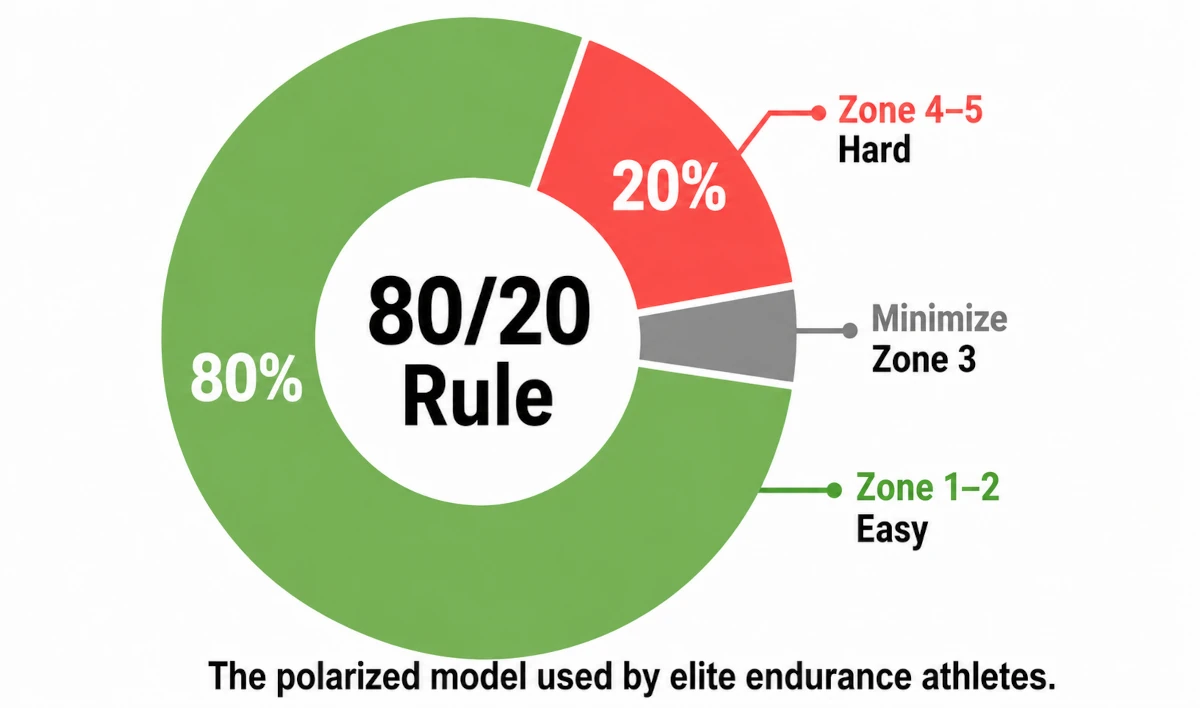
Zone 3 has its place in training (aerobic endurance runs, marathon pace work), but in the polarized training model, it's minimized in favor of more Zone 2 volume and sharper Zone 4–5 work.
Zone 4: The Tempo Zone
Zone 4 (80–90% HRR) is where tempo runs live. It's comfortably hard: your breathing is labored, and conversation is possible only in short phrases. This is your lactate threshold: the highest intensity at which your body can clear lactic acid as fast as it produces it.
Training at Zone 4 raises this threshold over time, which means you can run faster before fatigue sets in. That's directly valuable for any race from a 5K to a marathon. Classic Zone 4 workouts include 20–40 minute steady-state tempo runs and cruise intervals (3–5 × 8–12 minutes at threshold with short rest).
Recovery demand is significant. Most runners should include no more than 1–2 Zone 4 sessions per week, with Zone 1–2 runs between them.
Heart rate reserve isn't the only way to define that threshold zone. Joe Friel's LTHR-based zone system builds all 7 of its zones directly from a tested lactate threshold heart rate instead.
Zone 5: Speed and VO₂ Max
Zone 5 (90–100% HRR) is maximum intensity: you cannot speak, and you're working as hard as you can sustain. At this level, your VO₂ max, the ceiling of your aerobic power, is being directly trained.
Zone 5 work is typically done in short intervals: 400m to 1600m repeats at near-maximum effort with full recovery between sets. It builds speed, improves running economy at race pace, and raises the ceiling of aerobic performance. It's also highly taxing, most runners benefit from 1 Zone 5 session per week at most, with plenty of Zone 2 volume to support recovery.
How to Structure a Running Week by Zone
Here's a practical weekly structure for a runner doing 4 days per week, working toward half-marathon fitness:
| Day | Run Type | Zone | Duration |
|---|---|---|---|
| Monday | Easy run | Zone 2 | 40–50 min |
| Tuesday | Rest or cross-train | Zone 1 | – |
| Wednesday | Tempo run | Zone 4 | 35–45 min (20 min threshold effort) |
| Thursday | Easy run | Zone 2 | 35–45 min |
| Friday | Rest | – | – |
| Saturday | Long run | Zone 2 | 70–90 min |
| Sunday | Rest or recovery jog | Zone 1 | 20–30 min |
Tracking this structure over several weeks is where it pays off. A running log that imports directly from your GPS watch, like the free one at Run Hive, makes it easy to see whether your Zone 2 days are holding in Zone 2 and whether your Zone 4 sessions are trending the right way over a training block.
Common Heart Rate Zone Mistakes in Running
Most runners undo their own zone training with 1 of these 3 habits.
Running Zone 2 too fast. The most common error. Most runners have heard "easy runs should feel easy" but anchor their pace to habit rather than a heart rate target. If you're in Zone 3 or even Zone 4 on your "easy" days, you're accumulating more fatigue than the training stimulus warrants.
Ignoring heat and humidity. In warm conditions, the same pace requires more cardiac output. Your heart rate will be higher than usual at a given speed. Don't fight this by pushing harder, slow down to keep your heart rate in zone.
Using wrist optical HR for intensity work. Wrist-based optical heart rate monitors lag by 30–60 seconds at high intensities, making them unreliable for Zone 4–5 intervals. A chest strap (Garmin, Polar, Wahoo) gives near-instantaneous readings that are far more accurate for threshold and speed work.
Frequently Asked Questions
What heart rate zone is best for running to lose weight?
Zone 2 (60–70% of heart rate reserve) is the most effective zone for fat loss through running. At this intensity, fat is the primary fuel source. The advantage over higher zones goes beyond fat-burning efficiency per minute. You can sustain Zone 2 for much longer sessions, which means more total fat burned per workout. Aim for 45–90 minute Zone 2 runs, 3–4 times per week, for meaningful fat loss results.
What is the best heart rate zone for marathon training?
Marathon training is mostly built on Zone 2. Most elite marathon coaches prescribe 80% of weekly mileage in Zone 1–2 (easy, conversational pace) and 20% at Zone 4–5 (tempo and interval work). Zone 2 builds the aerobic base and fatigue resistance required to run 26.2 miles. Higher-intensity work builds speed and lactate threshold, but without a Zone 2 foundation, those sessions don't compound effectively.
How much of running training should be in Zone 2?
Research on elite endurance athletes and the polarized training model reliably points to 75–85% of training volume in Zone 1–2, with the remaining 15–25% at Zone 4–5. This 80/20 split is sometimes called polarized training. Zone 3, the "moderate hard" gray zone, tends to be the least productive zone for most runners because it's too taxing to recover from quickly but not intense enough to drive the adaptations you'd get from true threshold work.
Why does my heart rate spike during easy runs?
Several factors cause HR spikes during what should be easy running: heat and humidity (HR is higher in warm conditions even at the same pace), terrain (uphills drive HR up quickly), inadequate warmup (HR takes 5–10 minutes to stabilize), dehydration, and in new runners, underdeveloped aerobic efficiency. If your HR repeatedly spikes beyond Zone 2 during what feels like easy effort, slowing down, even to a walk-jog, is the correct response, not pushing through.
What does running in Zone 4 do?
Zone 4 (80–90% of heart rate reserve, or HRR) is the lactate threshold zone: the highest intensity your body can sustain without lactate accumulating faster than it's cleared. Training in Zone 4 raises your lactate threshold, which means you can run faster before lactic acid builds up. This is the primary zone for tempo runs. Zone 4 work is highly effective but demands significant recovery. Most runners should do no more than 1–2 Zone 4 sessions per week, with easy Zone 1–2 days in between.
This article is for informational purposes only and does not constitute medical advice. Please consult a physician or certified fitness professional before starting a new exercise program.