
What Zone 2 Is
Zone 2 is a heart rate training zone, not a pace, not a feeling, and not a percent effort. Specifically, it's the range from 60–70% of your heart rate reserve, the gap between your resting and maximum heart rate. At this intensity, your aerobic system runs on its preferred fuel: fat. Your breathing is elevated but controlled. You could carry on a conversation. You feel like you could keep going indefinitely.
It's worth distinguishing Zone 2 from what most people call "easy" running or riding. Easy is subjective. Zone 2 is a measurable physiological state. Many people who think they're doing easy cardio have drifted into Zone 3, past the metabolic boundary where fat oxidation starts giving way to carbohydrates. The difference matters for training adaptation.
There are 5 heart rate zones in the Karvonen system, each representing a different metabolic state. Zone 1 is light activity. Zone 2 is light aerobic. Zone 3 is moderate aerobic. Zones 4 and 5 are threshold and maximum intensity. Zone 2 isn't the bottom. It's the engine room.
The Physiology: Why Zone 2 Works
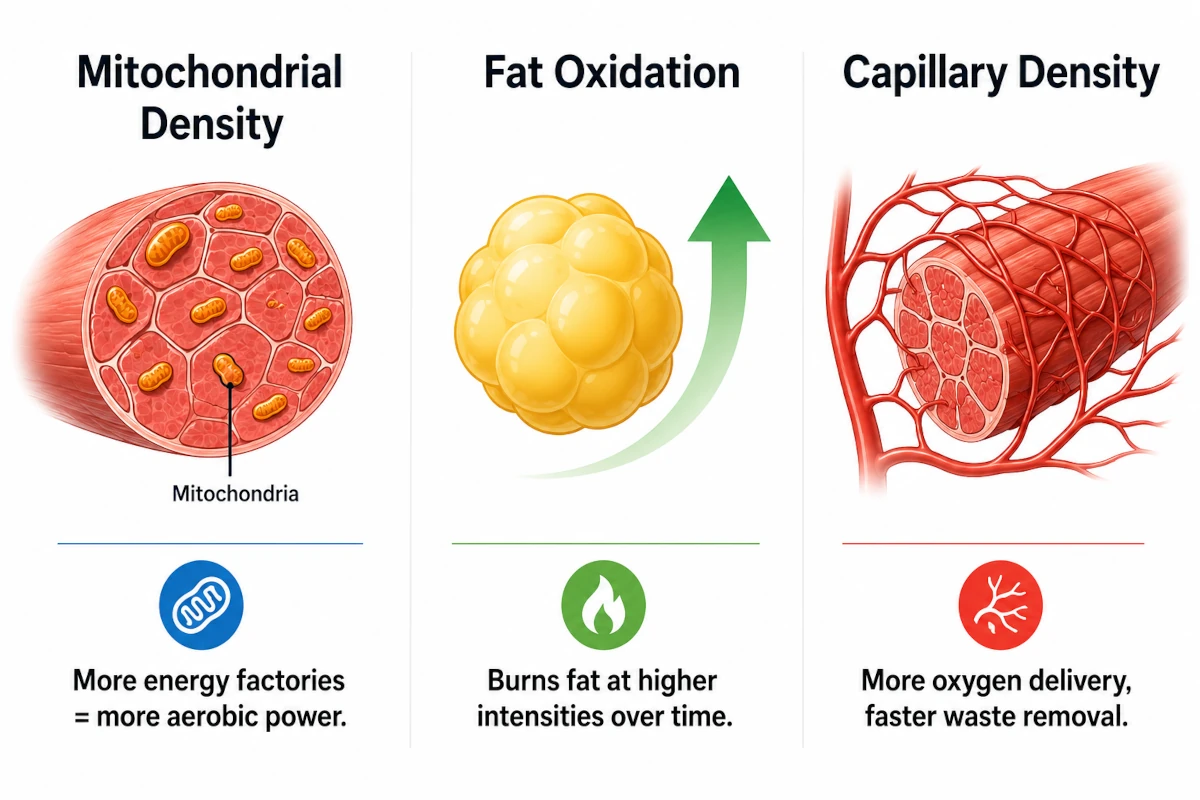
The core adaptation from sustained Zone 2 training is mitochondrial biogenesis, the creation of new mitochondria inside your muscle cells, alongside improved fat oxidation and greater capillary density around your muscle fibers. These are structural changes that take weeks to begin and months to fully develop, which is why Zone 2 rewards patience over intensity.
For the full breakdown of what's happening in your body, how slow-twitch fibers factor in, and the research behind it, see Zone 2 Training: What It Is, Why It Works, and How to Do It.
How to Find Your Zone 2
The most accurate way to calculate Zone 2 is the Karvonen formula, which uses your resting heart rate alongside your age-estimated maximum (see the 220 minus age calculator if you need that number quickly):
Zone 2 Upper = RHR + (0.70 × (MHR − RHR))
Where MHR = 220 − Age
Here's a worked example for a 42 year-old with a resting heart rate of 58 bpm:
- Max HR = 220 − 42 = 178 bpm
- Heart Rate Reserve = 178 − 58 = 120 bpm
- Zone 2 lower = 58 + (0.60 × 120) = 130 bpm
- Zone 2 upper = 58 + (0.70 × 120) = 142 bpm
The Talk Test: A Simple Field Check
If you don't have a heart rate monitor, the talk test is a reasonable proxy. At Zone 2 intensity, you should be able to speak in complete, grammatically correct sentences without pausing mid-sentence to breathe. A single phrase or grunt means you've gone past Zone 2. Comfortable silence might mean you haven't reached it yet.
This isn't as precise as a monitor, but it captures the right physiological state. The metabolic boundary between Zone 2 and Zone 3 correlates with the ventilatory threshold, the point where your breathing starts increasing disproportionately to effort. The talk test is a surprisingly reliable proxy for that threshold.
What Zone 2 Feels Like (And Why It's Uncomfortable)
Most people's first Zone 2 session is a disappointment. Not because it's hard. It isn't. It's because it's embarrassingly slow. Runners who jog at 9-minute miles find they need to drop to 12-minute miles to stay in Zone 2. Cyclists accustomed to tempo rides find themselves spinning at what feels like a recovery pace.
This is not a sign that Zone 2 isn't working. It's a sign that your aerobic base is underdeveloped relative to your anaerobic capacity. You've likely been training at intensities that develop your ability to push hard, but not your ability to go long efficiently. Zone 2 fixes the foundation.
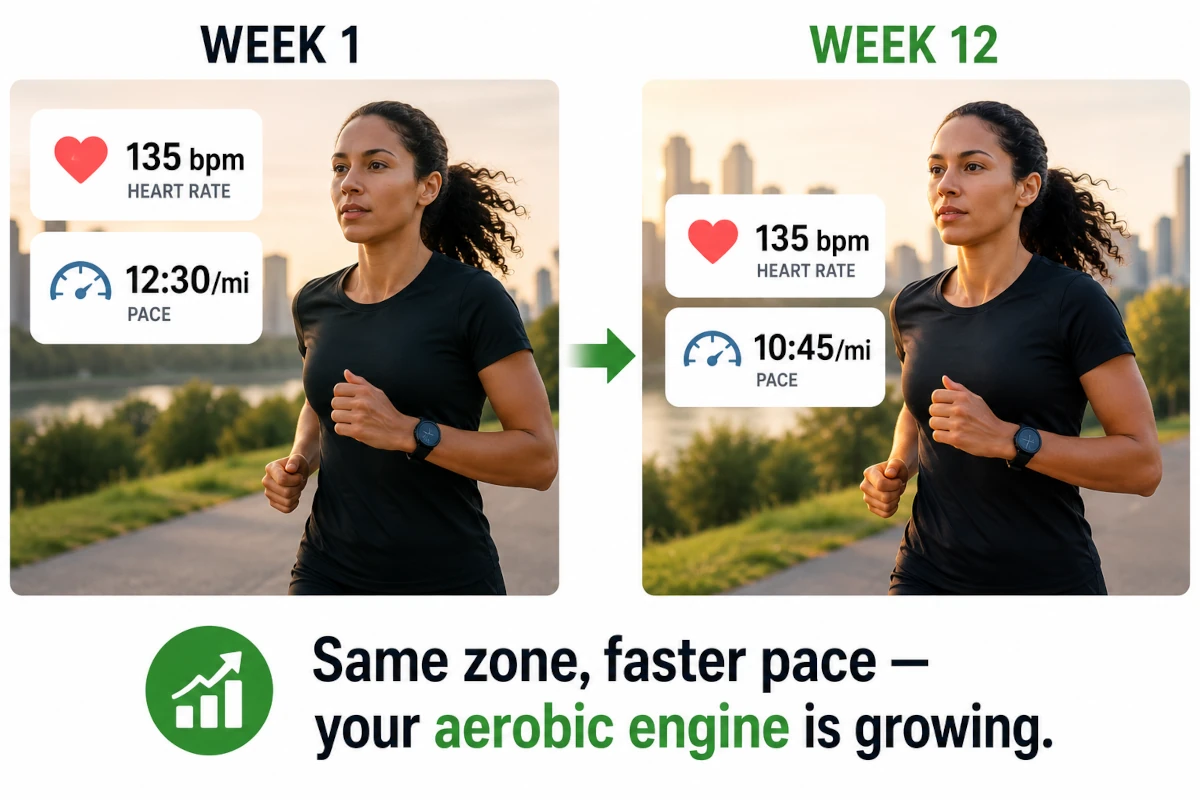
The good news is that this changes, and it changes noticeably. Within 8–12 weeks of steady Zone 2 training, most people find that they can cover the same distance at a higher heart rate, or the same heart rate at a meaningfully faster pace. Your Zone 2 pace improves because your aerobic engine is growing.
Session Structure and Protocols
Zone 2 sessions are deliberately simple. No intervals, no tempo blocks, no progression runs. You warm up, find your zone, and hold it. The only variable is duration.
Here's a sensible progressive block for someone building a Zone 2 base over 8 weeks:
| Weeks | Sessions / Week | Duration per Session |
|---|---|---|
| 1–2 | 3 | 30–40 min |
| 3–4 | 3–4 | 45–55 min |
| 5–6 | 4 | 55–70 min |
| 7–8 | 4–5 | 60–90 min |
Any aerobic activity works: running, cycling, rowing, swimming, hiking, the elliptical. The exercise modality matters far less than staying within the zone. Many people find that cycling or elliptical training allows them to maintain Zone 2 more easily than running, because impact and terrain don't spike heart rate unpredictably.
The 80/20 Split
If you're already doing some higher-intensity training, intervals, tempo runs, HIIT, Zone 2 doesn't replace it: it anchors it. The most well-supported model for endurance development is the polarized approach: roughly 80% of weekly training volume in Zone 1–2, and 20% at Zone 4–5 intensity, used by many of the world's top endurance athletes across running, cycling, triathlon, and rowing.
For the full science behind the split, the "black hole" problem most recreational athletes fall into, and practical tips for staying in Zone 2 when it feels too slow, see Zone 2 Training: What It Is, Why It Works, and How to Do It.
Who Benefits Most from Zone 2
Zone 2 pays off for 3 groups in particular, for 3 different reasons.
Endurance athletes (runners, cyclists, triathletes) benefit the most obviously, since Zone 2 directly improves the aerobic engine that powers all endurance events. But Zone 2 is also valuable for general fitness because it improves cardiovascular health, lowers resting heart rate, and builds a foundation that makes any subsequent higher-intensity exercise more productive.
People focused on fat loss benefit because Zone 2 is the intensity at which fat oxidation is highest per unit time, particularly over long sessions. The fat burning heart rate zone guide covers this in detail, or see which heart rate zone burns the most fat for the short version.
Anyone new to regular exercise benefits because Zone 2 is low enough impact to be done frequently without injury or excessive fatigue, which means it can be sustained as a habit.
The Long Game
Zone 2 training is not a shortcut. It won't make you faster in a month. The mitochondrial adaptations it produces take 8–12 weeks to become measurable and 6–12 months to fully develop. But they're also highly durable, aerobic base built through disciplined Zone 2 work is more persistent than fitness built through high-intensity training alone.
The athletes who've been training for years and seem to improve constantly without burning out aren't running harder intervals. They're running more Zone 2. The aerobic base is what lets everything else compound.
Frequently Asked Questions
What is the difference between Zone 2 and easy running?
They're often the same thing, but not always. Zone 2 is defined by heart rate, specifically 60–70% of your heart rate reserve using the Karvonen formula. Easy running is a subjective pace. If you measure easy runs with a heart rate monitor and find you're above Zone 2, you're running too hard to get Zone 2 benefits. For most runners, truly easy pace is slower than it feels.
How long should Zone 2 sessions be?
Most research and coaching protocols recommend 45–90 minutes per Zone 2 session for meaningful aerobic adaptation. Sessions under 30 minutes are too short to fully shift your body into fat oxidation mode. If you're new to Zone 2, starting with 30–45 minutes and building to 60–90 minutes over several weeks is a sensible approach.
Can you do Zone 2 training every day?
Yes. Zone 2 is low enough stress that daily sessions are possible for many people, especially if you're doing different activities (e.g., cycling one day, walking the next). That said, most people benefit from 3–5 sessions per week with at least 1 rest day. Listen to your body: chronic fatigue is a sign you're accumulating more stress than you're recovering from.
When should you do high-intensity training vs Zone 2?
A common evidence-based split is 80% Zone 2 (or lower) and 20% higher intensity (Zone 4–5). This '80/20 principle' is used by many elite endurance athletes. High-intensity work builds speed, VO2 max, and lactate threshold, but it requires more recovery. Zone 2 builds the aerobic base that makes high-intensity work more productive. Without an aerobic base, high-intensity intervals don't compound nearly as well.
How do you know if you're in Zone 2?
The most reliable test is the talk test: you should be able to speak in complete sentences without pausing for breath. If you're huffing between words, you've drifted out of Zone 2. For more precision, use a heart rate monitor and target 60–70% of your heart rate reserve (calculated with the Karvonen formula using your age and resting heart rate). The Maffetone Method, 180 minus your age, gives a rough ceiling for Zone 2 heart rate.
This article is for informational purposes only and does not constitute medical advice. Please consult a physician or certified fitness professional before starting a new exercise program.