

The Problem With How Most People Train for Weight Loss
Most people trying to lose weight through cardio make 1 of 2 mistakes. They go too hard, chasing a hard effort every session until they can't sustain 3 workouts a week, let alone 6. Or they go too easy, walking at a pace that barely raises a sweat, wondering a month later why nothing's changed.
Both mistakes come from the same place: nobody told them which heart rate zone does the work, or what "doing the work" even means for fat loss. The answer is a specific, findable range, and most people are training outside it without knowing.
The 5 Heart Rate Zones, Explained
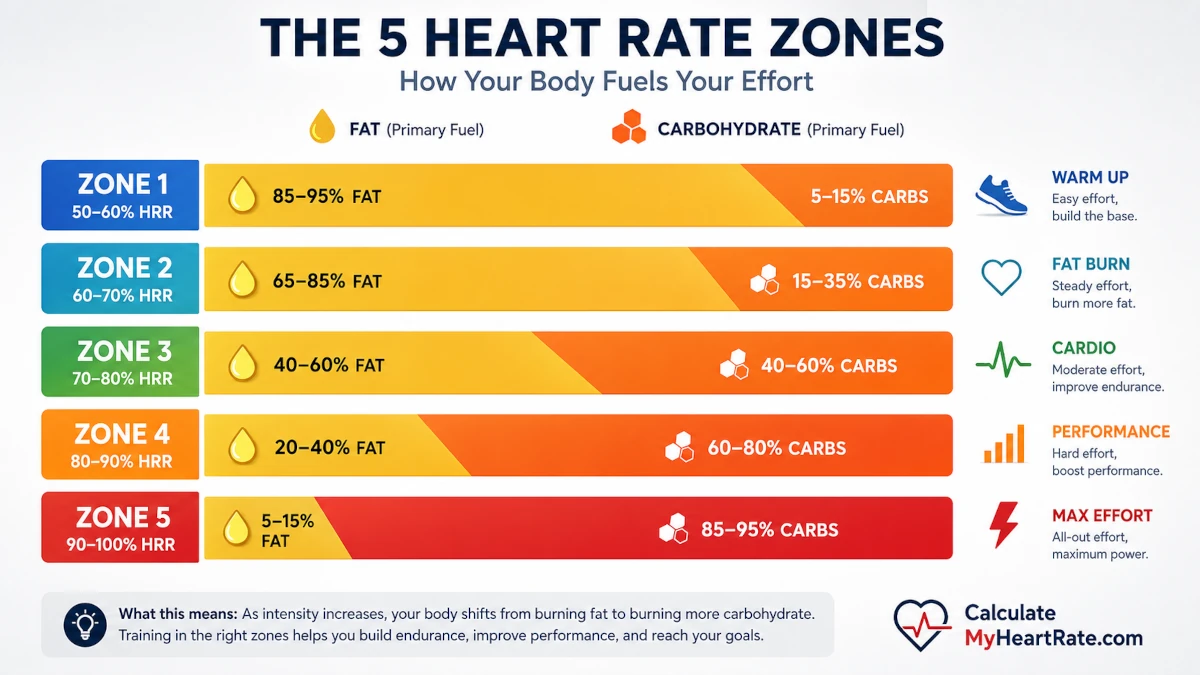
Heart rate zones are usually described as percentages of heart rate reserve (HRR), the gap between your resting heart rate and your max heart rate. 5 zones cover the full range, from barely-moving to all-out effort.
| Zone | % HRR | Feels Like | Talk Test |
|---|---|---|---|
| Zone 1 (Warm Up) | 50–60% | Easy walking pace | Full conversation, easily |
| Zone 2 (Fat Burn) | 60–70% | Steady, sustainable jog or brisk walk | Can hold a conversation, breathing noticeably deeper |
| Zone 3 (Cardio) | 70–80% | Moderate run, working but controlled | Short sentences only |
| Zone 4 (Performance) | 80–90% | Hard, sustained effort | 1 or 2 words at a time |
| Zone 5 (Max Effort) | 90–100% | All-out sprint | Can't talk at all |
These percentages are calculated using the Karvonen formula, which factors in your resting heart rate as well as your age. For the full walkthrough of the math, see how to calculate your heart rate zones.
Zone 2 vs. Zone 3: Where Fat Burning Happens
Zone 2 gets a bigger share of its calories from fat than Zone 3 or 4 does, but that doesn't mean it burns the most fat, and it definitely doesn't mean it burns the most total calories. Those are 3 different things, and mixing them up is where most fat-burning-zone advice falls apart.
At rest and at low intensities, your body runs mostly on fat. As intensity climbs, it shifts toward carbohydrate, since glucose delivers energy faster than fatty acids can be broken down. That shift happens gradually, not all at once, and it's driven by exercise intensity more than anything else.
Researchers have identified roughly where the balance tips. A study in the Journal of Applied Physiology of 300 healthy adults found that maximal fat oxidation, the point where your body is burning fat at its highest absolute rate, occurred on average at around 48% of VO2 max, or roughly 62% of max heart rate. On this site's heart rate reserve scale, that's easier than Zone 2 for most people. For a 40-year-old with a resting heart rate of 60, 62% of max is about 112 bpm, while Zone 2 starts at 132 bpm. Fitter people peak at higher intensities. In a study of trained cyclists, the peak came at about 74% of max heart rate, which lands inside Zone 2. Push past that point and your body increasingly favors carbohydrate, not because fat burning switches off, but because it can't keep pace with the energy demand at higher effort.
For a more focused answer to the "which zone burns the most fat" question on its own, including how Zone 2 compares with Zone 3, see our fat burning heart rate zone guide.
Why the "Fat Burn Zone" Myth Persists (And What to Do Instead)
Here's the mix-up: because easier zones get a bigger share of their calories from fat, people assume they burn more fat, period. But percentage isn't the same as total. A harder effort in Zone 3 or 4 burns fewer of its calories from fat, but it burns more calories overall, in the same amount of time. Do the math on total fat calories burned, and the gap between zones narrows a lot, sometimes disappearing entirely, depending on duration and intensity.
What drives weight loss is total caloric deficit, not which fuel your muscles happened to use during the workout. The American College of Sports Medicine's position stand on physical activity and weight loss doesn't recommend a specific fat-burning intensity. It recommends a volume of activity, generally 150 to 250+ minutes a week of moderate-to-vigorous exercise, because total energy expenditure is what drives weight loss.
So why does zone training still matter? Not because of the fuel mix, but because of adherence. Zone 2 is low-impact and repeatable. You can do it most days without breaking down, which means you rack up the weekly volume that produces results. A brutal workout you can only manage once a week doesn't out-total a moderate one you can do 5 times. For more on how Zone 2 specifically works as a training tool, including how to find your personal range, see our dedicated guide.
How to Find Your Personal Heart Rate Zones for Weight Loss
The Karvonen formula finds your personal zones by factoring in your resting heart rate on top of your estimated max heart rate, which reflects your fitness level as well as your age. Not sure if your own resting heart rate number is high, low, or right where it should be? See what is a good resting heart rate for the full breakdown by age and fitness level.
Compare that to the zones shown on a treadmill panel, which are almost always based on 220 minus your age. That formula alone has a standard deviation of roughly ±10-12 bpm, and it doesn't account for your fitness level at all. Two people the same age can have meaningfully different real-world zones despite getting an identical number from the panel.
- Estimated Max HR = 220 − 35 = 185 bpm
- Heart rate reserve = 185 − 68 = 117 bpm
- Zone 2 (60–70%) = 68 + (0.60–0.70 × 117) = 138–150 bpm
For this person, that's a real Zone 2 of 138 to 150 bpm, not the generic "60–70% of 185" a treadmill panel would show without the resting heart rate adjustment. You don't need to run this math by hand. Enter your age and resting heart rate into the Karvonen formula calculator and it returns all 5 zones instantly. If you'd rather start from a table than the raw formula, fat burning heart rate by age lays out Zone 2 ranges for common ages and resting heart rates side by side.
The Best Zone Combination for Sustainable Weight Loss
The most sustainable approach isn't picking 1 zone and living there. It's building a week around Zone 2 as the base, then layering in harder work on top of it. Here's a starting week with 3 Zone 2 days:
| Day | Zone | Purpose |
|---|---|---|
| Mon, Wed, Fri | Zone 2 | Sustainable volume, low injury risk, the bulk of your weekly minutes |
| Sat | Zone 3-4 | 1 harder session for extra caloric burn and a metabolic stimulus |
| Tue, Thu, Sun | Rest or light activity | Recovery, so the Zone 2 sessions stay easy |
Zone 2 forms the base because you can recover from it fast enough to do it often, which is what accumulates weekly volume. The 1 harder session adds extra calorie burn that Zone 2 alone won't match minute for minute. Neither piece works as well without the other: all Zone 2 caps your total calorie burn, and all high intensity burns you out before you rack up enough volume to matter. As your recovery allows, add Zone 2 sessions on the light days, up to 4 or 5 a week.
How to Stay in Your Zone During a Workout
Wearables: convenient, but optical wrist sensors can drift by 10+ bpm during faster efforts or in cold weather. Treat the number as a helpful estimate, not an exact reading, especially in Zone 3 and above.
The talk test: a low-tech backup that works surprisingly well. If you can hold a full conversation, you're likely in Zone 1 or 2. If you're down to short sentences, you're in Zone 3. One or 2 words at a time puts you in Zone 4 or beyond.
RPE (Rate of Perceived Exertion): rate your effort on a scale of 1 to 10. Zone 2 generally sits around a 3 to 4, noticeable but conversational.
Manual calculation with the Karvonen formula remains the most reliable baseline, since it's not affected by sensor placement, weather, or motion artifacts the way wearables are. Use your calculated zones as the reference point, and treat wearable readings and the talk test as ways to sanity-check in the moment. For more on where wearable readings drift from your actual zones, see our guide to wearable heart rate accuracy.
Frequently Asked Questions
Which heart rate zone is best for weight loss?
Zone 2 (60-70% of heart rate reserve) is generally the best default because it's sustainable enough to do often and fat still supplies a large share of its fuel. Total weekly calorie burn matters more than the fuel mix in any single session, so the most effective approach combines regular Zone 2 sessions with 1 harder Zone 3-4 session per week.
Does Zone 2 burn more fat than Zone 3 or Zone 4?
Zone 2 gets a bigger share of its calories from fat, but Zone 3 and 4 burn more total calories per minute, some of which still come from fat. Over an equal amount of time, the total fat burned between zones is often closer than people expect. The real advantage of Zone 2 is that you can sustain it longer and recover from it faster.
How many days a week should I train in Zone 2 for weight loss?
Start with 3 days of Zone 2 work a week and build toward 4 or 5, layered with 1 harder Zone 3-4 session for additional caloric burn. The right number depends on your recovery and how much weekly volume you can sustain without burning out.
Is the fat-burning zone shown on treadmills accurate?
Not usually. Most gym equipment estimates your zones from the 220-minus-age formula, which has a wide margin of error and ignores your resting heart rate entirely. The Karvonen formula, which factors in your resting heart rate, gives a more personalized and accurate range.
Can I lose weight without training in my fat-burning zone?
Yes. Weight loss ultimately comes down to a sustained caloric deficit, not which heart rate zone you trained in. Any zone that lets you exercise consistently and burn calories contributes to that deficit. Zone 2 is favored mainly because it's sustainable enough to do often, not because it's the only zone that works.
How long until I see weight loss results from heart rate zone training?
Most people notice measurable changes in resting heart rate and workout capacity within 4 to 8 weeks of consistent training. Visible weight loss results depend more on overall caloric deficit and consistency than on the specific zone, but a sustainable Zone 2 base combined with weekly harder sessions is a routine most people can stick with long enough to see results.
This article is for informational purposes only and isn't a substitute for personalized medical or fitness advice. If you're new to exercise or have a heart condition, check with a physician before starting a new cardio program. Results vary by individual.