

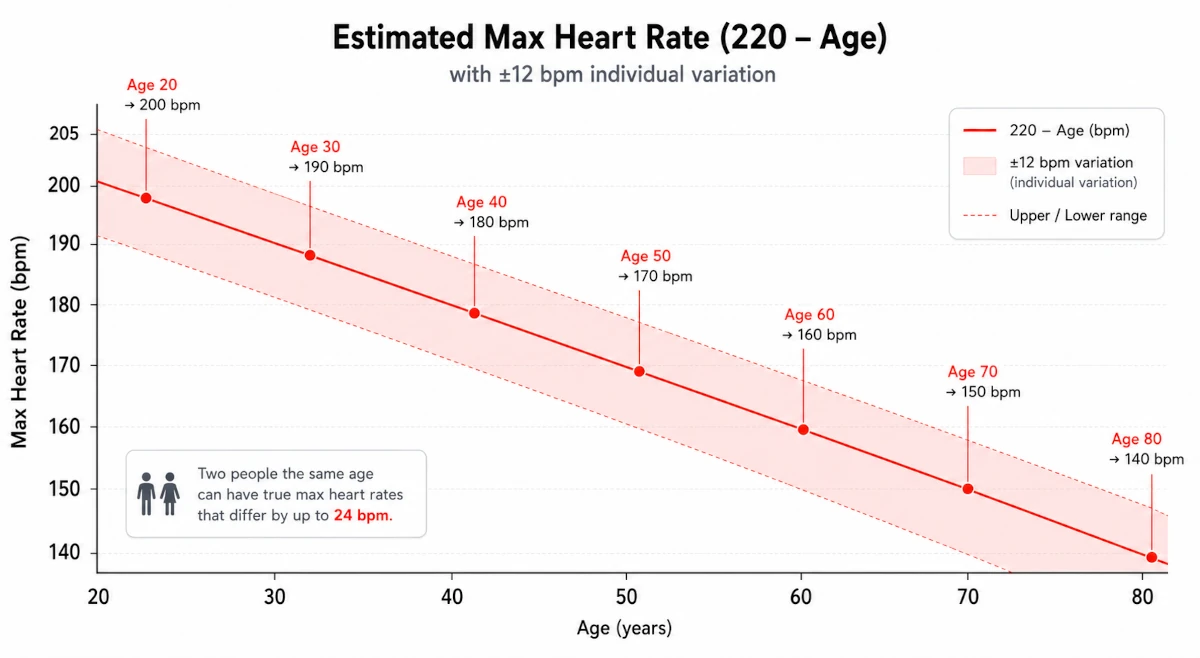
You're 45. 220 minus age puts your max heart rate at 175 bpm. The Tanaka formula says 177, and the Nes formula says 182. None of them measured your heart, and your true number can sit 10 to 12 bpm either side of all 3. Max heart rate by age is always an estimate, and the formula you pick decides which estimate you get. Below is what max heart rate is, a chart for every age from 15 to 85, and how to test your own.
What Is Maximum Heart Rate?
Maximum heart rate (MHR) is the highest number of beats per minute your heart can sustain during all-out physical effort. It represents the ceiling of your cardiovascular system's output capacity. Above MHR, your heart cannot beat faster regardless of how hard you push: it's a physiological limit, not a fitness target.
MHR is primarily determined by genetics and declines with age. Unlike resting heart rate, which can improve significantly with aerobic training, MHR stays relatively fixed once you're past your early 20s. You can't train it higher. What you can do is train your body to work more efficiently within the range you have.
Max Heart Rate by Age: Estimated Chart
The chart below lists estimated max heart rate for every age from 15 to 85, using the 4 most common formulas. 220 minus age is the one on most gym charts and watches. Tanaka (208 − 0.7 × age) and Nes (211 − 0.64 × age) fit measured values better for most adults, especially past 40. Gulati (206 − 0.88 × age) was built from women's data. Every column is a population average, so your real number can sit 10 to 12 bpm either side of it.
| Age | 220 − Age | Tanaka | Nes | Gulati (women) |
|---|---|---|---|---|
| 15 | 205 | 198 | 201 | 193 |
| 16 | 204 | 197 | 201 | 192 |
| 17 | 203 | 196 | 200 | 191 |
| 18 | 202 | 195 | 199 | 190 |
| 19 | 201 | 195 | 199 | 189 |
| 20 | 200 | 194 | 198 | 188 |
| 21 | 199 | 193 | 198 | 188 |
| 22 | 198 | 193 | 197 | 187 |
| 23 | 197 | 192 | 196 | 186 |
| 24 | 196 | 191 | 196 | 185 |
| 25 | 195 | 191 | 195 | 184 |
| 26 | 194 | 190 | 194 | 183 |
| 27 | 193 | 189 | 194 | 182 |
| 28 | 192 | 188 | 193 | 181 |
| 29 | 191 | 188 | 192 | 180 |
| 30 | 190 | 187 | 192 | 180 |
| 31 | 189 | 186 | 191 | 179 |
| 32 | 188 | 186 | 191 | 178 |
| 33 | 187 | 185 | 190 | 177 |
| 34 | 186 | 184 | 189 | 176 |
| 35 | 185 | 184 | 189 | 175 |
| 36 | 184 | 183 | 188 | 174 |
| 37 | 183 | 182 | 187 | 173 |
| 38 | 182 | 181 | 187 | 173 |
| 39 | 181 | 181 | 186 | 172 |
| 40 | 180 | 180 | 185 | 171 |
| 41 | 179 | 179 | 185 | 170 |
| 42 | 178 | 179 | 184 | 169 |
| 43 | 177 | 178 | 183 | 168 |
| 44 | 176 | 177 | 183 | 167 |
| 45 | 175 | 177 | 182 | 166 |
| 46 | 174 | 176 | 182 | 166 |
| 47 | 173 | 175 | 181 | 165 |
| 48 | 172 | 174 | 180 | 164 |
| 49 | 171 | 174 | 180 | 163 |
| 50 | 170 | 173 | 179 | 162 |
| 51 | 169 | 172 | 178 | 161 |
| 52 | 168 | 172 | 178 | 160 |
| 53 | 167 | 171 | 177 | 159 |
| 54 | 166 | 170 | 176 | 158 |
| 55 | 165 | 170 | 176 | 158 |
| 56 | 164 | 169 | 175 | 157 |
| 57 | 163 | 168 | 175 | 156 |
| 58 | 162 | 167 | 174 | 155 |
| 59 | 161 | 167 | 173 | 154 |
| 60 | 160 | 166 | 173 | 153 |
| 61 | 159 | 165 | 172 | 152 |
| 62 | 158 | 165 | 171 | 151 |
| 63 | 157 | 164 | 171 | 151 |
| 64 | 156 | 163 | 170 | 150 |
| 65 | 155 | 163 | 169 | 149 |
| 66 | 154 | 162 | 169 | 148 |
| 67 | 153 | 161 | 168 | 147 |
| 68 | 152 | 160 | 167 | 146 |
| 69 | 151 | 160 | 167 | 145 |
| 70 | 150 | 159 | 166 | 144 |
| 71 | 149 | 158 | 166 | 144 |
| 72 | 148 | 158 | 165 | 143 |
| 73 | 147 | 157 | 164 | 142 |
| 74 | 146 | 156 | 164 | 141 |
| 75 | 145 | 156 | 163 | 140 |
| 76 | 144 | 155 | 162 | 139 |
| 77 | 143 | 154 | 162 | 138 |
| 78 | 142 | 153 | 161 | 137 |
| 79 | 141 | 153 | 160 | 136 |
| 80 | 140 | 152 | 160 | 136 |
| 81 | 139 | 151 | 159 | 135 |
| 82 | 138 | 151 | 159 | 134 |
| 83 | 137 | 150 | 158 | 133 |
| 84 | 136 | 149 | 157 | 132 |
| 85 | 135 | 149 | 157 | 131 |
All values are in bpm. For training zones at each age, not only max heart rate, see the target heart rate by age chart, or use the calculator with your own resting heart rate for a personalized result.
Why the Formula Is Often Wrong
The 220-minus-age formula was a rough approximation popularized in the early 1970s, not the result of a dedicated study. Research since then puts its standard deviation at roughly ±10–12 bpm. For a 40-year-old with an estimate of 180, about 2 in 3 people land between 168 and 192 bpm, and some fall as low as 160 or as high as 200. If you've ever hit a heart rate your device called "impossible" for your age, this is why.
The formula also ignores sex, medications (beta-blockers lower max heart rate significantly, see our guide to training on beta-blockers), and genetic variation. Where it came from and where it fails most are covered in our 220 minus age formula guide.
Better Alternatives to 220 Minus Age
Newer formulas use a smaller age coefficient, which fits measured values better, especially past 40. Tanaka (208 − 0.7 × age) comes from a meta-analysis of 351 studies covering 18,712 subjects. Gellish (207 − 0.7 × age) gives nearly the same numbers, and the same study's Oakland nonlinear formula (191.5 − 0.007 × age²) models the faster decline at older ages. Nes and Gulati are in the chart above.
The formulas differ by about 6 bpm at age 20, agree closely around age 40, and drift apart again to about 8–9 bpm by age 70. None of them removes individual variation. For which one to use, the max heart rate calculator comparison covers each formula in detail.
How to Test Your Actual Maximum Heart Rate
The only way to know your true MHR is to reach it. There are a few approaches, ranging from clinical to DIY:
Laboratory VO2 max test: A graded exercise test performed on a treadmill or bike with metabolic monitoring. The gold standard. Finds true MHR while also measuring VO2 max, ventilatory thresholds, and fat oxidation. Available through university exercise science labs, cardiac rehab programs, and some sports performance clinics.
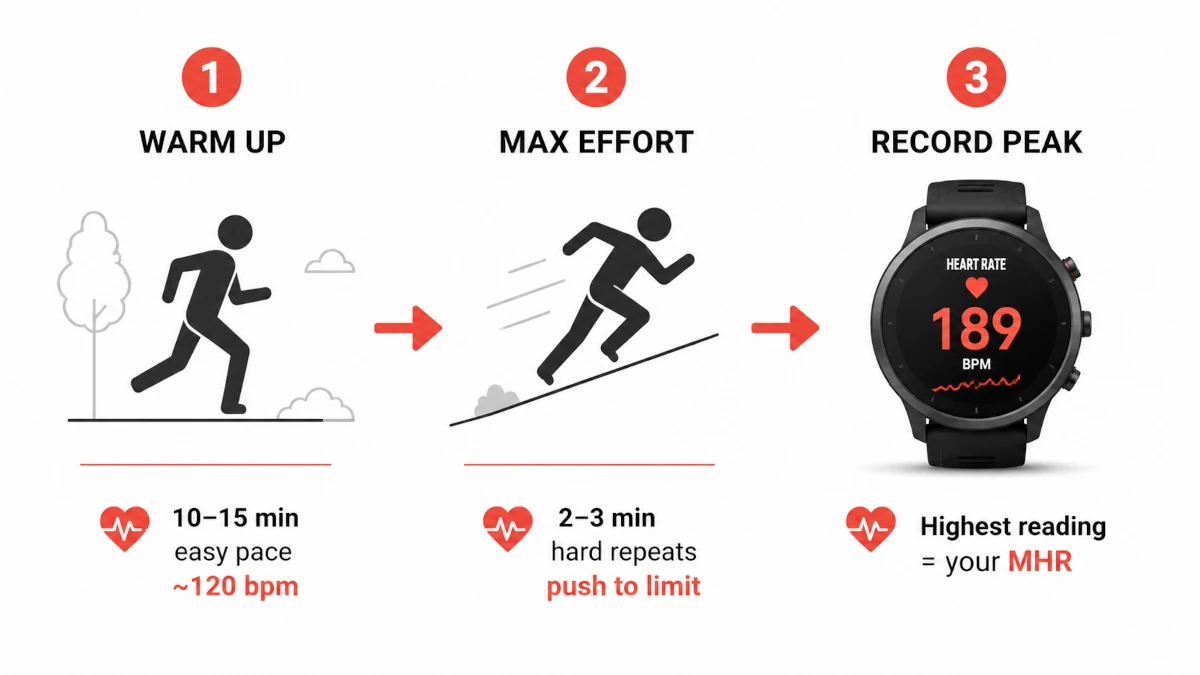
Supervised field test: After a thorough 10–15 minute warmup, perform 2 or 3 hard uphill repeats of 2–3 minutes each at near-maximum effort, with brief jogging recovery between them. The highest reading on your heart rate monitor during or immediately after the final set is a reliable practical MHR estimate. A heart rate chest strap is more accurate than an optical wrist monitor at high intensities.
Race-derived MHR: A well-executed 5K or 10K race at full effort will often drive heart rate close to, or at, true maximum. If you race hard and regularly monitor heart rate, your peak race reading is a reasonable real-world MHR estimate.
Note: maximal testing is appropriate for healthy, trained individuals. If you're new to exercise, have cardiovascular risk factors, or are over 45 without a recent physical, consult a physician before performing any maximal effort test.
How MHR Is Used in Training
Maximum heart rate matters for training primarily as the upper anchor in zone calculation. The percentage-of-MHR method and the more accurate heart rate reserve method (Karvonen formula) both start with an MHR estimate.
The Karvonen formula improves on raw MHR percentage, the approach used in standard American Heart Association exercise guidelines, by also incorporating resting heart rate. This accounts for the meaningful physiological difference between 2 people who have the same MHR but different fitness levels and cardiovascular efficiency. A resting heart rate of 48 bpm vs. 72 bpm at the same MHR produces different zone thresholds, and the Karvonen formula captures that distinction correctly.
Frequently Asked Questions
What is the average max heart rate for a 40-year-old?
Using the 220-minus-age formula, the estimated MHR for a 40-year-old is 180 bpm. The standard deviation around that estimate is about 10–12 bpm, so about 2 in 3 40-year-olds land between roughly 168 and 192 bpm. Some fall as low as 160 or as high as 200, depending on genetics and other factors.
Can max heart rate increase with training?
No. Maximum heart rate is largely determined by genetics and age, and training does not significantly increase it. What training does improve is your ability to work closer to your max for longer periods, and it lowers your resting heart rate, which increases your heart rate reserve (the usable range). A lower resting heart rate with the same max HR means more usable range for training zones.
Is a lower max heart rate dangerous?
Not on its own. Max heart rate naturally declines with age and varies by individual. Endurance training can lower max heart rate slightly, so a fit person can have a lower max than a sedentary peer of the same age. A low MHR only becomes a clinical concern if it's caused by an underlying condition (like sick sinus syndrome), accompanied by symptoms like dizziness or fainting, or if it drops suddenly without explanation. If concerned, consult a physician.
How accurate is the 220-minus-age formula?
The formula has a standard deviation of about ±10–12 bpm, which means roughly 68% of people will have an actual MHR within 10–12 beats of the estimate. About 32% will be outside that range. For training zone purposes, an error of even 10 bpm can shift your zones significantly, which is why the Karvonen formula (which incorporates resting heart rate) tends to give more accurate training zones than simple MHR percentage calculations.
What is the most accurate way to find my maximum heart rate?
A laboratory VO2 max test with direct measurement is the gold standard. Outside a lab, a graded exercise test (GXT) supervised by a clinician or sports scientist is next best. For DIY field testing: after a thorough warmup, run hard uphill for 2–3 minutes, recover briefly, then repeat at maximum effort. The highest reading you see is your practical MHR. This should only be done by fit, healthy individuals, not people new to exercise or with cardiovascular risk factors.
Once you have a max heart rate from 1 of these formulas, this step-by-step guide shows exactly where that number goes in the Karvonen calculator and how it combines with your resting heart rate.
This article is for informational purposes only and does not constitute medical advice. Consult a physician before performing maximal exercise tests, especially if you have cardiovascular risk factors or are new to exercise.