

You finish a workout and have no idea whether you pushed hard enough, or too hard. Most beginners go by feel, sweat, and how out of breath they are, and those signals are imprecise. Heart rate zones replace the guesswork with 5 bpm ranges, each tied to a different training effect, and you can calculate your own in about 5 minutes.
This guide covers the calculation: which formula to use, the 2 numbers you need, and a worked example. For what each zone does and feels like, see what exercise heart rate zones are. For which zone to start in and a 4-week plan, see the beginner's target heart rate guide.
Why the Karvonen Formula Beats the Simpler Method
The Karvonen formula is more accurate than the simpler "220 minus your age" method because it factors in your resting heart rate, not your age alone. The older approach gives you an estimated maximum heart rate, then multiplies that by a percentage to get a zone target. Simple enough, but it has a flaw: it doesn't account for your resting heart rate.
2 people who are both 35 years old could have resting heart rates of 50 bpm and 75 bpm respectively. Their cardiovascular systems are in completely different places, one likely much fitter than the other. Yet the basic formula would assign them identical zones.
The Karvonen formula fixes this. It uses your heart rate reserve (HRR), the gap between your resting and maximum heart rate, to calculate zones that reflect where you are, fitness-wise. Research on 63 adults found that percent of heart rate reserve tracks the share of aerobic capacity you're using almost exactly, which is why it's a standard way to set exercise intensity.
How to Calculate Your Heart Rate Zones (Step by Step)
Before you do the math, you need 2 numbers:
Your resting heart rate (RHR): Measure this first thing in the morning, before you get out of bed. Count the beats for a full 60 seconds, since a shorter count multiplies any miscount. The AHA calls 60 to 100 bpm normal for adults, and most land in the 60s or 70s. Well-conditioned people are often below 60.
Your maximum heart rate (MHR): The most common estimate is 220 minus your age. It can miss by 10 to 12 bpm, and it's close enough to start with. For more accuracy, a graded exercise test at a sports medicine clinic is the gold standard, but not necessary when you're just getting started.
The Karvonen formula:
Target HR = ((Max HR − Resting HR) × % Intensity) + Resting HR
First, calculate your Heart Rate Reserve:
HRR = Max HR − Resting HR
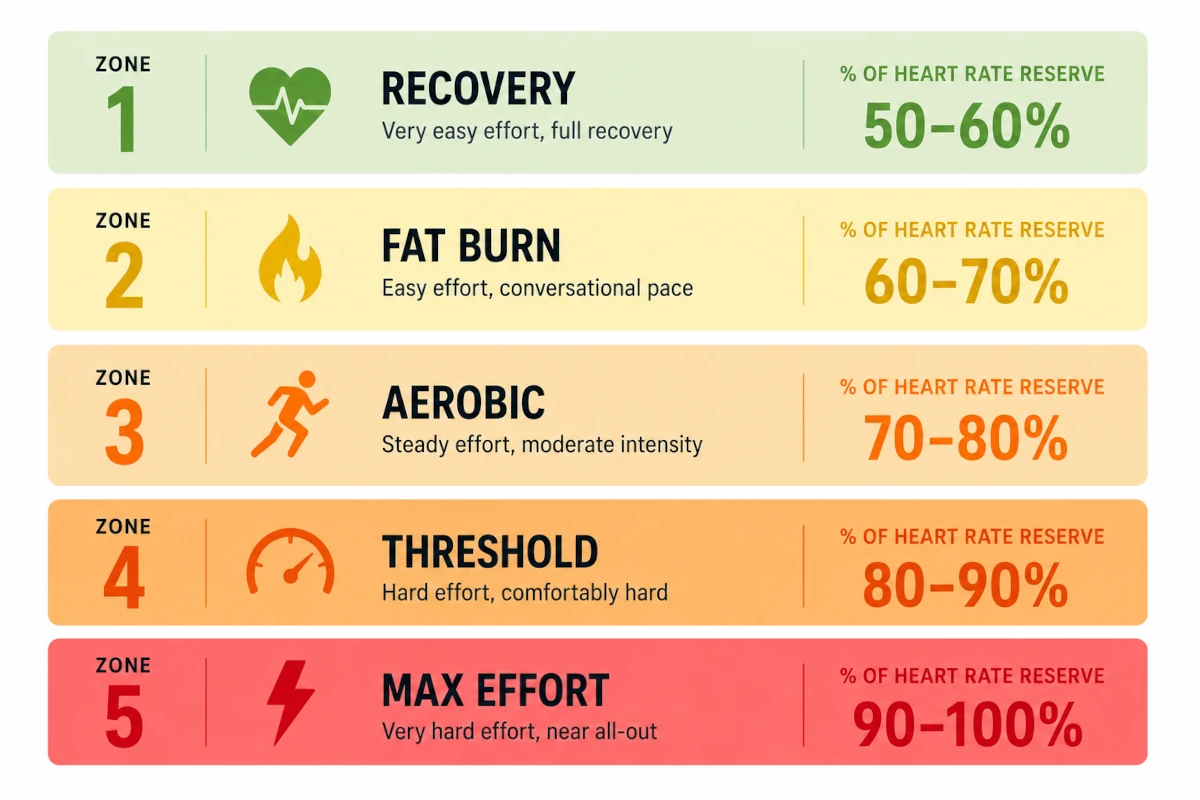
Then apply the intensity percentage for each zone:
| Zone | Name | % of HRR | What It Feels Like |
|---|---|---|---|
| Zone 1 | Recovery | 50–60% | Easy conversation, no real effort |
| Zone 2 | Fat Burn | 60–70% | Can still talk, mild breathing increase |
| Zone 3 | Aerobic | 70–80% | Harder to hold a full conversation |
| Zone 4 | Threshold | 80–90% | Short sentences only, uncomfortable |
| Zone 5 | Max Effort | 90–100% | Can't speak, unsustainable for long |
Worked example: 35-year-old, resting HR of 65 bpm
Max HR: 220 − 35 = 185 bpm
HRR: 185 − 65 = 120 bpm
Zone 2 lower bound: (120 × 0.60) + 65 = 137 bpm
Zone 2 upper bound: (120 × 0.70) + 65 = 149 bpm
Which Input Matters More: Max or Resting Heart Rate?
Max heart rate matters more. Both numbers go into the formula, but they don't carry the same weight.
Go back to the worked example: a 35-year-old with a resting heart rate of 65 bpm and an estimated max of 185 bpm, for a Zone 2 of 137 to 149 bpm. If their true max is 10 bpm higher, at 195, Zone 2 moves to 143 to 156 bpm, a shift of 6 to 7 bpm. If their resting heart rate is 10 bpm off instead, reading 75 rather than 65, Zone 2 becomes 141 to 152 bpm, a shift of only 3 to 4 bpm.
The formula explains the difference. For Zone 2, it takes 60 to 70% of your max heart rate but only 30 to 40% of your resting heart rate, so the same error in max heart rate moves your zone about twice as far.
That's why the biggest improvement to your zones usually comes from a better max heart rate, not a more precise resting reading. 220 minus age is off by 10 to 12 bpm for many people. The Tanaka formula (208 − 0.7 × age) fits measured values better for most adults past 40, and a measured max from a hard race or field test beats any formula. The max heart rate calculator comparison covers the options, and the max heart rate by age guide walks through a field test.
Resting heart rate still matters, since it's the input that moves as you get fitter. Measure it on 3 to 5 mornings in a row and use the average, which smooths out a bad night's sleep or a stressful day.
Which Zone Should Beginners Focus On?
For most beginners, Zone 2: roughly 80% of workouts, with occasional time in Zone 3. That mirrors the 80/20 split endurance athletes use, with most training at low intensity and a smaller share at higher intensity. In the worked example above, that means keeping most sessions between 137 and 149 bpm.
For what each of the 5 zones trains, see what exercise heart rate zones are. For how long to stay in Zone 2, the talk test, and a 4-week starter plan, see the beginner's target heart rate guide. For structuring longer Zone 2 sessions, see our Zone 2 training guide.
How to Measure Your Heart Rate During Exercise
You don't need expensive equipment. A few options:
Chest strap monitor (Polar, Garmin): Most accurate. Research reliably shows chest straps match clinical-grade monitoring for steady-state cardio.
Smartwatch / fitness tracker (Apple Watch, Garmin, Fitbit): Reasonably accurate for steady-state activity like walking, running, and cycling. Less reliable during high-movement exercises or rapid intensity changes.
Manual pulse check: Press 2 fingers to your wrist or neck right after you stop, count beats for 15 seconds, and multiply by 4. Heart rate drops quickly once you stop moving, so a short count taken right away is more accurate here than a full minute.
Frequently Asked Questions
How often should I check my resting heart rate?
Once a week is plenty once you have a baseline. Measure it on the same day each week, first thing in the morning. Over time, a declining resting HR is 1 of the clearest signs your fitness is improving.
My heart rate jumps above my zone during workouts. Is that okay?
Completely normal for beginners. Your cardiovascular system is adapting. Slow down a little, let your rate drop into range, and build gradually. Don't force a pace that keeps you above zone.
Do my zones change as I get fitter?
Yes. As your resting heart rate drops with improved fitness, your Karvonen-calculated zones shift slightly. Recalculate every 4 to 6 weeks, or whenever your resting heart rate moves by 3 bpm or more to keep your targets accurate.
Should I use 220 minus age or the Tanaka formula for my max heart rate?
For most adults past 40, Tanaka (208 minus 0.7 times age) is the better estimate. Below 40, the 2 formulas land within 6 bpm of each other, so either works. If you have a measured max heart rate from a race or field test, use that instead of either formula.
Can I use these zones for any type of exercise?
Generally yes: running, cycling, swimming, and cardio machines. Note that heart rate zones tend to run slightly lower for cycling than running, because running engages more muscle mass.
The math isn't hard, but there's no reason to do it by hand. Head to CalculateMyHeartRate.com, enter your age and resting heart rate, and your 5 Karvonen zones will be ready in seconds. Your zones are personal to you. Use them that way.
This article is for informational purposes only and does not constitute medical advice. Please consult a physician or certified fitness professional before starting a new exercise program.