

What Is a Good Resting Heart Rate for Men?
A good resting heart rate for a man is 50 to 69 bpm. The normal adult range runs from 60 to 100 bpm, and men who train for endurance can sit below 50 without anything being wrong.
The American Heart Association defines a normal resting heart rate as 60 to 100 beats per minute while you're sitting or lying down, calm, and feeling well. That's a wide net. A man at 62 and a man at 94 are both "normal," and they're rarely in the same shape.
Lower tends to be better within that range. A 2016 meta-analysis in the Canadian Medical Association Journal pooled 46 studies and more than 1.2 million people. Every 10 bpm increase in resting heart rate came with a 9% higher risk of death from any cause, and the relationship held in a straight line starting from 45 bpm. That doesn't mean your number decides your future. It means the trend points one way, and a lower resting heart rate is usually a sign your heart is doing its job with less effort.
Resting Heart Rate for Men by Age: What the CDC Data Shows
Age barely moves a man's resting heart rate. In national CDC data, the average man sat at 70 or 71 bpm in every age group from his 20s to past 80.
The numbers below come from the CDC's resting pulse rate reference data, which measured 7,348 men in the National Health and Nutrition Examination Survey between 1999 and 2008. The "middle 50%" column shows where the central half of men landed, from the 25th to the 75th percentile.
| Age | Average | Median | Middle 50% of Men | Lowest 5% Below |
|---|---|---|---|---|
| 20–39 | 71 bpm | 69 bpm | 61–76 bpm | 52 bpm |
| 40–59 | 71 bpm | 68 bpm | 61–77 bpm | 52 bpm |
| 60–79 | 70 bpm | 67 bpm | 60–75 bpm | 50 bpm |
| 80+ | 71 bpm | 68 bpm | 61–78 bpm | 51 bpm |
Data from CDC National Health Statistics Reports No. 41.
One detail matters when you compare yourself to this chart. The CDC took these readings seated, in an exam setting, after about 4 minutes of quiet rest, with a 30-second pulse count doubled to get beats per minute. A reading taken in bed right after you wake up tends to come in lower than that. If your watch says 58 and the chart says the average man sits at 71, part of that gap is method and part of it is you.
Wearable data tells a similar story. A 2020 study in PLOS ONE tracked daily resting heart rate in 92,457 Fitbit users and found that 95% of men sat between 50 and 80 bpm. Average resting heart rate rose slightly until about age 50 and then trended down. The same study found that 2 people's "normal" can differ by as much as 70 bpm, which is a good reason to track your own baseline instead of chasing someone else's number.
Why Men's Resting Heart Rates Run Lower Than Women's
Men's resting heart rates run 2 to 5 bpm lower than women's on average because a man's heart is larger and moves more blood with each beat. More blood per beat means fewer beats are needed at rest.
According to Cleveland Clinic, an adult male heart weighs about 25% more than a female heart on average, and women's hearts have a lower cardiac output. The CDC data backs up the gap. Women's average resting pulse was significantly higher than men's in every age group under 80: 76 vs. 71 bpm from 20 to 39, 73 vs. 71 bpm from 40 to 59, and 73 vs. 70 bpm from 60 to 79.
The practical takeaway is simple. If you're a man comparing notes with a female partner or training buddy, a few beats of difference at rest doesn't mean either of you is fitter. Compare yourself to men, and better yet, to your own numbers from last month.
What Counts as a Good, Average, or High Resting Heart Rate for a Man?
For most men, under 60 bpm is excellent, the 60s are good, the 70s are average, and 80 or higher leaves room to improve. Here's how each band lines up against the CDC data for U.S. men.
| Resting HR | Category | Where It Falls Among U.S. Men |
|---|---|---|
| Under 50 bpm | Athlete | Lower than about 95% of men. Common in endurance-trained men |
| 50–59 bpm | Excellent | Lower than at least 3 in 4 men |
| 60–69 bpm | Good | Around or below the median at every age |
| 70–79 bpm | Average | Above the median, up to about the top quarter |
| 80+ bpm | Below average | Higher than at least 3 in 4 men |
Categories match the site's resting heart rate calculator. Percentile positions come from the CDC reference data above.
Notice there's no separate column for age. Since a man's average barely changes from 20 to 80, the same bands apply whether you're 28 or 68. What moves a man from one row to the next is his aerobic fitness, along with sleep, stress, caffeine, alcohol, and body weight. For how resting heart rate compares across the whole population, including women and kids, see what is a good resting heart rate by age and fitness level.
Does Lifting Weights Lower a Man's Resting Heart Rate?
Not by much on its own. In men, endurance training lowers resting heart rate by about 4 bpm on average, while strength training alone hasn't shown a significant drop.
A 2018 meta-analysis in the Journal of Clinical Medicine pooled 191 studies and 12,952 participants. Endurance training lowered men's resting heart rate by 4.3 bpm compared with control groups. Strength training and combined strength and endurance programs lowered it in women but didn't produce a significant change in men. The researchers also found bigger drops in people who started with a higher resting heart rate and in younger participants.
This matters for a lot of men, since plenty of them train almost entirely with weights. Lifting builds strength and muscle and has health benefits of its own. It isn't the tool that pulls your resting heart rate down. If your number sits in the high 70s and you'd like it lower, adding 2 to 3 sessions of steady Zone 2 training each week will do more for it than an extra leg day. For the full list of what moves this number, see 7 proven ways to lower your resting heart rate.
When Should a Man Worry About His Resting Heart Rate?
See a doctor if your resting heart rate stays above 100 bpm, if it sits in the 90s with no clear reason, or if a low number comes with dizziness, fainting, fatigue, chest pain, or shortness of breath.
A resting rate above 100 bpm is classified as tachycardia. Below 60 is classified as bradycardia, but the AHA notes that lower rates are common in athletes because a well-conditioned heart doesn't need to work as hard. Symptoms are what separate a fit heart from a problem, not the number alone. The AHA also advises telling your doctor if your heart rate has been running slower or faster than usual for you, which is where tracking your own baseline pays off.
The 90s deserve attention even though they sit inside the "normal" range. In the Copenhagen Male Study, which followed about 2,800 middle-aged Danish men for 16 years, the men with resting heart rates above 90 bpm had roughly 3 times the risk of death of men with the lowest resting heart rates. Only 54 men fell in that top group, so the exact figure carries some uncertainty. The CMAJ meta-analysis found cardiovascular mortality rose significantly once resting heart rate reached 90 bpm.
One more thing to rule out: medication. Beta blockers and some other heart and blood pressure drugs lower resting heart rate on purpose. If you take one, your number and your training zones work differently, which is covered in heart rate zones on beta blockers.
How to Measure Your Resting Heart Rate Accurately
Measure it in the morning, before you get out of bed, and count for a full 60 seconds. Repeat for 3 mornings and average the results.
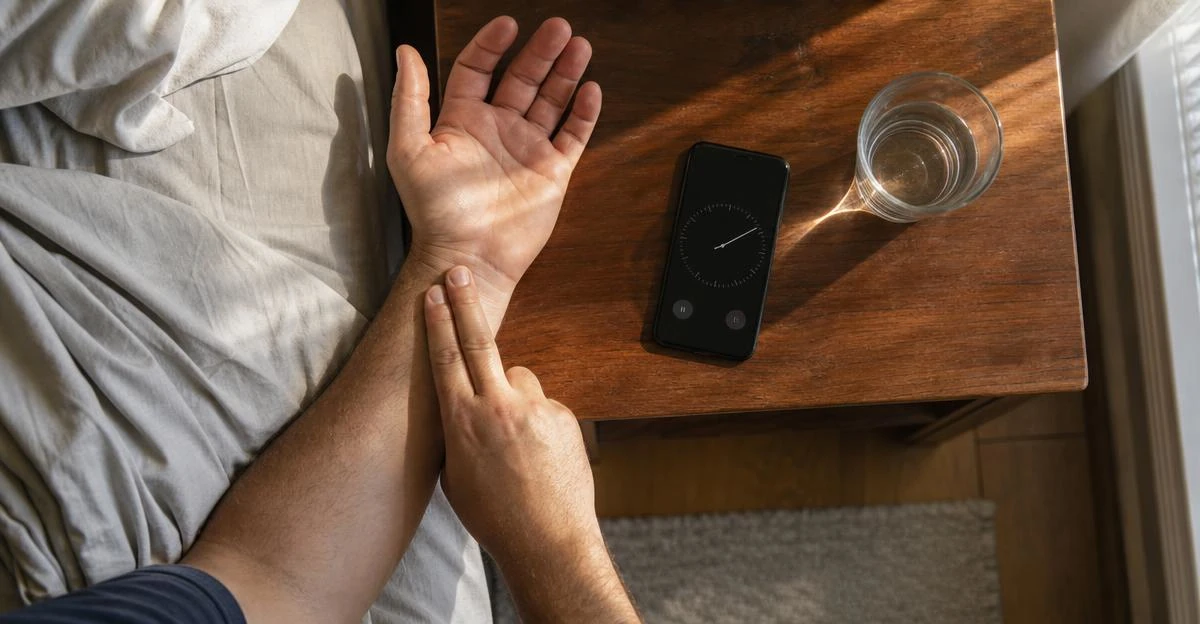
- Stay lying down. Sitting up or standing raises your heart rate before you've done anything.
- Find your pulse. Place 2 fingers on the thumb side of your wrist or beside your windpipe. Skip your thumb, since it has a pulse of its own.
- Count for 60 seconds. Shorter counts multiplied up add rounding error.
- Average 3 mornings. A single bad night of sleep or a late drink can skew a single reading by several beats.
A wearable that reports an overnight or 7-day average works well for trends. If it disagrees with your manual count by more than a few beats, trust a few mornings of manual counts over a single automated reading.
How Your Resting Heart Rate Changes Your Training Zones
A lower resting heart rate gives you a larger heart rate reserve, and that shifts every training zone the Karvonen formula calculates. Two men of the same age can end up with Zone 2 ranges that start 8 bpm apart.
Your heart rate reserve (HRR) is the gap between your maximum heart rate and your resting heart rate. The Karvonen formula builds your zones from HRR instead of from max heart rate alone, so your resting number becomes half the input:
- Resting HR 56: HRR = 175 − 56 = 119 bpm
- Resting HR 56: Zone 2 (60–70% HRR) = 56 + (0.60–0.70 × 119) = 127–139 bpm
- Resting HR 74: HRR = 175 − 74 = 101 bpm
- Resting HR 74: Zone 2 (60–70% HRR) = 74 + (0.60–0.70 × 101) = 135–145 bpm
An age-only chart that ignores resting heart rate would hand both men the same range, and it would be wrong for at least 1 of them. For a closer look at the max heart rate half of the formula, see max heart rate by age.
Frequently Asked Questions
Is 55 bpm a good resting heart rate for a man?
Yes. A resting heart rate of 55 bpm falls in the excellent range for men and is lower than at least 3 in 4 U.S. men in CDC data. It usually reflects good aerobic fitness. It's only a concern if it comes with dizziness, fainting, or unusual fatigue.
What is the average resting heart rate for a 40-year-old man?
In CDC reference data, men aged 40 to 59 averaged 71 bpm, with a median of 68 bpm. The middle half of men in that group sat between 61 and 77 bpm.
Is a resting heart rate of 80 bad for a man?
No, 80 bpm is within the normal 60 to 100 range. It's higher than about 3 in 4 U.S. men, which usually points to low aerobic fitness, poor sleep, stress, caffeine, or alcohol. Regular endurance training tends to bring it down within a few months.
Does a man's resting heart rate go up with age?
Not much. CDC data shows the average man sits at 70 to 71 bpm from his 20s through his 80s. Your maximum heart rate drops with age, but your resting heart rate stays fairly steady unless your fitness or health changes.
Do men have lower resting heart rates than women?
Yes. Men average 2 to 5 bpm lower than women at rest, mainly because a man's heart is larger and pumps more blood with each beat.
This article is for informational purposes only and does not constitute medical advice. Talk with a physician before starting a new exercise program, and see one promptly if your resting heart rate stays above 100 bpm or comes with dizziness, fainting, chest pain, or shortness of breath.