
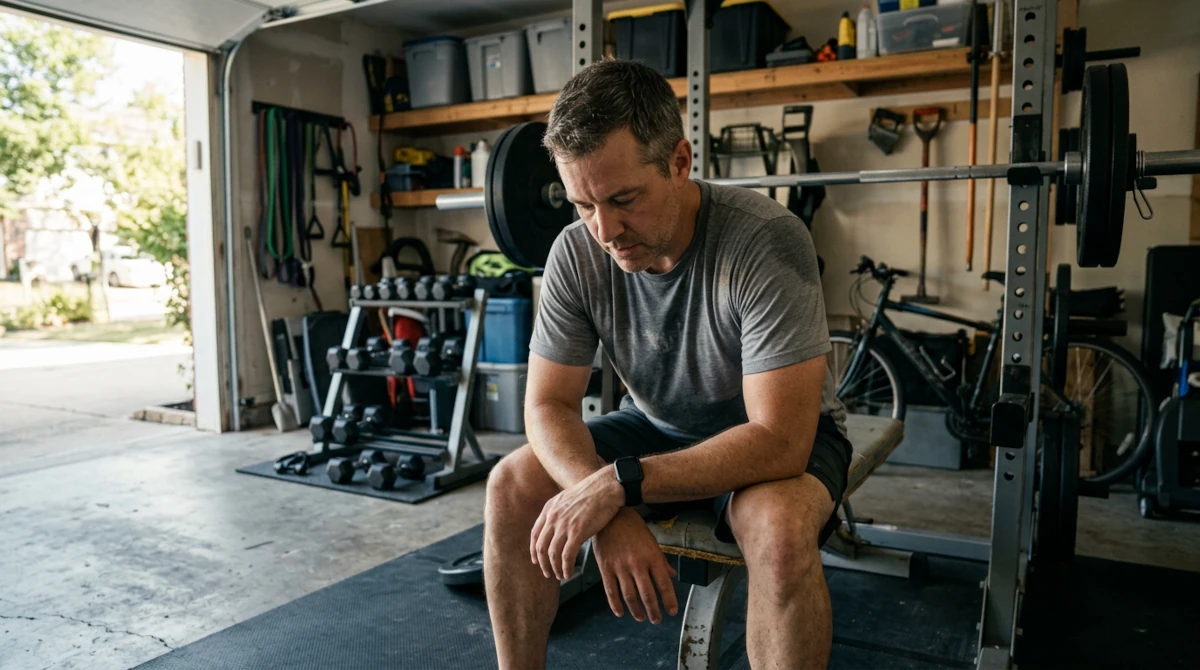
Your watch jumps to 140 bpm on your last set of squats, drops to 100 while you rest, and at the end of the session it says you earned 25 cardio minutes. So was that a cardio workout? Heart rate during weight lifting doesn't follow the steady pattern that heart rate zones were built for, which makes the number on your wrist easy to misread.
What's a Normal Heart Rate During Weight Lifting?
There's no single normal number. Your heart rate climbs during each set, falls during rest, and climbs again on the next set. Heavier loads, longer sets, and big leg exercises push it higher than light arm work, and there's no research-based target heart rate for lifting the way there is for cardio.
Heart rate zones suit steady aerobic exercise like walking, running, or cycling, where your heart rate settles at a level that matches the effort. Lifting is stop and start. A 40-second set followed by 2 minutes of rest produces a saw-tooth pattern on your watch, and the average for the session depends as much on how long you rest as on how hard you lift.
Here's what that saw-tooth looks like in zone terms. This site builds zones with the Karvonen formula, which works from your heart rate reserve (HRR), the gap between your resting and maximum heart rate. Each zone is a percentage of HRR added back onto your resting heart rate, so 2 people the same age with different resting heart rates get different zones. Take a 40-year-old with a resting heart rate of 60 doing the squat session from the opening.
- Max HR: 220 − 40 = 180 bpm
- HRR: 180 − 60 = 120 bpm
- Zone 1 (50–60% HRR) = 120–132 bpm, Zone 2 (60–70% HRR) = 132–144 bpm
- Last set at 140 bpm: (140 − 60) ÷ 120 = 67% of HRR, Zone 2
- Resting at 100 bpm: (100 − 60) ÷ 120 = 33% of HRR, below Zone 1
- 40-second sets with 2-minute rests: (40 × 140 + 120 × 100) ÷ 160 = 110 bpm average, below Zone 1
Because rest makes up most of the clock, the session average tells you more about your rest periods than about how hard the sets were. Track your lifting by sets, reps, and effort, and read the heart rate number as background.
At light loads, heart rate still tracks the work fairly well. In a 2019 study in PLOS ONE, Reis and colleagues tested 56 trained men on 8 exercises at 12 to 24% of their one-rep max. Heart rate predicted the energy cost of each exercise with errors under 10%. That study tested light loads only, so it doesn't tell you how well heart rate tracks a heavy set of 5.
Why Your Heart Rate Spikes During a Set
Your heart rate spikes during a set because working muscles squeeze the blood vessels running through them, and straining against a heavy load raises the pressure in your chest. Your heart speeds up and pushes harder to keep blood moving against that resistance.
When a muscle contracts hard, it compresses the arteries inside it, which makes it harder for blood to flow through. Your blood pressure rises to push blood past that resistance, and the effect grows with the size of the muscle mass and the load. If you hold your breath and bear down, a move called the Valsalva maneuver, the pressure inside your chest climbs too.
That blood pressure rise can be large. In a 1985 study in the Journal of Applied Physiology, MacDougall and colleagues measured blood pressure directly through a catheter in the arm artery of 5 experienced bodybuilders lifting to failure at 80 to 100% of their max. During a double-leg press, blood pressure averaged 320/250 mmHg, and one lifter went past 480/350. Single-arm curls to failure averaged 255/190. The researchers concluded that part of the rise came from the Valsalva maneuver.
When the set ends, the squeeze on your blood vessels releases and your heart rate starts falling within seconds. That quick drop between sets is normal, and the pattern repeats each set.
Does Weight Lifting Count as Cardio?
Circuit-style lifting can build aerobic fitness. Traditional sets with long rests build strength, and the federal guidelines count them separately from your cardio minutes.
A 2021 meta-analysis in the journal Biology by Ramos-Campo and colleagues pooled 45 studies of resistance circuit training, where you move from exercise to exercise with little rest. Circuit training raised VO2 max, the top measure of aerobic fitness, by an average of 6.3%, along with improving strength and body composition.
Traditional lifting is a different story for your heart. A 2018 meta-analysis in the Journal of Clinical Medicine found that strength training alone didn't significantly lower resting heart rate in men, while endurance training did. It did lower resting heart rate in women by about 2 bpm. What is a good resting heart rate for men covers those numbers in more detail.
The CDC's activity guidelines for adults treat them as separate targets: 150 minutes of moderate aerobic activity a week, and in addition, at least 2 days of muscle-strengthening activity that works all major muscle groups.
| Lifting Style | Heart Rate Pattern | Aerobic Benefit |
|---|---|---|
| Heavy, long rest | Sharp spikes, deep drops | Little |
| 8 to 12 reps | Rises and falls | Little alone |
| Circuits | Stays high | Yes |
Why Your Watch Gives You Cardio Credit for Lifting
Your watch gives you cardio credit for lifting because it counts time spent in heart rate zones. It doesn't know whether that heart rate came from a run or from a heavy set of squats.
Fitbit's Active Zone Minutes are a good example. According to Fitbit's help page, you earn 1 Active Zone Minute for each minute in the moderate fat burn zone and 2 for each minute in the cardio or peak zones, toward a starting goal of 150 a week. Hard sets can push your heart rate into those zones for a minute at a time, so a lifting session can rack up minutes even when the workout was mostly rest.
Those minutes reflect real effort, and the session still trained your aerobic system less than a steady run would. If you lift in circuits, the credit is closer to earned. If you lift heavy with long rests, count the session toward your 2 strength days and get your cardio minutes somewhere else.

One more caveat about the number itself. Most watches read heart rate with light shining through the skin of your wrist. In a 2016 Cleveland Clinic study in JAMA Cardiology, researchers tested 4 wrist-worn monitors on 50 healthy adults against ECG and a chest strap. Accuracy dropped as exercise got harder, and none of the wrist devices matched the chest strap. That study tested treadmill exercise, not lifting, but if you want a heart rate you can trust during hard sets, a chest strap is the safer choice. The best heart rate monitors for beginners compares straps and watches, and why your wearable's zones feel wrong covers the zone settings.
Heart Rate, Blood Pressure, and Breathing on Heavy Lifts
Breathe out through the hardest part of each rep instead of holding your breath. Holding your breath and straining adds to the blood pressure spike, and the spike is biggest on heavy, high-effort sets of large muscle groups.
The MacDougall study shows why this matters. The biggest pressures came on the double-leg press taken to failure, and the researchers traced part of the rise to the Valsalva maneuver. For most healthy lifters, those short spikes are part of hard training. If you have high blood pressure, a heart condition, or take heart rate or blood pressure medication, talk with your doctor about how heavy you lift and how close to failure you take your sets.
Stop lifting and get checked if you feel chest pain, dizziness, faintness, or unusual shortness of breath. The American Heart Association advises calling 911 if your heart rate suddenly runs far higher or lower than usual for you, especially alongside those symptoms.
How to Combine Lifting and Cardio in Your Week
Lift on at least 2 days a week, and get your 150 aerobic minutes from steady cardio guided by heart rate zones. Lifting and cardio do different jobs, so you need both.
The American Heart Association's scientific statement on resistance training, led by Amanda Paluch and published in Circulation in 2024, reports that adults who do resistance training have about 15% lower risk of death from any cause and 17% lower risk of cardiovascular disease. The greatest risk reduction showed up at roughly 30 to 60 minutes of resistance training a week.
The statement recommends 8 to 10 exercises for the major muscle groups, 1 to 3 sets of 8 to 12 reps, at least twice a week. It also notes that combining resistance and aerobic training may cut obesity, diabetes, and high cholesterol risk more than either one alone.
- 2 to 3 days: lifting. Track the session by sets, reps, and effort, and treat heart rate as background information.
- 3 to 5 days: steady cardio. Sessions that add up to at least 150 minutes a week of walking, cycling, or running, with most of them in Zone 2, 60 to 70% of HRR. Zone 2 training covers how to build it, and heart rate zones for walking shows how to get there on foot.
- Optional: 1 circuit or interval day. If you like the conditioning side of lifting, a circuit day gives you some of both. Heart rate zones for HIIT covers how to target the hard efforts.
Your heart rate zones come from your age and your resting heart rate, and they're what make the cardio days count. Measure your resting heart rate in the morning before you get out of bed, and recheck it every couple of months as your fitness changes.
Frequently Asked Questions
What should my heart rate be when lifting weights?
There's no research-based target heart rate for lifting. Your heart rate rises during each set and falls during rest, and how high it goes depends on the load, the muscle groups, and how long you rest. Guide your lifting by sets, reps, and effort, and save heart rate zones for steady cardio.
Is it normal for my heart rate to jump during a set?
Yes. Working muscles squeeze the blood vessels inside them, and straining raises the pressure in your chest, so your heart speeds up during a hard set and slows quickly once you stop. Stop and get checked if a spike comes with chest pain, dizziness, or unusual shortness of breath.
Does lifting weights count as cardio?
Circuits can. A 2021 meta-analysis of 45 studies found that resistance circuit training raised VO2 max by about 6%. Traditional lifting with long rests mainly builds strength, and the CDC counts muscle-strengthening separately from your 150 weekly aerobic minutes.
Why does my Fitbit give me Active Zone Minutes for lifting?
Active Zone Minutes count time your heart rate spends in your fat burn, cardio, and peak zones, whatever caused it. Hard sets can push you into those zones briefly, so lifting earns minutes even though it trains your aerobic system less than steady cardio does.
Does weight lifting lower your resting heart rate?
Not much on its own in men. A 2018 meta-analysis found that strength training alone didn't significantly lower men's resting heart rate, while it lowered women's by about 2 bpm. Endurance training lowered it in both.
Should I hold my breath when lifting heavy?
Breathe out through the hardest part of the rep instead. In a study that measured blood pressure directly, part of the large spike during heavy lifts came from holding the breath and straining.
This article is for informational purposes only and does not constitute medical advice. Talk with a physician before starting a new exercise program, especially if you have high blood pressure, a heart condition, or take heart rate or blood pressure medication, and stop and seek care if you feel chest pain, dizziness, or unusual shortness of breath while lifting.