

You finish a hard interval, stop, and watch the number on your wrist fall from 172 to 150 in a minute. Is that good? Heart rate recovery after exercise, the speed your heart rate drops once you stop, takes 60 seconds to measure and tells you something about your fitness that your peak heart rate can't. Here's how to measure it, what counts as a good number, and what changes it.
What Heart Rate Recovery Measures
Heart rate recovery is the number of beats per minute your heart rate drops in a fixed window, usually the first minute, after you stop a hard effort. It's typically written as a single number, like "recovery of 22," meaning your heart rate fell 22 bpm in that first 60 seconds.
Most people who track heart rate obsess over the top of the range instead. How high did it climb during that last interval. Did it hit Zone 4. That number gets attention because it's the one flashing on the screen mid-workout. Heart rate recovery asks a different question, and it might be the more useful one: how fast does your heart rate come back down once you stop?
The moment you stop moving, your heart rate doesn't drop instantly. It fades, and the speed of that fade is driven by your vagus nerve switching back on. During exercise, your body suppresses vagal (parasympathetic) activity to let your heart rate climb. The faster that system reactivates once effort stops, the faster your heart rate falls. A well-conditioned autonomic nervous system reactivates quickly. A less conditioned one takes its time.
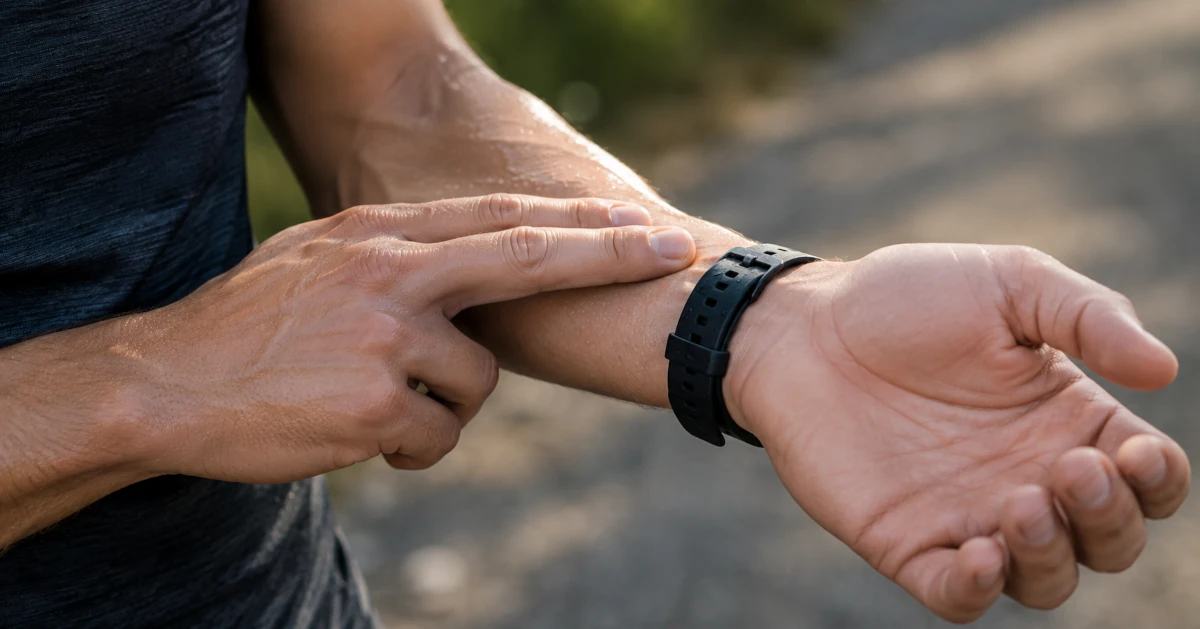
How to Measure Your Heart Rate Recovery
The math is simple. The discipline in timing it correctly is where most people go wrong.
- Get to a hard effort. This needs to be near the top of your range, roughly Zone 4 or 5, sustained for at least a few minutes. A light jog won't produce a meaningful reading.
- Note your heart rate the instant you stop. This is your peak, or as close to it as you'll capture without lab equipment.
- Stay still (or keep walking slowly) and start a timer. Whether you sit, stand, or keep a slow walk changes the number, so pick one method and stay consistent between sessions.
- Check your heart rate again at exactly 60 seconds. Not 70, not 50. The published benchmarks are built around the 1-minute mark specifically.
- Subtract. Peak heart rate minus your 1-minute heart rate equals your heart rate recovery.
Peak heart rate at the end of a hard interval set: 172 bpm
Heart rate 60 seconds later: 148 bpm
Heart rate recovery = 172 − 148 = 24 bpm
A recovery of 24 bpm sits comfortably above the general 18 bpm benchmark for adults, which points to a heart that reactivates its vagal tone quickly after hard effort.
Most modern fitness watches automate this. Garmin measures at 2 minutes instead of 1, so if you're comparing your number to the widely cited benchmarks below, check which window your device is using before you draw conclusions. Apple Watch calls this metric "cardio recovery" and measures it at roughly 1 minute after an outdoor workout ends. Different terms, same underlying idea. For more on getting a clean reading in the first place, see our comparison of heart rate monitors for beginners.
What Counts as a Good Heart Rate Recovery
There's no single official chart that maps heart rate recovery precisely to age, sex, and fitness level the way there is for resting heart rate. What exists instead is a general benchmark plus a documented low-end warning line, both well established in the research.
According to the Cleveland Clinic, a good 1-minute heart rate recovery for the general adult population is 18 bpm or higher. On the other end, a landmark study is more precise about where concern starts.
That study, published by researchers at the Cleveland Clinic in the New England Journal of Medicine in 1999, followed 2,428 adults with an average age of 57 for 6 years. Researchers classified a heart rate recovery of 12 bpm or fewer at the 1-minute mark as abnormal and tied it to a meaningfully higher risk of death over the follow-up period, even after adjusting for other known risk factors.
Two things worth holding onto here. First, this was a study of adults undergoing exercise testing for diagnostic reasons, not a general fitness population, so it isn't a direct prediction for any one individual's future. Second, a single low reading doesn't mean much by itself. Trend matters more than any single number, the same way it does with resting heart rate.
Why Heart Rate Recovery Matters Beyond the Gym
The reason researchers care about this number goes back to that vagal reactivation mechanism. A fast recovery reflects a nervous system that shifts smoothly between "go" and "rest" states. A slow recovery suggests that shift is sluggish, and a sluggish autonomic nervous system has been independently linked to cardiovascular risk in multiple follow-up studies since the original 1999 paper.
None of that means a single sluggish reading is a diagnosis. It means the number is worth tracking over time the same way you would track your resting heart rate, watching for a consistent pattern rather than reacting to one bad session after a rough night of sleep.
What Affects Your Number
Heart rate recovery moves for a mix of reasons, some you control and some you don't.
Fitness Level and Training Consistency
This is the factor you control most. A well-trained aerobic system reactivates the vagus nerve faster, which is why endurance athletes routinely post recovery numbers well above 25 bpm. This is the same adaptation covered in our guide to Zone 2 training, and it builds through the same consistent, moderate-effort work.
Age
Recovery tends to slow gradually with age, mirroring the general decline in maximum heart rate and cardiovascular elasticity. This is a trend, not a hard rule. A highly trained 60-year-old can post a faster recovery than an untrained 30-year-old.
Body Position After Exercise
Lying down immediately after exercise lets blood return to the heart more easily than standing does, which speeds up the drop. If you're comparing your number across sessions, keep your post-exercise position consistent, or the comparison won't be fair.
Sleep, Hydration, and Caffeine
The same factors that push resting heart rate up tend to blunt recovery too. Poor sleep and dehydration both keep the sympathetic nervous system more active than it should be, and caffeine close to a workout can delay the parasympathetic reactivation that drives the number down. For the fuller list of everyday factors, see 7 proven methods to lower your resting heart rate, most of which move recovery in the same direction.
Medications
Beta blockers and some other heart medications blunt both peak heart rate and the size of the drop afterward, which can make a raw recovery number misleading without context. If you take a heart-rate-affecting medication, talk to your doctor about what a meaningful change looks like for you specifically, rather than comparing your number directly to the general benchmarks here. Our guide to training on beta-blockers covers how to gauge intensity without relying on heart rate numbers at all.
How to Improve Your Heart Rate Recovery
The path here isn't exotic. It's the same aerobic base-building that improves nearly every other cardiovascular marker on this site.
| What to Do | Why It Helps |
|---|---|
| 3 to 5 Zone 2 sessions per week | Builds the aerobic base that speeds vagal reactivation over time |
| 1 harder interval session per week | Adds a stronger training stimulus without overloading recovery |
| Consistent sleep schedule | Keeps your nervous system from starting each workout already sympathetic-dominant |
| Track the trend, not single sessions | Smooths out day-to-day noise from sleep, hydration, and stress |
Most people who train consistently see a measurable improvement in their heart rate recovery within a few months, tracking closely with the same timeline most people see for a drop in resting heart rate. If you haven't calculated your training zones yet, start with your estimated max heart rate by age, then plug your numbers into the calculator to structure the work.
Frequently Asked Questions
What is a good heart rate recovery?
For most adults, a drop of 18 beats per minute or more in the first minute after stopping exercise is considered good, according to the Cleveland Clinic. A drop of 12 beats per minute or less is classified as low and worth mentioning to a doctor, especially alongside symptoms like dizziness or chest discomfort.
Is a heart rate recovery of 20 bpm good?
Yes. A 20 bpm drop in the first minute is above the general 18 bpm benchmark for adults, which points to a nervous system that reactivates efficiently and a reasonable level of cardiovascular fitness.
Why is my heart rate recovery so slow?
A slow recovery is most often explained by lower fitness, older age, poor sleep, dehydration, caffeine close to your workout, or staying upright instead of lying down right after you stop. Certain medications, including beta blockers, also change the number. If it stays low across several sessions with no clear cause, it is worth a conversation with a doctor.
Does a fitness watch measure heart rate recovery accurately?
Reasonably well for tracking your own trend over time, though optical wrist sensors can lag during the rapid heart rate swings right after a hard effort. A chest strap gives a more precise single reading. For spotting whether your recovery is improving month over month, a wrist-based reading is generally good enough.
Can heart rate recovery improve with training?
Yes. Heart rate recovery improves through the same consistent aerobic training that lowers resting heart rate, particularly regular Zone 2 work. Most people see a measurable improvement within a few months of consistent training.
This article is for informational purposes only and doesn't constitute medical advice. If your heart rate recovery is persistently low, especially alongside symptoms like dizziness, chest discomfort, or shortness of breath, talk to a physician before continuing a training program. Results vary by individual.