
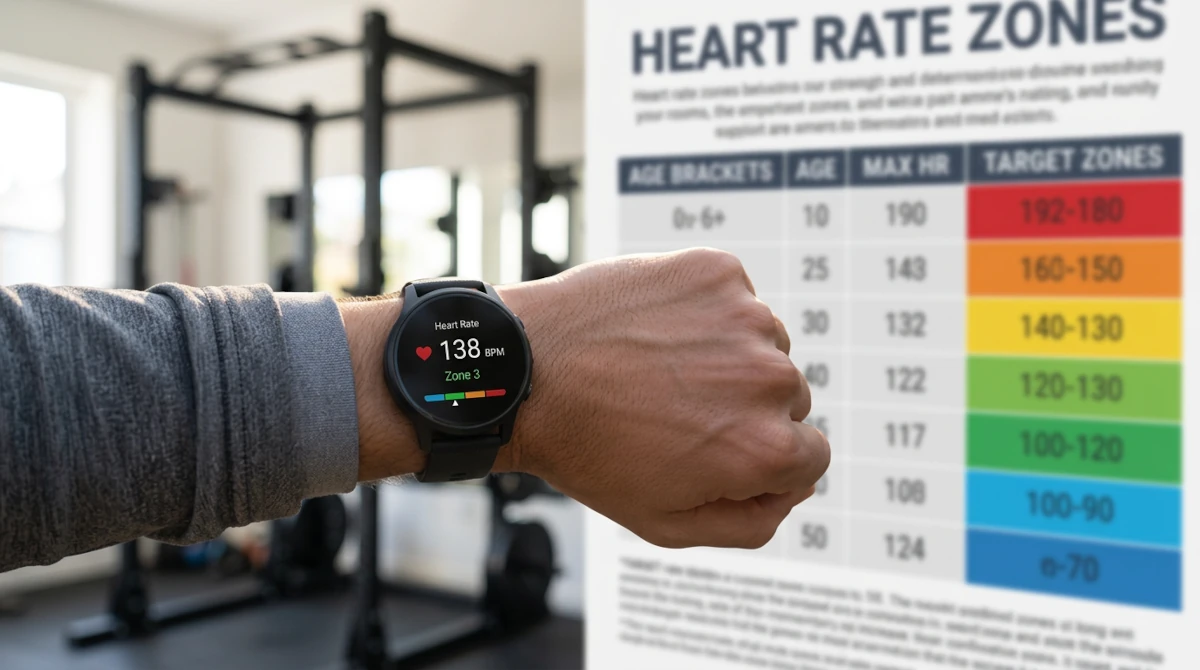
Every gym wall and treadmill display has one: a chart that turns your age into a target heart rate range in seconds. The catch is that everyone your age gets the same range, whether they've been running for 10 years or started walking last month. Below is the standard target heart rate by age chart, what it's good for, and how to get a range that fits your own fitness.
What Is Your Target Heart Rate, Exactly?
Your target heart rate is the range your heart should sit in during exercise to get cardiovascular benefit without overreaching. It's expressed as a percentage of your maximum heart rate, usually 50 to 85 percent, and it's the number most age-based charts are trying to hand you.
The chart below is that standard version. It's a reasonable starting point, and the sections after it cover where it falls short.
Target Heart Rate by Age Chart (20 to 70)
Find your age, then read across for your estimated max heart rate and the two standard training ranges: moderate intensity (50–70% of max) and vigorous intensity (70–85% of max).
| Age | Est. Max HR (220 − Age) | Moderate (50–70%) | Vigorous (70–85%) |
|---|---|---|---|
| 20 | 200 bpm | 100–140 bpm | 140–170 bpm |
| 25 | 195 bpm | 98–137 bpm | 137–166 bpm |
| 30 | 190 bpm | 95–133 bpm | 133–162 bpm |
| 35 | 185 bpm | 93–130 bpm | 130–157 bpm |
| 40 | 180 bpm | 90–126 bpm | 126–153 bpm |
| 45 | 175 bpm | 88–123 bpm | 123–149 bpm |
| 50 | 170 bpm | 85–119 bpm | 119–145 bpm |
| 55 | 165 bpm | 83–116 bpm | 116–140 bpm |
| 60 | 160 bpm | 80–112 bpm | 112–136 bpm |
| 65 | 155 bpm | 78–109 bpm | 109–132 bpm |
| 70 | 150 bpm | 75–105 bpm | 105–128 bpm |
Ranges are estimates based on the 220-minus-age formula. Individual max heart rate can vary by 10–20 bpm or more at any given age.
Why This Chart Gives Everyone Your Age the Same Zone
The chart above treats age as the only input that matters. It doesn't ask whether you've run 3 miles a week for the last decade or haven't exercised since high school. Both people get the same row.
Max HR = 220 − Age
The formula itself has a documented margin of error. Research on the 220-minus-age estimate puts the standard deviation at roughly ±10 to 12 bpm, meaning a 45-year-old with an estimated max heart rate of 175 bpm could have a true max anywhere from about 153 to 197 bpm. That's before fitness level, medication, or genetics even enter the picture. For a closer look at where this formula came from and what replaces it, see our guide on the 220-minus-age formula's accuracy and limitations.
Age-only percentage charts also don't distinguish between a well-trained heart and a sedentary one. That distinction is exactly what the resting heart rate fixes.
How Your Resting Heart Rate Changes the Picture
Your resting heart rate personalizes the chart by measuring your actual cardiovascular fitness instead of guessing at it from your birth year. This is the basis of the Karvonen formula, also called the heart rate reserve method.
Target HR = Resting HR + (Intensity% × HRR)
- Max HR = 220 − 45 = 175 bpm
- Heart Rate Reserve = 175 − 68 = 107 bpm
- Zone 2 lower = 68 + (0.60 × 10⁷) = 132 bpm
- Zone 2 upper = 68 + (0.70 × 10⁷) = 143 bpm
Compare that to the standard chart's moderate range for age 45: 88–123 bpm. The Karvonen zone sits noticeably higher, because it's measuring effort relative to this person's actual heart rate reserve instead of a flat percentage of an age-estimated ceiling.
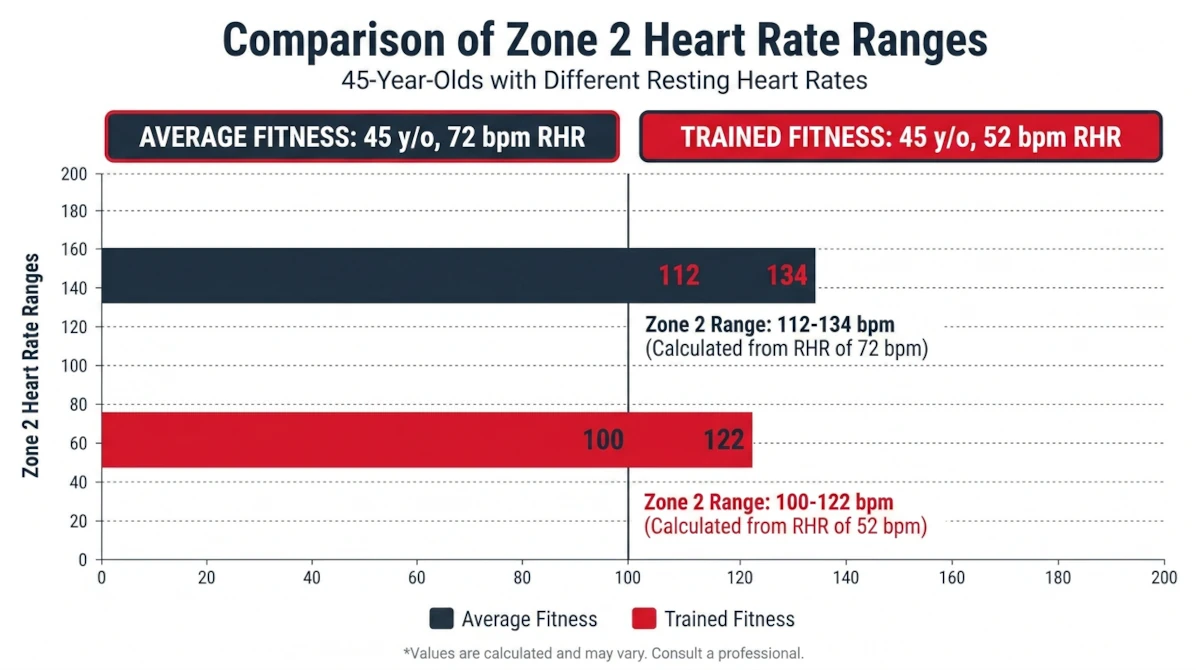
The gap gets more interesting when you hold age constant and change fitness level. Here's the same age, 45, with 2 different resting heart rates:
How to Use This Chart During a Workout
Use the chart as a rough starting reference, then check your actual heart rate against it during exercise. Most fitness watches and chest straps display heart rate continuously, so you can glance down and compare.
Without a wearable, count your pulse at your wrist or neck for 15 seconds and multiply by 4, or for 30 seconds and multiply by 2. Do this mid-workout without stopping completely, since heart rate drops quickly once you slow down.
If you're consistently below your target range, you likely have room to push harder. If you're consistently above it, especially in the vigorous column, dial back the pace. For a broader framework on interpreting these readings during different types of workouts, see how to tell if you're exercising hard enough.

When the Standard Chart Doesn't Apply to You
The standard chart applies least to people whose max heart rate is meaningfully different from what 220-minus-age predicts. That includes people on beta-blockers or other heart rate-affecting medications, since these medications can lower max heart rate independent of age or fitness. It also includes anyone whose max heart rate sits well above or below average, which happens at every fitness level, and older adults, where the 220-minus-age formula tends to underestimate max heart rate the most. Pregnancy changes the numbers too, since resting heart rate rises about 10 to 20 bpm by the third trimester. See our guide to safe heart rate during pregnancy rather than relying on this chart.
If any of that applies to you, a formula like Tanaka, which research shows performs better for older adults, or a supervised field test, will get you closer to your real number than the standard chart alone. Anyone with a cardiac condition or new to exercise should check with a physician before using max-effort testing to find their true ceiling. If you're over 60, our guide to target heart rate for seniors walks through the numbers for your age.
Frequently Asked Questions
What is a normal target heart rate for my age?
Using the standard formula, a 40-year-old's target heart rate for moderate activity is roughly 90 to 126 bpm, and 126 to 153 bpm for vigorous activity. Subtract your age from 220 to estimate your own max heart rate, then take 50 to 70 percent of that number for moderate intensity and 70 to 85 percent for vigorous intensity.
Is the target heart rate chart accurate for everyone?
No. The chart is built on the 220-minus-age formula, which carries a standard deviation of roughly plus or minus 10 to 12 bpm. It also ignores your resting heart rate, so two people the same age with different fitness levels get the exact same range. It's a reasonable starting point, not a personal number.
What's the difference between target heart rate and max heart rate?
Max heart rate is a ceiling, the highest your heart can beat during all-out effort. Target heart rate is a working range below that ceiling, usually 50 to 85 percent of max, where you get cardiovascular benefit without overreaching. You calculate target heart rate from max heart rate, not the other way around.
How do I find my target heart rate without a chart?
Subtract your age from 220 to estimate max heart rate, then multiply by 0.5 and 0.85 to get the moderate-to-vigorous range. For a more personalized number that accounts for your fitness level, use the Karvonen formula with your resting heart rate, or enter your age directly into a Karvonen calculator.
Does target heart rate change with fitness level?
Your max heart rate stays roughly fixed for your age regardless of fitness. What changes is your resting heart rate, which typically drops as cardiovascular fitness improves. Since the Karvonen formula factors in resting heart rate, a fitter person's target zones shift lower and wider than the standard age-only chart shows, even though their age hasn't changed.
This article is for informational purposes only and does not constitute medical advice. Consult a physician before starting a new exercise program or performing maximal effort testing, especially if you have cardiovascular risk factors.