

Why Fat Burning Heart Rate Charts Are Usually Wrong
Most fat burning heart rate charts share the same flaw: they're built on 220 minus your age and nothing else. Search for one online and you'll land on a wall of generic tables: age 30, this bpm, age 40, that bpm, with no room for individual variation.
That formula has a standard deviation of roughly ±10-12 bpm. A 40-year-old with a resting heart rate of 55 and a 40-year-old with a resting heart rate of 80 are not the same, even though a generic chart assigns them an identical fat burning zone. The gap between those 2 people at the same age is often 10 bpm or more, which is a meaningfully different target, not a rounding error. For the full 5-zone breakdown by age, not just the fat-burning range, see our target heart rate by age chart.
Just want the short answer before working through the age-by-age numbers below? See our quick explainer on which zone burns the most fat.
The Simple Formula Most Sites Use (And Why It Falls Short)
The problem with 220 minus age is what it leaves out. It says nothing about your resting heart rate, which is 1 of the clearest everyday markers of cardiovascular fitness. A trained runner and someone who hasn't exercised in years can have the same estimated max heart rate at the same age, but their bodies are working from different baselines. A formula that ignores that difference gives both of them the same fat burning target, which doesn't hold up.
That doesn't make it a bad formula. It's a fast way to estimate maximum heart rate, and it works fine as a rough starting point, it just isn't the whole picture.
The Karvonen Method: A More Accurate Fat Burning Target
The Karvonen formula, first published in 1957, closes that gap by adding 1 more input: your resting heart rate.
The fat burning zone (Zone 2) sits at 60-70% intensity in this formula. Here's what that looks like for a 45-year-old with a resting heart rate of 65 bpm.
- Estimated Max HR = 220 − 45 = 175 bpm
- Heart rate reserve = 175 − 65 = 110 bpm
- Zone 2 (60–70%) = 65 + (0.60–0.70 × 110) = 131–142 bpm
This person's fat burning zone is 131 to 142 bpm, not the single number a generic age-only chart would show for age 45 without accounting for their resting heart rate.
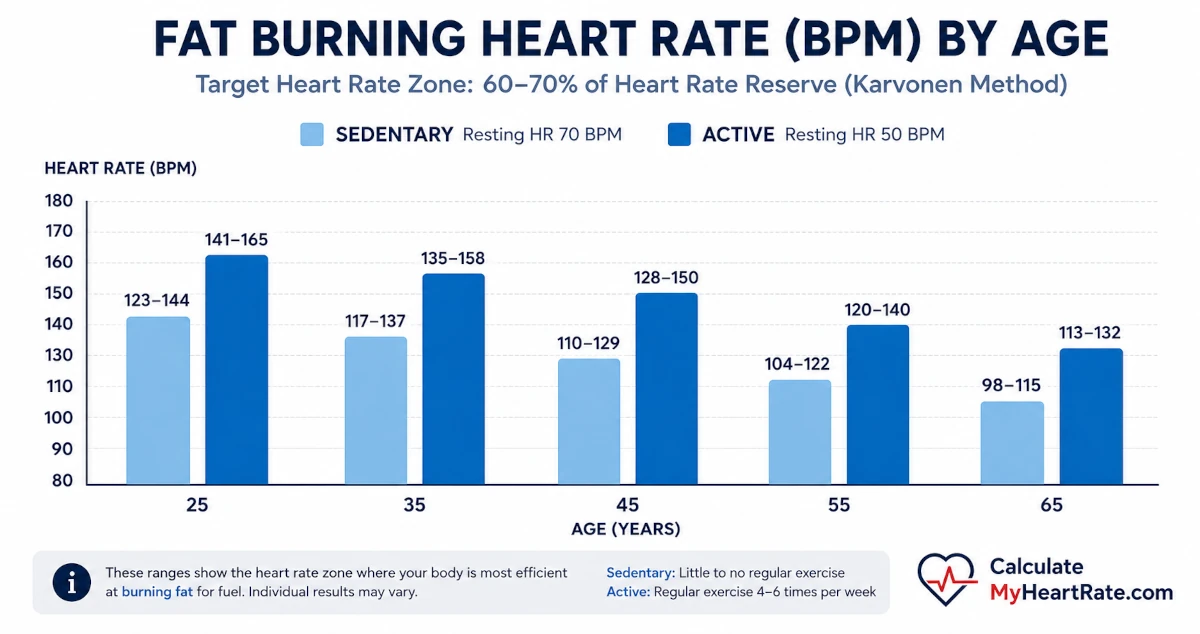
Fat Burning Heart Rate by Age: Karvonen-Based Ranges
The table below shows Zone 2 (60-70% heart rate reserve) at 5 ages, each with 2 resting heart rate scenarios: a more sedentary resting rate of 70 bpm and a fitter, more active resting rate of 55 bpm. These are calculated directly from the Karvonen formula above, not estimated.
| Age | Resting HR ~70 (Sedentary) | Resting HR ~55 (Active) |
|---|---|---|
| 25 | 145-158 bpm | 139-153 bpm |
| 35 | 139-150 bpm | 133-146 bpm |
| 45 | 133-144 bpm | 127-139 bpm |
| 55 | 127-136 bpm | 121-132 bpm |
| 65 | 121-130 bpm | 115-125 bpm |
Notice the pattern: at every age, the more active resting heart rate produces a lower fat burning zone, by roughly 6-9 bpm depending on age. These are still estimates, since your true max heart rate can vary from the 220-minus-age formula by ±10-12 bpm regardless of which method calculates the zone around it. For a number tied to your specific inputs rather than an age bracket, use the Karvonen formula calculator directly.
How to Find Your Resting Heart Rate (The Right Way)
Take it in the morning, before getting out of bed, while you're still lying down. Count your pulse for a full 60 seconds rather than a 15-second count multiplied by 4, since a full minute smooths out any irregular beats.
The accuracy of every number above depends on this 1 input: an honest resting heart rate. Measure it wrong, and the rest of the calculation follows that error. Do this for 5 mornings in a row and average the results. A single day can be skewed by poor sleep, stress, or a late workout the night before. For the full picture of what your number means and what moves it day to day, see what is a good resting heart rate.
How to Stay in Your Fat Burning Zone During Exercise
Once you have your zone, a few practical checks keep you in it during a workout.
The talk test: if you can hold a full conversation without much effort, you're likely below Zone 2. If you can talk in full sentences but notice your breathing, that's the range you're after. Once talking drops to short phrases, you've moved past it.
RPE (Rate of Perceived Exertion): on a 1-10 scale, Zone 2 generally sits around a 3 to 4, noticeable effort that still feels sustainable.
Wearables: useful for a real-time number, but optical wrist sensors can drift, especially at faster paces or in cold weather. Treat the reading as a helpful guide rather than an exact measurement, and check it against how you feel. See our guide to wearable heart rate accuracy for why the number on your wrist doesn't always match your actual zone.
What to Do If You Keep Slipping Out of the Zone
Break the workout into shorter intervals inside your zone with brief walking recovery between them, rather than trying to hold a steady pace for the full session right away. Check your RPE every few minutes instead of only at the start. And if you're consistently drifting 10+ bpm above your target, slow down more than feels natural.
The most common problem isn't going too easy. It's pushing too hard without realizing it, especially for anyone used to training at a harder effort by habit. Zone 2 is supposed to feel almost too easy. That's the point, and it's also the part beginners tend to resist the most. For a broader look at how Zone 2 fits into a weight loss routine, see our guide on finding your fat burning heart rate zone, and for why total calories matter more than which zone you're in, see heart rate zones for weight loss.
Frequently Asked Questions
What is a good fat burning heart rate for my age?
It depends on your resting heart rate, not just your age. 2 people the same age with different resting heart rates will have different fat burning zones. Use the Karvonen formula with your own resting heart rate for an accurate number, rather than a generic age-based chart.
Is 220 minus age accurate for finding my fat burning zone?
It's a reasonable starting point for estimating max heart rate, but on its own it ignores your fitness level. The Karvonen formula improves on it by factoring in your resting heart rate, which gives a more individualized zone.
Should I stay in the fat burning zone for my whole workout?
Not necessarily. Zone 2 is sustainable and a good base for most of your weekly cardio, but total calories burned matters more for weight loss than staying in 1 specific zone the entire time.
How do I find my resting heart rate accurately?
Measure it first thing in the morning, before getting out of bed, using a 60-second count. Average your readings over 5 days for a stable number, since a single reading can be thrown off by sleep quality or stress.
Can my fat burning heart rate change over time?
Yes. As your fitness improves, your resting heart rate typically drops, which shifts your Karvonen zones. Recalculating every few months, especially after a noticeable change in fitness, keeps your target range accurate.
This article is for informational purposes only and isn't a substitute for personalized medical or fitness advice. If you're new to exercise or have a heart condition, check with a physician before starting a new cardio program. Results vary by individual.