
Why Swimming Heart Rate Zones Run Lower Than Land Zones
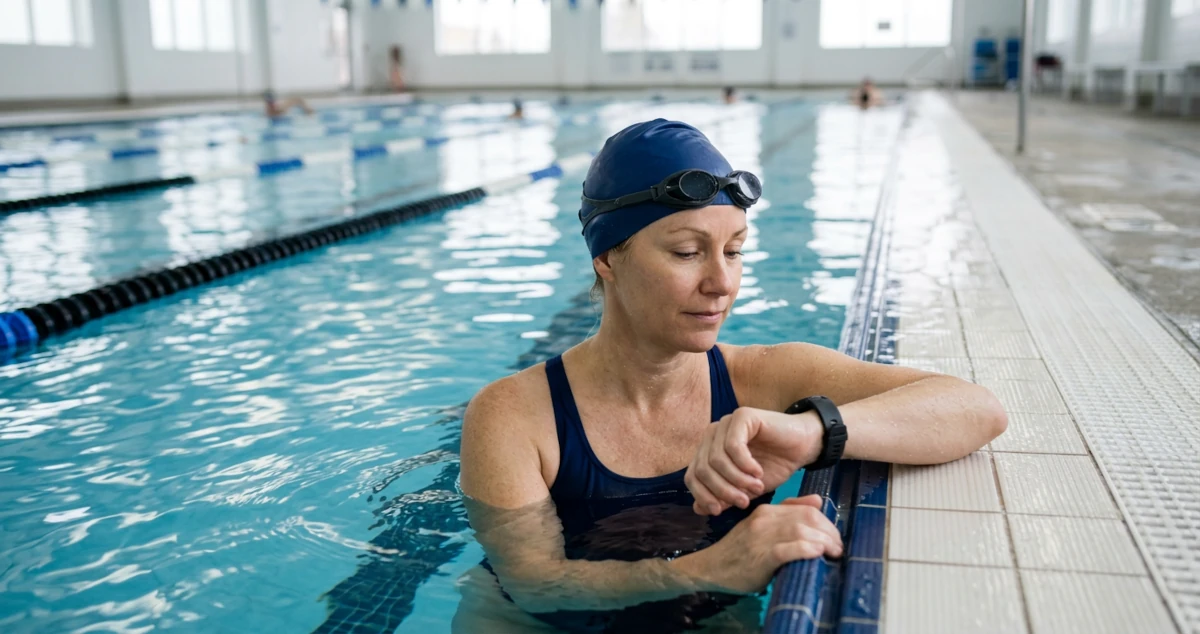
Your heart rate tops out lower in the pool than it does on land, so swimming zones built from your running or age-predicted max heart rate come out too high. The research-backed fix is to subtract about 12 bpm from your land max before you calculate your zones.
That number comes from a 1991 study in the International Journal of Sports Medicine. DiCarlo and colleagues took 34 college-age fitness swimmers to max effort twice, once running on a treadmill and once in a tethered swim. Peak heart rate in the water came in about 11 bpm below their treadmill peak and about 13 bpm below 220 minus age. Their recommendation for young adult fitness swimmers: take the max heart rate from a treadmill test or from age, and reduce it by 12 bpm.
Later work points the same way. In a 2019 study in the journal Sports, Olstad and colleagues tested 12 elite swimmers on 3 different swim step tests and on land. Their swimming max heart rate came in 6.7 bpm below their running max of about 200 bpm. The authors note that earlier studies of triathletes and fitness swimmers found swimming max heart rate 9 to 14 bpm lower than running and cycling.
The exact gap varies from person to person and study to study. The direction doesn't. If you swim with zones copied from your running watch, every one of them is set too high.
Keep in mind where the 12 bpm figure comes from. DiCarlo's group tested college-age fitness swimmers, and the elite swimmers in the Olstad study showed a gap closer to 7 bpm. No study has mapped the gap across every age and training level, so treat 12 bpm as a starting estimate you can adjust. If your pool Zone 2 still feels too easy after a few weeks, your personal gap is likely smaller, and a pool test, covered below, will settle it.
Why Your Heart Rate Is Lower in the Water
Swimming is done lying flat, in water, with the upper body doing most of the work. Each of those lets your heart move the blood you need with fewer beats.
The amount of blood your heart pumps each minute is your heart rate times your stroke volume, the blood pushed out with each beat. When more blood fills the heart between beats, stroke volume goes up, and your heart can deliver the same flow at a lower rate.
- You're horizontal. When you stand or run, gravity pulls blood down into your legs, and it has to travel uphill to get back to your heart. Lying flat removes most of that pull, so more blood returns to the heart and each beat pumps more of it. The Olstad paper lists body position as a likely factor in the lower swim max.
- Water pressure pushes blood toward your chest. The water presses on your legs and torso and moves blood from your limbs toward your heart, which adds to the stroke volume gain from lying flat. Buoyancy also carries your body weight, so your leg muscles do less work than they do when you run.
- The water keeps you cool. On a warm run, a large share of your blood goes to your skin to shed heat, and your heart rate climbs to cover it. Water pulls heat away far faster than air, so less blood goes to the skin and more stays with your working muscles. The Olstad paper lists this as another possible factor.
- Your face is in the water. Putting your face in cool water triggers the dive reflex, a response that slows your heart rate. It's strongest during breath holds, and front crawl builds a short breath hold into every stroke cycle, so it may add to the gap.
- Your arms and shoulders tire first. Front crawl leans on the upper body, a smaller muscle mass than your legs. Swimmers may hit their limit in the shoulders before their heart reaches the rate it would on a run.
A hard set in the pool still feels hard. Your heart reaches that effort at a lower number, so your zones have to move down to match.
Calculate Your Swimming Heart Rate Zones
Enter your age and resting heart rate to get your 5 swimming heart rate zones. The calculator uses the Karvonen formula with a swim max heart rate 12 bpm below your land max, and shows your land zones next to them for comparison.
The Karvonen formula builds each zone from your heart rate reserve (HRR), the gap between your max and resting heart rate. Because your resting heart rate is part of the math, your zones reflect your fitness as well as your age. Measure it in the morning before you get out of bed, or use the resting heart rate calculator to see where yours lands.
Target HR = Resting HR + (Intensity% × (Swim Max HR − Resting HR))
| Zone | Purpose | Pool (bpm) | Land (bpm) |
|---|
If you've done a max effort test in the pool, choose "I know my swim max HR" and the calculator uses that number as is. That's the most accurate option, since it skips the 12 bpm estimate entirely.
The 5 Swimming Heart Rate Zones
Swimming training heart rate zones use the same 5 bands of heart rate reserve as running and cycling. Only the max heart rate underneath them changes.
| Zone | % HRR | Effort Feel | Best For |
|---|---|---|---|
| Zone 1 | 50–60% | Easy, relaxed stroke | Warm-up, cooldown, technique drills |
| Zone 2 | 60–70% | Comfortable, steady breathing | Aerobic base, longer steady swims |
| Zone 3 | 70–80% | Harder, breathing picks up | Aerobic endurance (use sparingly) |
| Zone 4 | 80–90% | Hard, you want the wall | Threshold repeats with short rest |
| Zone 5 | 90–100% | All-out | Short sprints with long rest |
For most fitness swimmers, Zone 2 deserves the biggest share of pool time. It's the same aerobic base work covered in Zone 2 training, and it's where you can hold good technique for long stretches. Zones 4 and 5 make the most sense as short, structured sets once your base is in place. The same pattern runs through heart rate zones for running and cycling heart rate zones, if you train across sports.
Worked Example: Land Zones vs. Pool Zones at Age 45
For a 45-year-old with a resting heart rate of 60 bpm, every swimming zone sits 6 to 12 bpm below the matching land zone. The gap grows toward the top, because the 12 bpm cut comes off the max.
- Land max HR: 220 − 45 = 175 bpm, HRR = 175 − 60 = 115 bpm
- Land Zone 2 (60–70% HRR) = 60 + (0.60–0.70 × 115) = 129–141 bpm
- Swim max HR: 175 − 12 = 163 bpm, HRR = 163 − 60 = 103 bpm
- Swim Zone 2 (60–70% HRR) = 60 + (0.60–0.70 × 10³) = 122–132 bpm
Picture this swimmer using land zones for an easy aerobic set. Holding 129 to 141 bpm in the pool would put them in their swim Zone 3, working harder than they planned on every length. It's an easy mistake when your zones come from a running test or from 220 minus age.
How to Check Your Heart Rate While Swimming
A chest strap or a head-mounted optical sensor gives the most reliable swimming heart rate. A wrist watch is the least reliable in the water, and a quick pulse count at the wall works as a free backup.
A 2020 study in PLOS ONE by Olstad and Zinner tested 2 optical sensors on 26 competitive swimmers during a front crawl training session, using a chest strap as the reference. An optical sensor worn at the temple under the swim cap matched the chest strap well. A wrist watch read max and average heart rate significantly lower, and its limits of agreement ran from 53 bpm too low to 34 bpm too high. The authors pointed to arm motion, a slow response when efforts started, and a film of water between the watch and skin.
- Chest strap. The reference standard in the study. Check that yours is rated for swimming and stays put when you push off the wall.
- Optical sensor under the cap. Worn at the temple, it matched the chest strap in the study. Head movement is smaller than arm movement, and the cap keeps water away from the sensor.
- Wrist watch. Fine for counting laps. Treat its heart rate in the pool as a rough guide, and expect it to read low during hard efforts.
- Pulse count at the wall. Stop, place 2 fingers on the side of your neck right away, count for 10 seconds, and multiply by 6.
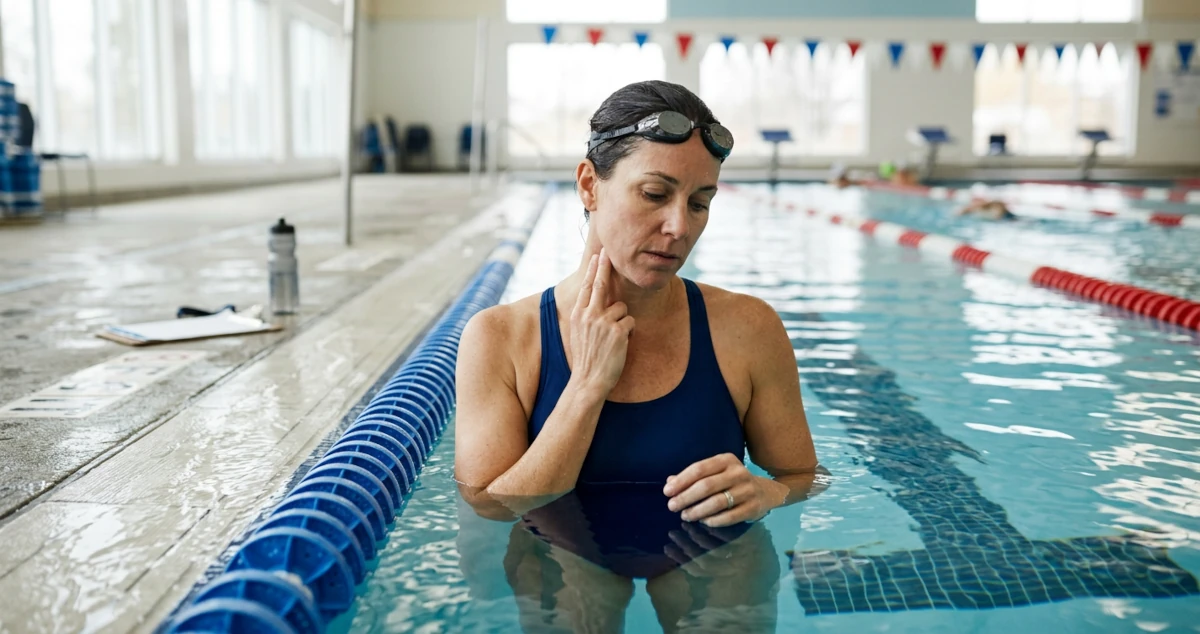
The wall count trades precision for speed. Your heart rate starts falling as soon as you stop swimming, so a longer count would read low. Being off by 1 beat in 10 seconds moves the result by 6 bpm, which is still close enough to tell Zone 2 from Zone 4. For a resting reading, use the full 60-second count with the free pulse timer. If you want a device for the pool, the best heart rate monitors for beginners compares chest straps and optical sensors.
How to Train by Heart Rate in the Pool
You can't read a watch in the middle of a length, so heart rate works best in the pool as a way to set your pace, then confirm it at the wall. Most swimmers and coaches run their sets off the pace clock, and the 2 methods fit together well.
- Find your Zone 2 pace. Swim 4 × 100 at an easy, steady effort with 20 seconds rest between each. Check your heart rate at the wall after every 100, and adjust your speed until you finish inside your pool Zone 2. Note your time per 100.
- Swim aerobic sets by that pace. Hold that time per 100 on the pace clock instead of trying to read your watch mid-length. Check your heart rate at the wall every few repeats to make sure you're still in range.
- Retest every 4 to 6 weeks. As your aerobic fitness improves, the same heart rate produces a faster pace. Repeat the 4 × 100 and update your target time.
Hard sets work differently. Your heart rate takes 30 seconds or more to catch up with a jump in effort, so on a 50 or 100 sprint it may not peak until after you touch the wall. For Zone 4 and 5 work, swim by pace and rate of perceived exertion (RPE), a 1 to 10 scale of how hard the effort feels. Check your heart rate after the set to confirm you got there.
Expect your numbers to shift with conditions. A warm pool, a short rest interval, or a stroke you're less efficient at will all push your heart rate higher at the same pace. Compare sessions in the same pool, with the same stroke and rest, when you're tracking progress.
Should You Test Your Max Heart Rate in the Pool?
Only if you're healthy, already swim regularly, and have cleared hard exercise with your doctor. For most fitness swimmers, subtracting 12 bpm from a land max is accurate enough to train with.
A pool test removes the estimate. In the Olstad study, swimmers reached max heart rate with step tests that built through progressively faster repeats and finished with an all-out effort, after a long warm-up. That's a protocol for trained athletes, monitored by researchers. If you try a version of it, wear a chest strap, swim with someone on deck, and stop if you feel dizzy, short of breath beyond what the effort explains, or any chest discomfort.
Age-based estimates carry their own error before you subtract anything. For how much 220 minus age and the newer formulas can miss by, see max heart rate by age. A measured running max, minus 12 bpm, is a step up from either.
Frequently Asked Questions
Is my max heart rate lower when swimming?
Yes, for most people. Studies of fitness swimmers and triathletes have found swimming max heart rate about 9 to 14 bpm lower than running max. A 1991 study of 34 college fitness swimmers recommended subtracting 12 bpm from your treadmill or age-predicted max for swim training. Elite swimmers tend to show a smaller gap.
Can I use my running heart rate zones for swimming?
Not without adjusting them. Running zones are built from a higher max heart rate, so they put every swimming zone too high. Subtract about 12 bpm from your running max, then recalculate your zones with the Karvonen formula.
What heart rate zone should I swim laps in for fitness?
Zone 2, 60 to 70% of your heart rate reserve, is the best default for steady lap swimming. It builds aerobic fitness and lets you hold good technique for longer. Save Zones 4 and 5 for short, structured sets.
Are swim watches accurate for heart rate?
Wrist watches are the least accurate option in the water. In a 2020 study of 26 competitive swimmers, a wrist watch read max and average heart rate significantly lower than a chest strap, while an optical sensor worn at the temple under the swim cap matched it well.
How do I check my heart rate in the pool without a monitor?
Stop at the wall, place 2 fingers on the side of your neck right away, count the beats for 10 seconds, and multiply by 6. Count quickly, since your heart rate starts dropping as soon as you stop.
Why does swimming feel hard if my heart rate is lower?
Swimming loads your arms and shoulders, a smaller muscle mass than your legs, and they often tire before your heart reaches its land max. Lying flat in the water also changes how blood moves through your body. The effort is real, and your heart reaches it at a lower number.
This article is for informational purposes only and does not constitute medical advice. Talk with a physician before starting a new exercise program or attempting a max effort test, especially if you have a heart condition, take heart rate lowering medication, or feel chest pain, dizziness, or unusual shortness of breath while swimming.